English हिन्दी
Connect with us

India News

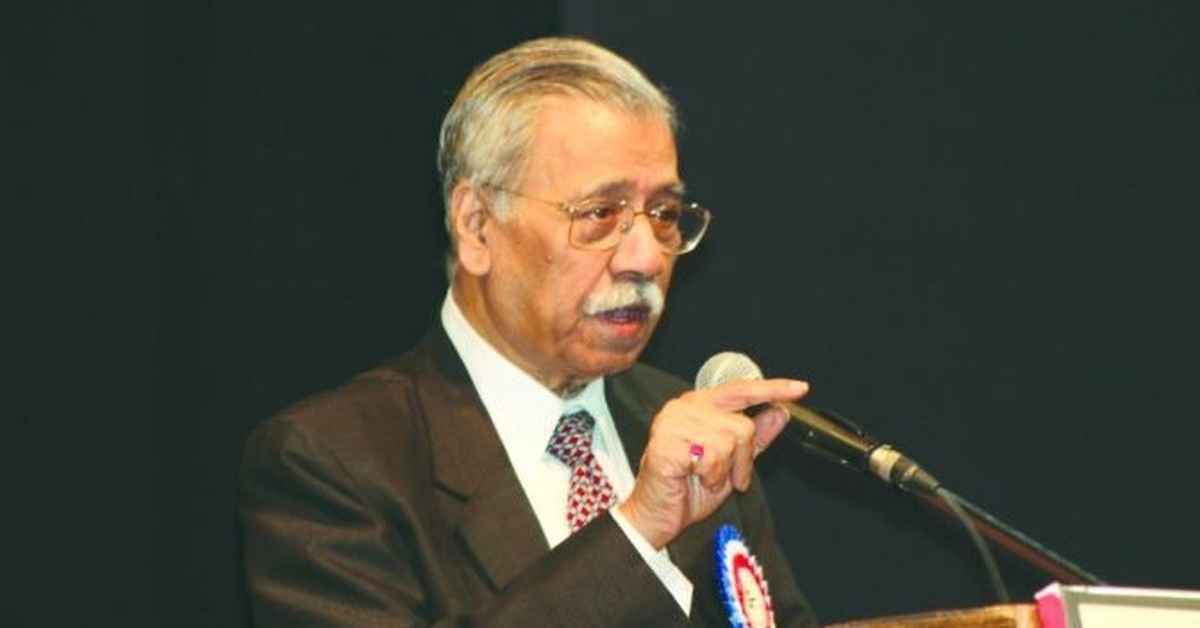
AM Ahmadi, former Chief Justice of India, passes away at 91

AM Ahmadi he was the 26th Chief Justice of India and served from 1994 to 1997.

Published

on

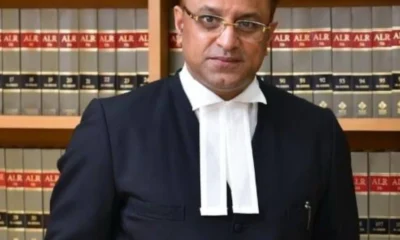
AM Ahmadi, former Chief Justice of India

Former Chief Justice of India AM Ahmadi passed away on Thursday morning. He was 91. Born as Aziz Mushabber Ahmadi, he was the 26th Chief Justice of India and served from 1994 to 1997.
Ahmadi started his law career in 1954 after he received a Bachelor of Laws and joined the Bar. In 1964, he was appointed judge to the City Civil and Sessions Court of Ahmedabad. Additionally, he was also appointed as Secretary of the Legal Affairs of the State of Gujarat during this time in 1974.

While serving as the Judge of the Gujarat High Court, Ahmadi worked as Chairman of multiple advisory boards including Maintenance of Supplied Essential Commodities, Prevention of Black Marketing, and Conservation of Foreign Exchange and Prevention of Smuggling Activities.

Read Also: PM Modi addresses foreign ministers’ meet at G20, says global governance has failed

AM Ahmadi also worked as a Member of the Ravi and Beas Waters Disputes Tribunal under the Rajiv-Longowal Settlement following which he was appointed as a Justice in the Supreme Court of India in December 1988. After serving in this position, he was appointed as Chief Justice of India in October 1994 and became the third Muslim ever to become the CJI.

After over two years of serving as the Chief Justice of India and authoring 232 judgments and being a part of 811 benches, Ahmadi announced his retirement in March 1997.

Ahmadi became chancellor of the Aligarh Muslim University after retiring from the Supreme Court. He was re-elected in 2002 for three years.

US student beats up teacher for taking away her video game, video goes viral | Watch

PM Modi addresses foreign ministers’ meet at G20, says global governance has failed

India News

K Kavitha suggests US Senate-like model for Rajya Sabha amid delimitation debate

K Kavitha has proposed a US Senate-like model for the Rajya Sabha, calling for equal representation of states and stronger legislative powers amid the delimitation debate.

Published

on

K Kavitha

Telangana leader K Kavitha has proposed a significant restructuring of the Rajya Sabha, suggesting it be given powers similar to the United States Senate to protect the interests of states amid the ongoing debate over delimitation.

Speaking on the issue, Kavitha said the Upper House should have greater authority in legislative matters, including the ability to stall bills if states do not agree. She argued that such a mechanism would ensure political and financial security for states within India’s federal structure.

Her proposal comes at a time when discussions around delimitation — the redrawing of parliamentary constituencies based on population — have raised concerns about potential imbalances between states.

Equal representation for states proposed

Kavitha suggested that each state should have a fixed number of seats in the Rajya Sabha, regardless of population, to maintain balance across regions. She also advocated equal voting rights for states in the Upper House.

According to her, empowering the Rajya Sabha in this manner would help ensure that states have a stronger voice in national decision-making.

She further proposed that all key legislation, including finance bills, should be routed through the Rajya Sabha, similar to the functioning of the US Senate.

Context of delimitation debate

The proposal comes against the backdrop of the Delimitation Bill, 2026, which aims to readjust the allocation of Lok Sabha seats based on population changes. The exercise has sparked political debate, with concerns that some states could gain more representation while others may lose relative influence.

Kavitha indicated that even if some states lose seats due to delimitation, a stronger Rajya Sabha with equal representation could help maintain federal balance.

Focus on strengthening federal structure

Emphasising the need to protect the role of states, Kavitha said enhancing the powers of the Rajya Sabha would ensure that no single region dominates national policymaking.

Her remarks add to the broader political discourse around delimitation and federalism, with multiple leaders proposing alternative models to address concerns of regional imbalance.

Continue Reading

India News

Clashes erupt between TMC and BJP supporters during Bengal repolling in South 24 Parganas

Clashes between TMC and BJP supporters disrupt repolling in Bengal’s South 24 Parganas as voting continues under tight security.

Published

on

Clashes broke out between supporters of the Trinamool Congress (TMC) and the Bharatiya Janata Party (BJP) during repolling in West Bengal’s South 24 Parganas district on Saturday, highlighting ongoing political tensions in the state.

The incidents occurred as fresh voting was underway at 15 polling booths across the Magrahat Paschim and Diamond Harbour assembly constituencies. The repolling was ordered by the Election Commission following reports of irregularities during the earlier phase of voting held on April 29.

According to reports, confrontations between rival party supporters led to disruption in some areas, with allegations that certain voters were being prevented from casting their votes. Authorities responded by deploying heavy security forces to bring the situation under control and ensure the continuation of polling.

The repolling exercise is being conducted under strict security arrangements, with personnel deployed across sensitive locations to maintain order. Officials have emphasised that the process is being closely monitored to ensure free and fair voting.

The Election Commission had earlier declared polling in these booths void after receiving complaints of electoral malpractices and procedural lapses. Fresh voting began at 7 am and is scheduled to continue until 6 pm.

The affected booths include 11 in Magrahat Paschim and four in Diamond Harbour, both considered politically significant constituencies in the ongoing assembly elections.

Despite the clashes, authorities said efforts were being made to ensure that voting proceeds without further disruption, as the state moves closer to the counting of votes.

Continue Reading

India News

Bhagwant Mann rejects alcohol allegations in assembly, AAP counters with land case claim

Bhagwant Mann denies opposition claims of intoxication in assembly, while AAP counters with allegations against a Congress MLA in a land case.

Published

on

A political confrontation erupted in the Punjab assembly after Chief Minister Bhagwant Mann dismissed opposition allegations that he attended the session under the influence of alcohol, calling the claims baseless and politically motivated.

The controversy began when opposition leaders, including Congress members, demanded that the chief minister undergo an alcohol test, alleging that he appeared intoxicated during proceedings. Leader of Opposition Partap Singh Bajwa questioned the purpose of continuing assembly business under such circumstances and called for testing of all members.

Responding to the accusations, Mann said the opposition had “no real issues” to raise and was resorting to distractions. He questioned the demand for testing and rejected the allegations outright.

The issue led to heated exchanges inside the House, with both sides engaging in a war of words. Leaders from the BJP also criticised the chief minister, calling the allegations serious and raising concerns over governance.

AAP counters with land case allegation

Amid the controversy, the ruling Aam Aadmi Party shifted the focus by accusing the opposition of diverting attention from a separate issue. Punjab Finance Minister Harpal Cheema alleged that the uproar was linked to a land encroachment case involving Congress MLA Sukhpal Singh Khaira.

According to Cheema, a report related to the case had triggered the opposition’s reaction, leading to disruptions and a walkout in the assembly. He claimed the episode highlighted deeper issues within the Congress.

Political tensions escalate

The developments have intensified political tensions in Punjab, with both the ruling party and opposition trading sharp accusations. While the opposition continues to press for accountability over the allegations against the chief minister, the AAP maintains that the claims are an attempt to deflect attention from other controversies.

The allegations against Mann remain unproven, but the episode has added to the ongoing friction between the state’s major political parties.

Continue Reading

Trending

© Copyright 2022 APNLIVE.com