
India News
Monsoon to start withdrawing from country by end of this week, says IMD


After a spell of abnormally heavy rains, up to ten times the normal in many parts – although still leaving a 9 percent deficit overall – the monsoon is likely to start withdrawing from the country by the end of the week, the Indian Meteorological Department (IMD) said in a forecast on Tuesday.
The monsoon normally starts withdrawing from the first week of September, but it has been delayed primarily due to the development of cyclonic conditions.
A change in the wind pattern is likely over west Rajasthan from Thursday and monsoon withdrawal could start from Saturday, IMD said in a statement.
“Prevalence of dry weather is likely over western Rajasthan from tomorrow. Reduction in the moisture associated with the monsoon flow and a changeover in the low level wind pattern are also likely over this region from 27th September. These are indicative of the likely commencement of withdrawal of Southwest monsoon from western Rajasthan around 29th September,” said the IMD forecast.
According to the IMD data, India still has a 9% rainfall deficit and 11 of India’s 36 subdivisions — 29% of the country’s area — have seen a deficit of 29% in monsoon rains between 1st June and 23rd September.
The maximum deficit has been in northeastern India — with Arunachal Pradesh, Assam and Meghalaya recording a 32% and 28% shortfall in their monsoon quotas. Jharkhand, Bihar, Saurashtra and Kutch, Rayalseema and north interior Karnataka are among the subdivisions that have registered a deficit of greater than 25%.
The monsoon, which delivers 70 percent of India`s annual rainfall, is critical for 263 million farmers and their rice, sugarcane, corn, cotton and soybean crops because nearly half of the country`s farmland lacks irrigation.
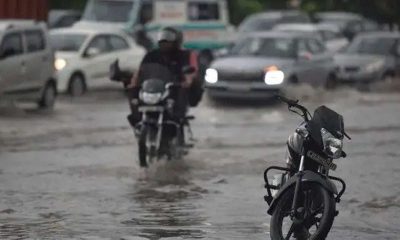
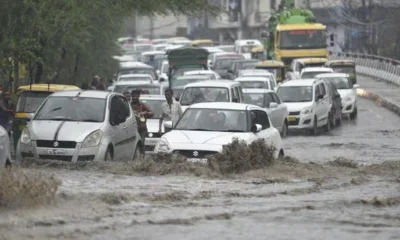
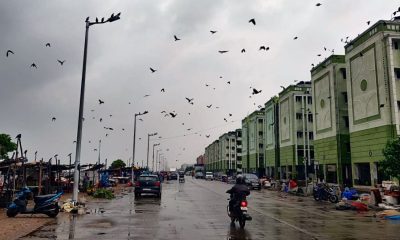
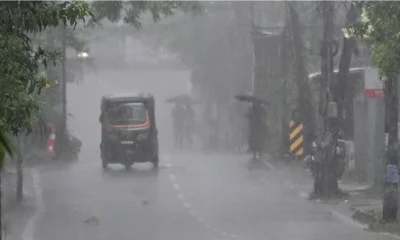
The last few days saw incessant rainfall up to 10 times higher than normal in parts of north India, and heavy snowfall in the upper reaches of the Himalayas.
This, said a report in Hindustan Times (HT) quoting experts, was caused by a combination of strong westerly winds over Gujarat and a deep depression caused by Cyclone Daye over the coast of Odisha, weather experts said on Monday.
Since Friday, north-west India received 454% , or five-and-a-half times, more rainfall than the normal for this period, the report said.
The departure was highest for Punjab, which received over 12 times – 1,193% – more rainfall than usual, and lowest for western Rajasthan, which also got 317% more rain than normal.
The rainfall being experienced by the region at the moment is a result of moisture from both the Bay of Bengal to the east and the Arabian Sea to the west, the HT report said.
“The large low pressure area caused by Cyclone Daye, extending to the coast of Gujarat, got ‘hooked’ with the westerly winds coming from Arabian sea, taking the moisture upwards towards north,” India Meteorological Department (IMD) director general KJ Ramesh told HT.
Although Cyclone Daye made a landfall at Gopalpur in Odisha on Friday morning after weakening substantially, the winds covered a large part of India — from the Telangana-Karnataka region to the Madhya Pradesh-Gujarat-southern Rajasthan region, bringing widespread rainfall, he added. The north would have also received normal rainfall, but strong westerly winds pulled the moisture from Cyclone Daye upwards, giving a “double dose” of rainfall to the region, Ramesh said.
The condition has led to a dip in temperature — by three to five degree Celsius — and caused snowfall in the upper reaches of Himachal Pradesh and Jammu & Kashmir, which is highly unusual in September. The tribal belt of Himachal Pradesh and Ladakh in Jammu & Kashmir received about one feet of snow on Sunday,damaging potato and apple crops,according to local farmers.
The heavy rainfall has also damaged paddy crop in large parts of Punjab and Haryana. According to farmers, paddy, which is at the maturing stage, has got flattened at several areas. “Paddy grown in low-lying areas is vulnerable to damage due to rains, as it usually gets submerged in water. We are assessing the damage,” said JS Bains, a director of the Punjab agriculture department.
Not just the north, even parts Andhra Pradesh, Telangana and Karnataka received excess rainfall due to depression cause by the Cyclone Daye.
In Bangalore, several low-lying areas were inundated because of heavy rainfall leading to flooding of roads and uprooting of trees.
“Bengaluru got between 12 to 20 cm of rain due to south-west monsoon in the last 24 hours,” said IMD’s Bengaluru director CS Patil. This was double the normal rainfall for this period of the season.
The unusually heavy rains led to swollen rivers carrying heavy silt from erosion due to loose mountain sides washed away roads and highways and at least 23 people in Himachal Pradesh, Punjab, Jammu & Kashmir and Haryana were reported killed till Monday, September 24.
Himachal Pradesh is experiencing what has been called its worst flood-like situation in 23 years. 45 people including 35 IIT Roorkee students have gone missing in Lahaul Spiti alone. Schools were shut in 9 of 12 districts in the state after landslides and snow shut down important roads, and the Beas River overflowed its banks.
Infrastructure too has been severely affected with widespread landslides snapping over 200 road links. Authorities have conducted many rescues in flood-stricken areas like Kullu, Koksar, Rohtang and Mari. However, hundreds more, including tourists, are still reportedly stranded in various parts of the state.
According to reports, three people were washed away in Manali in Himachal Pradesh when their vehicle fell into the Beas river. Three others died in Kullu, one of the worst affected districts. One man was drowned in a swollen rivulet in Kangra district, while yet another man died after a building was washed away in Una district, media reports said.
Educational institutions will remain closed in Himachal Pradesh, Punjab and Haryana on Tuesday. The situation is expected to improve in some of the states tomorrow.
Punjab too faced the wrath of rains as six people lost their lives to different rain-related incidents across the state. Three victims were from Kapurthala, two from Amritsar, while an 8-month-old girl was from Jalandhar. The state government issued a red alert in the state, ordered schools to be shut and asked all districts to remain on vigil. Rescue and relief teams have been organised to evacuate people and distribute food to beleaguered residents and livestock.
In Jammu & Kashmir, five members of a family were killed in Doda district after a landslide crushed their mud house, officials said on Monday.
The multi-state downpour has also affected tourism. Roads leading to Badrinath, Kedarnath and Yamunotri (all major pilgrimage sites) in Uttarakhand have been blocked due to heavy rain and landslides.





India News
Mallikarjun Kharge seeks all-party meeting with PM Modi on delimitation
Congress president Mallikarjun Kharge has written to Prime Minister Narendra Modi for the fourth time, seeking an all-party meeting on delimitation. He also flagged the 64-day delay in proroguing Parliament’s Monsoon Session.


India News
Abhijeet Dipke detained ahead of CJP’s national flag march in Delhi
Cockroach Janta Party founder Abhijeet Dipke was detained by Delhi Police on October 16, 2026, shortly before a planned national flag march. The proposed rally followed the judicial custody of two CJP members who had waved the Tricolour at Jantar Mantar.

India News
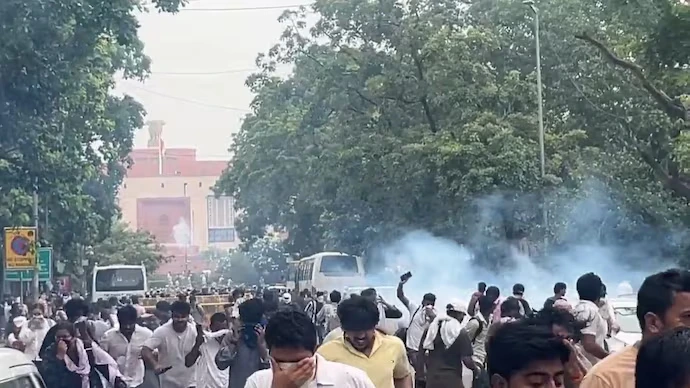
Delhi deploys 25,000 personnel, installs CCTV cameras ahead of CJP march
More than 25,000 police and paramilitary personnel have been deployed in Delhi ahead of the CJP’s planned protest march at Connaught Place. Authorities have also imposed restrictions and stepped up CCTV surveillance.

Delhi Police offers 11-person limit for CJP’s Connaught Place protest

Actor Imran Khan asked to leave India after CJP protest

Mallikarjun Kharge’s ‘Your Friends’ jab at Rahul Gandhi over congress exits

Magnitude 7 earthquake strikes Russia’s Kamchatka Peninsula

Delhi deploys 25,000 personnel, installs CCTV cameras ahead of CJP march

Mallikarjun Kharge seeks all-party meeting with PM Modi on delimitation

Abhijeet Dipke detained ahead of CJP’s national flag march in Delhi
Magnitude 7 earthquake strikes Russia’s Kamchatka Peninsula
Delhi deploys 25,000 personnel, installs CCTV cameras ahead of CJP march
Mallikarjun Kharge’s ‘Your Friends’ jab at Rahul Gandhi over congress exits

Afghan Men Try To Hang With The Jet Engine Of The Aircraft in Kabul- Afghanistan News – Kabul News
Trending Top 10 News: 10000 Crore Fine on Flipkart, Apple to Launch Unique Feature, Hdfc Bank Job Ad

Trending Top 10 News: Nokia 6310, Apple sales, Bachpan ka Pyar Video Kid, Dainik Bhaskar IT Raid

Trending Top 10 News: Canada bans Indian flights, Rain in Delhi NCR, AIMIM Twitter hacked, Raj Kundra case

Trending Top 10 News: Shein India, Apple New Service, Pocket Oxygen, Oppo Launched New Phone
-
 India News23 hours ago
Delhi Police offers 11-person limit for CJP’s Connaught Place protest
-
 India News24 hours ago
Actor Imran Khan asked to leave India after CJP protest
-
 India News11 hours ago
Mallikarjun Kharge’s ‘Your Friends’ jab at Rahul Gandhi over congress exits
-
 Latest world news11 hours ago
Magnitude 7 earthquake strikes Russia’s Kamchatka Peninsula
-
 India News11 hours ago
Delhi deploys 25,000 personnel, installs CCTV cameras ahead of CJP march
-
 India News2 hours ago
Abhijeet Dipke detained ahead of CJP’s national flag march in Delhi
-
 India News37 mins ago
Mallikarjun Kharge seeks all-party meeting with PM Modi on delimitation
