English हिन्दी
Connect with us

India News

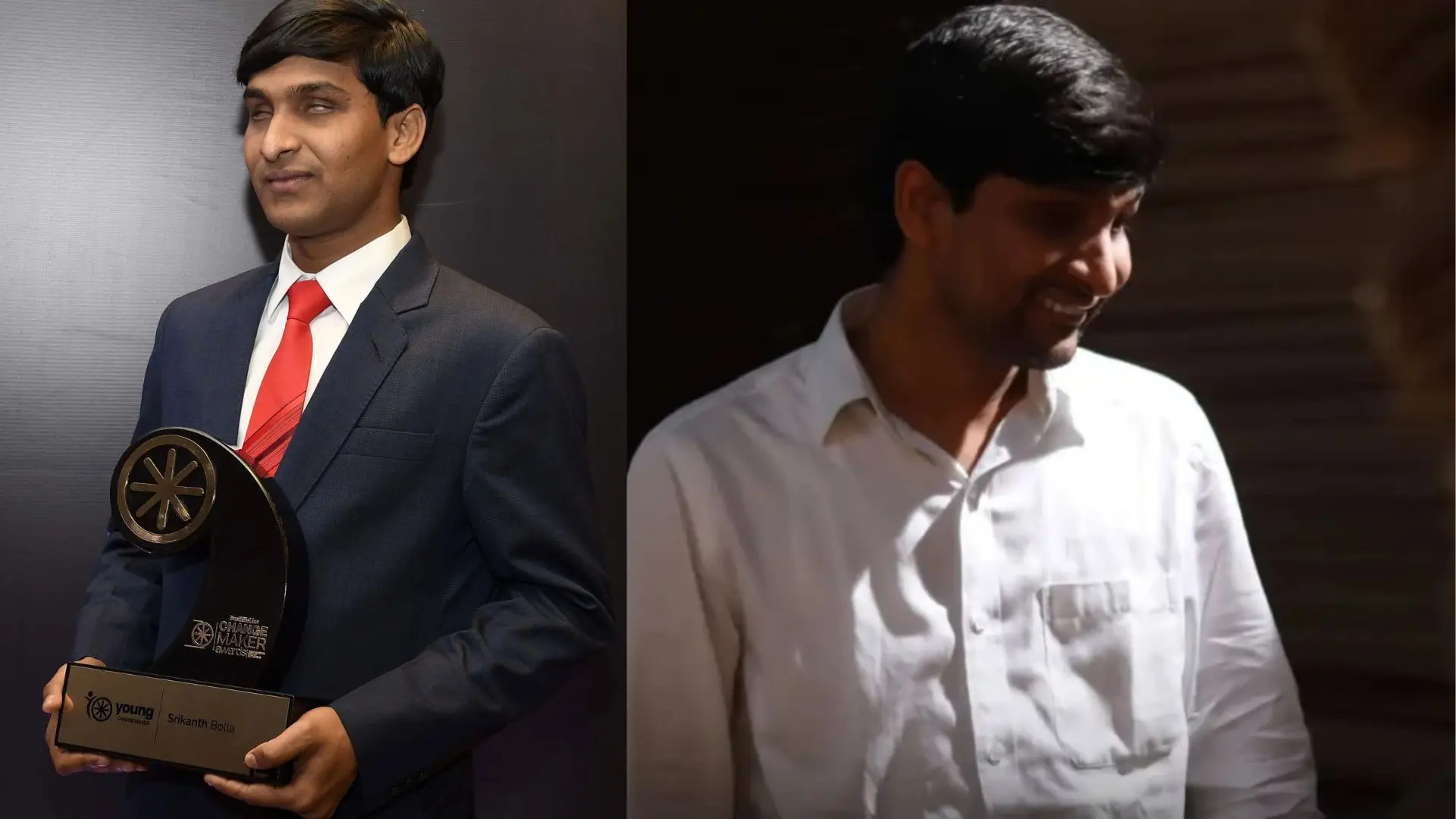
Who is Srikanth Bolla? Meet the visually impaired entrepreneur on Shark Tank India

Entrepreneur Srikanth Bolla joins Shark Tank India as a judge. From overcoming visual impairment to leading a multi-million-dollar company, his journey is inspiring.

Published

on

Srikanth Bolla, Shark Tank India, Bollant Industries, entrepreneurship, visually impaired entrepreneur, Ratan Tata, Rajkummar Rao, Srikanth movie, startup India, business reality show

Shark Tank India, the popular business reality show, has introduced a new judge to its panel—Srikanth Bolla. The visually impaired entrepreneur and CEO of Bollant Industries recently shared his excitement about joining the show, emphasizing how entrepreneurship in India has been positively impacted by the platform.

In a social media post, Bolla expressed his enthusiasm, stating, “To survive a pool of sharks, you need to become one yourself.” .” In his recent post, Shark Tank new judge also highlighted how the experience reinforced the importance of taking action on ideas rather than just thinking about them.

Who is Srikanth Bolla?

Srikanth Bolla is an accomplished Indian industrialist, co-founder, and chairman of Bollant Industries Private Limited. Despite being visually impaired since birth, he became the first blind student to study at the Massachusetts Institute of Technology (MIT), specializing in Management Science at the Sloan School of Management.

With Bollant Industries achieving an annual turnover exceeding $150 million, the company provides employment to over 500 individuals, including people with disabilities.

Early life and challenges

Born on July 7, 1991, in Seetharamapuram, Machilipatnam, Andhra Pradesh, Srikanth Bolla hails from a humble Telugu family. His parents, who were farmers with no formal education, faced difficulties in ensuring proper educational opportunities for him.

Despite scoring 98% in his Class XII board exams, he struggled to gain admission to engineering institutes. Undeterred, he took legal action and won a six-month-long court battle to pursue higher education. However, coaching institutes refused to admit him for IIT entrance preparations due to his visual impairment.

Achievements and career milestones

Srikanth Bolla has been a youth leader since 2005 and was an active member of Lead India 2020, a national youth movement initiated by former President A.P.J. Abdul Kalam.

In 2011, he co-founded Samanvai Center for Children with Multiple Disabilities and launched a Braille printing press to assist visually impaired students.

Recognizing his impact, Forbes included him in its prestigious ’30 under 30′ list for Asia in 2017.

Bollant Industries and entrepreneurial success

Bolla established Bollant Industries in 2012 alongside co-founder Ravi Mantha. The company, backed by industrialist Ratan Tata, specializes in manufacturing areca-based eco-friendly products. Additionally, it provides sustainable solutions by recycling municipal waste, plastic waste, and paper, ensuring employment for disabled individuals.

Srikanth Bolla’s story on the silver screen

Srikanth Bolla’s remarkable journey has been adapted into a Bollywood biopic titled Srikanth, starring Rajkummar Rao in the lead role. His inspiring life story continues to motivate aspiring entrepreneurs and individuals overcoming adversities.

India News

PM Modi assures no discrimination in women’s quota, delimitation debate intensifies in Parliament

PM Narendra Modi has assured that women’s reservation will be implemented without discrimination, amid a heated debate over delimitation in Parliament.

Published

on

PM modi

Prime Minister Narendra Modi has assured that there will be no discrimination in the implementation of women’s reservation, as Parliament witnessed a sharp debate over the proposed linkage between the quota and delimitation exercise.

During the ongoing special session, the government reiterated its commitment to ensuring fair representation while addressing concerns raised by opposition parties regarding the timing and structure of the legislation.

The proposed framework aims to reserve 33 percent of seats for women in the Lok Sabha and state assemblies. However, its implementation is tied to a fresh delimitation exercise, which is expected after the next census.

Opposition questions timing and intent

Opposition leaders have raised concerns that linking the women’s quota to delimitation could delay its implementation. They argue that the process of redrawing constituencies may push the actual rollout further into the future.

The issue has triggered a broader political confrontation, with multiple parties questioning whether the move could alter representation across states.

Some critics have also alleged that the delimitation exercise could disproportionately benefit certain regions based on population, a charge the government has rejected.

Government reiterates commitment to fair implementation

Responding to these concerns, the Centre has maintained that the reforms are necessary to ensure accurate and updated representation based on population data.

Leaders from the ruling side have repeatedly emphasized that the process will be carried out transparently and without bias. The assurance that there will be “no discrimination” is aimed at addressing fears among states and opposition parties.

The debate marks a key moment in Parliament, with both sides engaging in intense exchanges over one of the most significant electoral reforms in recent years.

Continue Reading

India News

Give all tickets to Muslim women, Amit Shah says, attacking Akhilesh Yadav on sub-quota demand

A sharp exchange between Amit Shah and Akhilesh Yadav in Parliament over sub-quota for Muslim women highlights key divisions on women’s reservation implementation.

Published

on

A heated exchange broke out in Parliament during discussions on the women’s reservation framework, with Union Home Minister Amit Shah and Samajwadi Party chief Akhilesh Yadav locking horns over the demand for a sub-quota for Muslim women.

The debate unfolded as the government pushed forward key legislative measures to implement 33% reservation for women in the Lok Sabha and state assemblies.

Akhilesh Yadav argued that the proposed reservation must ensure representation for women from marginalised communities, including Other Backward Classes (OBCs) and Muslim women. He said that without such provisions, large sections could remain excluded from political participation.

He also questioned the timing of the bill, alleging that the Centre was avoiding a caste census. According to him, a census would lead to renewed demands for caste-based reservations, which the government is reluctant to address.

Government rejects religion-based quota

Responding to the demand, Amit Shah made it clear that reservation based on religion is not permitted under the Constitution.

He stated that any proposal to provide quota to Muslims on religious grounds would be unconstitutional, firmly rejecting the idea of a separate sub-quota for Muslim women within the broader reservation framework.

The government has maintained that the existing framework already includes provisions for Scheduled Castes (SC) and Scheduled Tribes (ST) women within the overall reservation structure.

Wider political divide over implementation

The issue of sub-categorisation within the women’s quota has emerged as a major flashpoint, even as most opposition parties broadly support the idea of women’s reservation.

Samajwadi Party leaders reiterated that their support for the bill depends on inclusion of OBC and minority women, while the government continues to defend its constitutional position.

The debate is part of a broader discussion during the special Parliament session, where multiple bills linked to delimitation and implementation of the women’s quota are being taken up.

Continue Reading

India News

No state will lose a seat, Centre assures as delimitation debate takes centre stage in Parliament

Parliament’s special session begins with key focus on implementing women’s reservation and delimitation, setting the stage for major electoral changes.

Published

on

Parliament

A special session of Parliament commenced on Thursday, with the Centre set to take up crucial legislation related to women’s reservation and delimitation of constituencies. The session, scheduled over three days, is expected to witness intense debate as the government pushes forward its legislative agenda.

At the centre of discussions is the proposal to operationalise the women’s reservation law, which seeks to allocate 33 percent of seats in the Lok Sabha and state assemblies to women. The law, passed earlier, requires enabling provisions before it can be implemented.

The rollout of the reservation is closely tied to the delimitation exercise — a process that redraws parliamentary constituencies based on updated population data. The implementation is expected only after the next census and delimitation process are completed.

The government is aiming to put in place the framework so that the reservation can be enforced in future elections, likely around 2029.

Delimitation and numbers at play

Delimitation is a key aspect of the proposed changes, as it will determine how seats are redistributed and which constituencies are reserved. The exercise is expected to reflect population shifts and may also involve an increase in the total number of Lok Sabha seats.

This linkage has made the issue politically sensitive, with several opposition parties backing women’s reservation in principle but raising concerns over how and when delimitation will be carried out.

Political reactions and expected debate

The session is likely to see sharp exchanges between the government and opposition. While there is broad agreement on increasing women’s representation, disagreements remain over the timing, process, and potential political implications of the delimitation exercise.

Some leaders have argued that delimitation could significantly alter the balance of representation among states, making it a contentious issue beyond the women’s quota itself.

The government, however, has framed the move as a step toward strengthening women’s participation in governance and ensuring more inclusive policymaking.

Continue Reading

Trending

© Copyright 2022 APNLIVE.com