English हिन्दी
Connect with us

Latest world news

China reacts after Zelensky accuses Russia of dragging Beijing into Ukraine war

Without directly naming Zelensky, Lin urged all concerned parties to “correctly and soberly understand China’s role and refrain from making irresponsible statements.”

Published

on

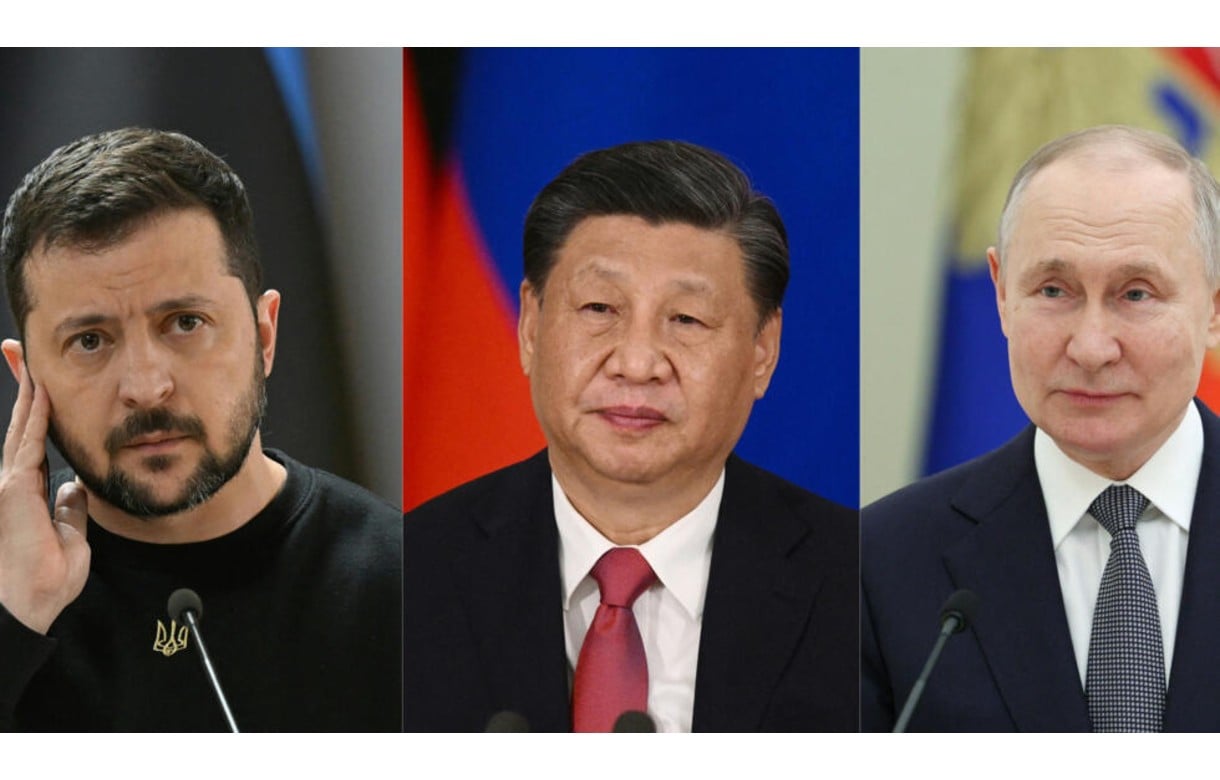
China on Thursday, April 10, reiterated its commitment to promoting peace in the Ukraine conflict while cautioning against “irresponsible remarks” from relevant parties, in an apparent response to Ukrainian President Volodymyr Zelensky’s recent allegations.

Zelensky had claimed on Wednesday that 155 Chinese citizens were fighting alongside Russian forces in Ukraine, a statement that drew sharp rebuttals from both Beijing and Moscow.

During a regular news conference, Chinese Foreign Ministry spokesperson Lin Jian emphasized China’s neutral position, stating, “I would like to reiterate that China is neither the initiator of the Ukrainian crisis nor a participating party. We are a firm supporter and active promoter of a peaceful settlement.”

Without directly naming Zelensky, Lin urged all concerned parties to “correctly and soberly understand China’s role and refrain from making irresponsible statements.”

China, which has maintained a “no-limits” strategic partnership with Russia since early 2022, has positioned itself as a mediator in efforts to end the war, avoiding any direct criticism of Russia’s full-scale invasion of Ukraine that began in February of that year.

Lin also reiterated Beijing’s official guidance to its citizens, urging them to avoid armed conflict zones and “refrain from participating in military actions on either side.”

Zelensky’s comments stemmed from reports of two Chinese nationals captured by Ukrainian forces in eastern Ukraine, where Russian troops have been making gains. He alleged that Russia was recruiting Chinese citizens through social media, with the knowledge of Chinese officials, and that Ukraine’s security services had compiled detailed lists including names, birth dates, and military unit assignments of these individuals.

Zelensky further suggested that Ukraine was investigating whether these recruits were acting under instructions from Beijing, labeling their involvement as Russia’s “second mistake” in the war—following what he and Western nations describe as the deployment of over 11,000 North Korean troops to Russia’s Kursk region.

Meanwhile, the Kremlin, on the same day, dismissed Zelensky’s assertions that China was being drawn into the conflict.

Kremlin spokesperson Dmitry Peskov told reporters, “This is not the case. China maintains a balanced position. China is our strategic partner, friend, and comrade.” Peskov argued that Moscow was not pulling Beijing into the fray and countered, “Zelenskyy is wrong.”

The backdrop to these exchanges is the deep ties between Russia and China, which were formalized days before President Vladimir Putin ordered the invasion of Ukraine in February 2022. This partnership has allowed both nations to coordinate closely on geopolitical issues, with China often acting as a counterbalance to Western influence.

Latest world news

Lashkar commander admits Hamas links, raises alarm over expanding terror nexus

A senior Lashkar-e-Taiba commander’s admission of meetings with Hamas leaders has intensified concerns over growing coordination between terror groups operating across regions.

Published

on

Lashkar Commander

A senior commander of Pakistan-based Lashkar-e-Taiba has publicly acknowledged links with Hamas and confirmed meetings with its top leadership, triggering fresh concerns among security agencies about an emerging alliance between globally designated terrorist organisations.

In a recent video accessed by media, Faisal Nadeem, a senior figure associated with the Pakistan Markazi Muslim League, widely regarded as Lashkar’s political front, said he met senior Hamas leaders in Doha, Qatar, in 2024. Nadeem operates in Pakistan’s Sindh province and claimed that Saifullah Kasuri, alleged by Indian agencies to be involved in the Pahalgam terror attack in Jammu and Kashmir, accompanied him during the visit.

According to Nadeem’s statement, the delegation met senior Hamas leader Khaled Mashal, a disclosure that intelligence officials view as direct evidence of coordination between terror networks operating across South Asia and the Middle East. Security analysts say the admission points to a growing effort to share operational experience, logistics and propaganda strategies.

The confession follows earlier reports of a meeting between a senior Hamas commander and a Lashkar leader in Pakistan’s Gujranwala during a public event organised by the same political outfit. An undated video that surfaced recently showed both leaders sharing the stage, with officials noting that the public nature of the interaction reflected increasing confidence and deepening ties between the groups.

Investigators have pointed out that the Hamas representative attended the event as a chief guest, while the Lashkar leader appeared under the cover of a political role. Security officials have also flagged multiple visits by Hamas operatives to Pakistan since October 2023, indicating sustained engagement.

Counter-terrorism experts note that both Hamas and Lashkar-e-Taiba are designated terrorist organisations by the United States and several other countries. Any coordination between them, they warn, could have serious implications for regional and international security.

Indian intelligence agencies are closely monitoring developments related to the Hamas-Lashkar engagement. Officials said the emerging evidence may be raised at international platforms, including financial watchdogs and counter-terror forums, as authorities assess potential legal and diplomatic responses.

Analysts tracking the evolving situation say the growing trail of videos and public statements points to a broader ideological and operational alignment, marking a concerning shift in the global terror network landscape.

Continue Reading

Latest world news

India-EU free trade pact set to lower prices of luxury cars, wines and medicines

The India-EU free trade pact is set to cut import duties on luxury cars, wines and medicines, while opening European markets for Indian exports.

Published

on

India European Deal

After nearly two decades of negotiations, India and the European Union have sealed a Free Trade Agreement that is expected to significantly reduce prices of several European products in India while expanding export opportunities for Indian manufacturers.

Described by European Commission President Ursula von der Leyen as the “mother of all trade deals”, the pact aims to deepen economic cooperation by easing tariffs and improving market access on both sides.

Luxury cars likely to become more affordable

One of the most noticeable impacts of the agreement will be in the premium automobile segment. Imported European cars such as Mercedes, BMW and Audi currently face import duties exceeding 100 per cent in India.

Under the new agreement, vehicles priced above 15,000 euros (around Rs 16 lakh) will see duties reduced to 40 per cent initially, with a further cut to 10 per cent planned over time. This is expected to bring down prices by several lakh rupees.

The concessions will operate under a quota system to safeguard India’s domestic automobile industry. Officials clarified that smaller, mass-market cars — which dominate India’s auto sector — will not be directly exported by European manufacturers, though local manufacturing remains an option.

Imported wines and spirits to get cheaper gradually

European wines from countries such as France, Italy and Spain are also set to become more affordable. India currently levies an import duty of 150 per cent on wines. Under the pact, this will be reduced to 20 per cent, though the change will be phased in over five to ten years to limit disruption to domestic producers.

The agreement is expected to reduce prices of premium spirits such as cognac, high-end gins and vodkas. However, wines priced below 2.5 euros will not receive duty concessions, a move aimed at protecting Indian manufacturers. Indian wines, meanwhile, will gain improved access to European markets.

Cheaper medicines and medical equipment

The trade deal is expected to benefit India’s healthcare sector by lowering the cost of imported medicines, particularly for cancer and other critical illnesses. Advanced medical equipment sourced from Europe is also likely to become cheaper.

At the same time, pharmaceuticals manufactured in India will gain access to all 27 EU member countries, strengthening India’s position as a global supplier of affordable medicines.

Electronics, steel and chemicals to benefit

The agreement removes tariffs on aircraft spare parts, mobile phone components and other high-tech electronic items imported from Europe. This could reduce manufacturing costs for electronic devices in India, potentially benefiting consumers.

Additionally, proposals for zero tariffs on iron, steel and chemical products may lower raw material costs for industries such as construction, with possible downstream benefits for homebuyers and infrastructure projects.

Overall, the India-EU Free Trade Agreement is being seen as a major boost for Indian exports, particularly in sectors such as garments, leather and jewellery, while offering Indian consumers access to more competitively priced European goods.

Continue Reading

Latest world news

India plans sharp cut in car import tariffs under proposed EU trade pact

India is planning a sharp reduction in car import tariffs as part of a proposed free trade agreement with the European Union, potentially opening up its auto market to European brands.

Published

on

India is planning a significant reduction in import tariffs on cars from the European Union as part of a proposed free trade agreement, according to sources familiar with the discussions. The move could mark the biggest opening yet of India’s tightly protected automobile market.

Under the plan, import duties on a limited number of cars priced above 15,000 euros are set to be reduced to 40% from the current levels that go as high as 110%. Over time, these duties could be lowered further to 10%, the sources said.

The decision is expected to benefit European automakers including Volkswagen, Renault and Stellantis, along with luxury manufacturers Mercedes-Benz and BMW, which have long raised concerns over high import taxes in India.

Trade pact announcement expected soon

India and the European Union are expected to announce the conclusion of negotiations for the long-pending free trade agreement as early as Tuesday. The pact has already been described by officials as a landmark deal, with final details to be worked out and ratified subsequently.

The agreement could significantly expand bilateral trade and provide relief to Indian exporters of products such as textiles and jewellery, which have been impacted by steep tariffs in recent months.

Limited quota, phased reduction

Sources indicated that India has proposed an immediate tariff cut for around 200,000 combustion-engine cars annually. While the quota could still see last-minute changes, it represents the most aggressive step yet by New Delhi to open up its auto sector.

Battery electric vehicles will not be included in the duty reductions for the first five years. This exemption is aimed at safeguarding investments made by domestic manufacturers such as Tata Motors and Mahindra & Mahindra in the developing EV segment. After the five-year period, EVs are expected to follow a similar tariff-cut path.

European brands see growth opportunity

India is currently the world’s third-largest car market after the United States and China, with annual sales of about 4.4 million units. However, European carmakers hold less than a 4% share of the market, which is dominated by Japanese and Indian manufacturers.

Lower import taxes could allow global brands to introduce a wider range of models at more competitive prices and assess consumer demand before committing to additional local manufacturing.

With the Indian car market projected to grow to 6 million units annually by 2030, several European automakers are already planning new investments, seeing India as a key growth destination beyond their traditional markets.

Continue Reading

Trending

© Copyright 2022 APNLIVE.com