English हिन्दी
Connect with us

India News

India accelerates stealth fighter jet project as China readies to offer Pakistan with J-35 offer

India has approved its first stealth fighter aircraft project led by ADA, opening doors to private defence firms, while China proposes J-35 jets to Pakistan.

Published

on

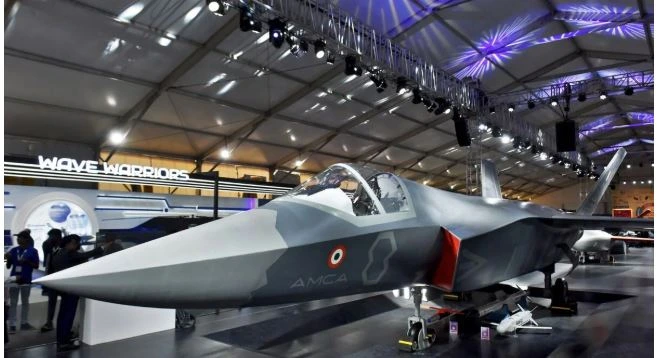
India has approved a crucial step forward in its defense capabilities by greenlighting the development of its first stealth fighter jet amid increasing regional military tensions. This move comes on the heels of reports that China is fast-tracking a proposal to provide its advanced stealth aircraft to Pakistan.

India’s indigenous stealth jet gets green signal

Defence Minister Rajnath Singh has cleared a detailed framework to develop a twin-engine, fifth-generation stealth fighter jet. The project will be led by the state-run Aeronautical Development Agency (ADA), marking a significant milestone in India’s quest for air combat self-reliance.

The new stealth fighter is poised to be India’s most advanced aircraft to date. ADA is expected to soon invite both public and private defense sector players to express interest in building a prototype. Notably, the initiative will be limited to domestic entities, allowing for independent bids or collaborative joint ventures.

This strategic shift to involve private companies stems from a key defence committee recommendation earlier this year, which emphasized easing the burden on Hindustan Aeronautics Limited (HAL). HAL has been grappling with delivery setbacks, particularly concerning the Light Combat Aircraft (LCA) Tejas programme—a 4.5-generation fighter jet initiative. HAL has attributed these delays primarily to engine supply issues from the U.S.-based General Electric.

Engine innovation and air fleet modernization

While the stealth jet project progresses, the Defence Research and Development Organisation (DRDO) is concurrently working on an indigenous engine under the Kaveri project. Designed for the LCA Tejas, the GTX-35VS Kaveri engine is still under development and represents a significant effort toward full-spectrum self-reliance in fighter jet production.

India’s current air fleet comprises primarily of Russian and French-origin jets, and the Indian Air Force operates with 31 active squadrons—well below the sanctioned strength of 42. The indigenous stealth fighter is seen as a strategic necessity in bridging this critical capability gap.

Regional dynamics: China-Pakistan axis

India’s move gains added urgency in light of regional developments. China is reportedly expanding its aerial dominance by developing a sixth-generation fighter jet, believed to be the J-36. Concurrently, Beijing has offered Pakistan the Shenyang J-35—a state-of-the-art, all-weather, stealth combat aircraft. Pakistan already operates the Chinese-made J-10 jets, and the addition of the J-35 could significantly enhance its aerial strike capability.

India’s focus on accelerating the indigenous stealth aircraft program comes as a timely countermeasure to these developments, aiming to reinforce its air superiority while reducing long-term reliance on foreign suppliers.

India News

Women’s quota bill fails in Lok Sabha as it falls short of two-thirds majority

Women’s reservation proposal failed in Lok Sabha after securing 298 votes, below the required two-thirds majority

Published

on

Parliament

Government secures 298 votes in favour, 230 against; proposal does not pass constitutional threshold

The proposed amendment related to women’s reservation failed to pass in the Lok Sabha on Friday after the government could not secure the required two-thirds majority.

The bill received 298 votes in favour and 230 against, falling short of the constitutional threshold needed for passage. As a constitutional amendment, it required the support of at least two-thirds of members present and voting.

Despite securing a simple majority, the government was unable to gather sufficient support to meet this requirement.

Debate continues over two days

The discussion on the bill extended late into Thursday and continued on Friday, with members from both sides participating in the debate on women’s representation in legislative bodies.

Prime Minister Narendra Modi urged members to support the proposal, calling for wider consensus on the issue.

Implications of the outcome

The failure of the bill underscores the challenges in securing broad political agreement on constitutional amendments, especially those related to representation and electoral reforms.

The proposal was aimed at advancing women’s representation in the Lok Sabha and state assemblies, an issue that has remained under discussion for several years.

Continue Reading

India News

Rahul Gandhi faces FIR order as Allahabad High Court acts on dual citizenship plea

High Court allows plea in Rahul Gandhi citizenship case, paving the way for further legal process.

Published

on

Rahul Gandhi

The Lucknow bench of the Allahabad High Court has allowed a petition seeking legal action in connection with allegations related to Congress leader Rahul Gandhi’s citizenship status, marking a fresh development in the case.

The petition was filed by a political worker, who had approached the court seeking directions for registration of a case over claims that Gandhi may have held foreign citizenship. The High Court, while hearing the matter, passed directions for further proceedings in accordance with law.

The development comes after a special MP/MLA court in Lucknow had earlier declined to order registration of an FIR, reportedly observing that it lacked jurisdiction in matters concerning citizenship.

Background

The case is linked to allegations that Rahul Gandhi may have held British citizenship. Under Indian law, dual citizenship is not permitted. However, these claims remain part of the petitioner’s submissions and have not been established by any court.

During earlier hearings, the High Court had sought records and considered material presented by the parties involved.

What happens next

With the High Court allowing the plea, the matter is expected to proceed as per due legal process. This may involve examination by the appropriate authority and further judicial review at subsequent stages.

The case carries both legal and political significance given Rahul Gandhi’s role as Leader of the Opposition in the Lok Sabha.

Continue Reading

India News

Pawan Khera faces fresh setback as Supreme Court refuses relief in passport row case

Congress leader Pawan Khera faces fresh setback as Supreme Court refuses interim relief and directs him to seek bail from Guwahati High Court.

Published

on

Pawan Khera

Congress leader Pawan Khera suffered another legal setback on Friday after the Supreme Court of India declined to extend protection in a case linked to his remarks about Himanta Biswa Sarma’s wife.

A bench of the apex court refused to interfere with an earlier order that had stayed the transit anticipatory bail granted to Khera by the Telangana High Court. This decision leaves the Congress leader open to possible arrest by Assam Police in connection with the case.

During the hearing, Khera’s counsel sought interim protection, but the court declined the request and advised him to approach the appropriate court in Assam for relief. The bench clarified that the Guwahati High Court should decide any bail plea independently and on its merits.

“Am I a terrorist?” remark during hearing

While seeking protection, Khera’s legal team expressed concern over the urgency of the situation. In court, his counsel remarked, “Am I a terrorist?” highlighting the plea for temporary relief until a fresh bail application could be filed.

The Supreme Court also raised concerns over the submission of incorrect documents during the proceedings, adding another layer to the legal complications faced by the Congress leader.

Case linked to remarks on CM’s wife

The case stems from a press conference held earlier this month, where Khera made allegations regarding the citizenship status and financial assets of the Assam Chief Minister’s wife, Riniki Bhuyan Sharma.

He had claimed that she possessed multiple passports and owned undisclosed overseas properties. These allegations were strongly denied by the Chief Minister’s family, who termed them fabricated and misleading.

Legal battle intensifies

Earlier, the Telangana High Court had granted Khera temporary transit anticipatory bail, allowing him time to seek relief from a competent court in Assam. However, the Supreme Court stayed that order following a challenge by Assam authorities, escalating the legal battle.

With the latest ruling, Khera is now expected to move the Guwahati High Court for anticipatory bail as the case continues to unfold.

Continue Reading

Trending

© Copyright 2022 APNLIVE.com