English हिन्दी
Connect with us

India News

Portion of helipad sinks as President Murmu’s chopper lands in Kerala

A newly concreted helipad in Kerala’s Pramadam partially caved in after President Droupadi Murmu’s chopper landed during her visit to the Sabarimala temple.


Published

on

President Droupadi Murmu chopper

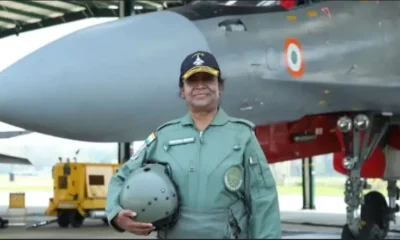
A portion of the newly built helipad in Kerala’s Pathanamthitta district caved in moments after President Droupadi Murmu’s helicopter landed during her visit to Sabarimala on Wednesday.

Temporary helipad sinks under helicopter’s weight

The Indian Air Force Mi-17 helicopter carrying President Murmu landed at the Rajiv Gandhi Indoor Stadium in Pramadam, where the freshly concreted helipad surface partially sank. Officials said the concrete had not fully set, resulting in depressions where the wheels touched the ground.

Originally, the landing was scheduled for Nilackal near Pamba, but bad weather forced a last-minute change to Pramadam. The helipad, officials added, was constructed overnight on Tuesday. After the landing, police and fire personnel were seen pushing the chopper’s wheels out of the softened tarmac.

President Murmu’s Sabarimala visit

After arriving in Thiruvananthapuram on Tuesday evening for her four-day Kerala tour, President Murmu travelled by road to Sabarimala to offer prayers at the Lord Ayyappa temple. She became the first woman head of state to visit the shrine and only the second president overall, after VV Giri in the 1970s.

Following her visit, the President is scheduled to unveil a bust of former President KR Narayanan at Raj Bhavan on Thursday. She will also inaugurate the Mahasamadhi Centenary celebrations of Sree Narayana Guru at Sivagiri Mutt in Varkala and attend the platinum jubilee valedictory event of St Thomas College in Pala. Her Kerala visit concludes on October 24 with the centenary celebrations of St Teresa’s College, Ernakulam.

India News

Mamata Banerjee says she will take over Delhi after Bengal win, sharpens attack on BJP

Mamata Banerjee says her party will move towards Delhi after winning Bengal, signalling national ambitions.

Published

on

Mamata Banerjee

West Bengal Chief Minister Mamata Banerjee has made a strong political statement during the ongoing West Bengal assembly elections 2026, saying her party will aim for a larger role at the national level after securing victory in the state.

Addressing a rally, Banerjee said that once her party wins the Bengal elections, it will move forward to “take over Delhi,” indicating a broader political strategy beyond the state. The remark comes at a time when campaigning has intensified across constituencies.

Her statement is being seen as part of a wider push by the Trinamool Congress to position itself as a key force against the Bharatiya Janata Party at the national level.

Banerjee has repeatedly expressed confidence that her party will return to power in West Bengal, aiming for another consecutive term.

Political context

The West Bengal elections have witnessed aggressive campaigning from both the ruling Trinamool Congress and the BJP. Leaders from both sides have exchanged sharp remarks, highlighting the high-stakes nature of the contest.

Banerjee’s latest comment adds to her earlier calls for opposition unity and signals her intent to expand political influence beyond the state. Similar remarks in recent weeks have indicated that her party sees the Bengal result as a stepping stone toward a larger national role.

At the same time, BJP leaders have projected confidence about their performance in the elections, further intensifying the political contest.

High-stakes election

The 2026 West Bengal assembly elections are crucial for both parties, with the Trinamool Congress seeking to retain power and the BJP aiming to make significant inroads in the state.

Banerjee’s “Delhi” remark underscores the broader national implications of the election, as regional parties increasingly position themselves in the national political landscape.

Continue Reading

India News

Pawan Khera denied anticipatory bail by Gauhati High Court in Assam case

The Gauhati High Court has denied anticipatory bail to Congress leader Pawan Khera in a case filed by Assam CM’s wife over alleged remarks.

Published

on

Congress leader Pawan Khera

The Gauhati High Court has rejected the anticipatory bail plea filed by Congress leader Pawan Khera in connection with a criminal case registered in Assam.

The case stems from a complaint filed by Riniki Bhuyan Sarma, wife of Assam Chief Minister Himanta Biswa Sarma, following remarks made by Khera earlier this month.

A single-judge bench heard arguments from both sides earlier this week and reserved its order before delivering the verdict on Friday. With the rejection of anticipatory bail, Khera no longer has protection from arrest in the case.

Background of the case

The FIR against Pawan Khera was lodged after he made allegations during a press conference on April 5, claiming that the Chief Minister’s wife possessed multiple passports and undisclosed overseas assets.

Following these statements, legal proceedings were initiated in Assam, invoking multiple charges including defamation, cheating, and forgery.

Arguments in court

During the hearing, Khera’s legal team argued that the case was politically motivated and that arrest was not necessary, asserting that he was not a flight risk.

On the other hand, the Assam government opposed the plea, stating that the case involved serious offences beyond simple defamation and required custodial investigation.

Supreme Court’s earlier stance

Before approaching the Gauhati High Court, Khera had sought protection from arrest from the Supreme Court. However, the apex court declined to extend relief and directed him to approach the appropriate court in Assam.

What happens next

With the High Court denying anticipatory bail, the legal proceedings against Khera are set to continue, and he may now face arrest depending on the course of the investigation.

The case has also triggered political reactions, adding to tensions between the Congress and the Assam government.

Continue Reading

India News

Nirmala Sitharaman reviews AI cybersecurity risks in banking, calls for stronger safeguards

Sitharaman urges banks to boost cybersecurity and adopt real-time intelligence sharing to counter AI threats.

Published

on

Nirmala Sitharaman

Union Finance Minister Nirmala Sitharaman chaired a high-level meeting with bank heads and key stakeholders to assess cybersecurity risks linked to artificial intelligence (AI) in the banking sector.

The meeting comes amid global concerns over advanced AI models that could potentially expose vulnerabilities in financial systems. Authorities discussed how such technologies may be misused to exploit software weaknesses and compromise sensitive banking data.

Banks asked to strengthen cybersecurity frameworks

During the discussions, banks were advised to take pre-emptive measures to secure IT systems, protect customer data, and safeguard financial assets.

The government emphasised the need for robust cybersecurity infrastructure, including stronger monitoring systems and improved incident response protocols. Banks were also encouraged to enhance internal preparedness against evolving digital threats driven by AI technologies.

Focus on real-time threat intelligence sharing

A key takeaway from the meeting was the push to establish a real-time threat intelligence sharing mechanism between banks, regulatory bodies, and cybersecurity agencies such as CERT-In.

This system is expected to help identify emerging risks early and enable faster response across the financial ecosystem, reducing the chances of large-scale disruptions.

Concerns linked to advanced AI models

The review gains significance in light of concerns around advanced AI systems, including models that reportedly highlight vulnerabilities in widely used software environments.

Officials noted that while AI offers significant benefits, it also introduces new challenges, particularly in cybersecurity, requiring coordinated action across institutions.

Government adopts proactive approach

The meeting reflects the government’s broader strategy to stay ahead of technological risks while promoting digital growth.

With increasing adoption of AI in financial services, authorities are focusing on ensuring that innovation is matched with strong safeguards to maintain trust and stability in the banking system.

Continue Reading

Trending

© Copyright 2022 APNLIVE.com