English हिन्दी
Connect with us

Latest world news

India-EU free trade pact set to lower prices of luxury cars, wines and medicines

The India-EU free trade pact is set to cut import duties on luxury cars, wines and medicines, while opening European markets for Indian exports.

Published

on

India European Deal

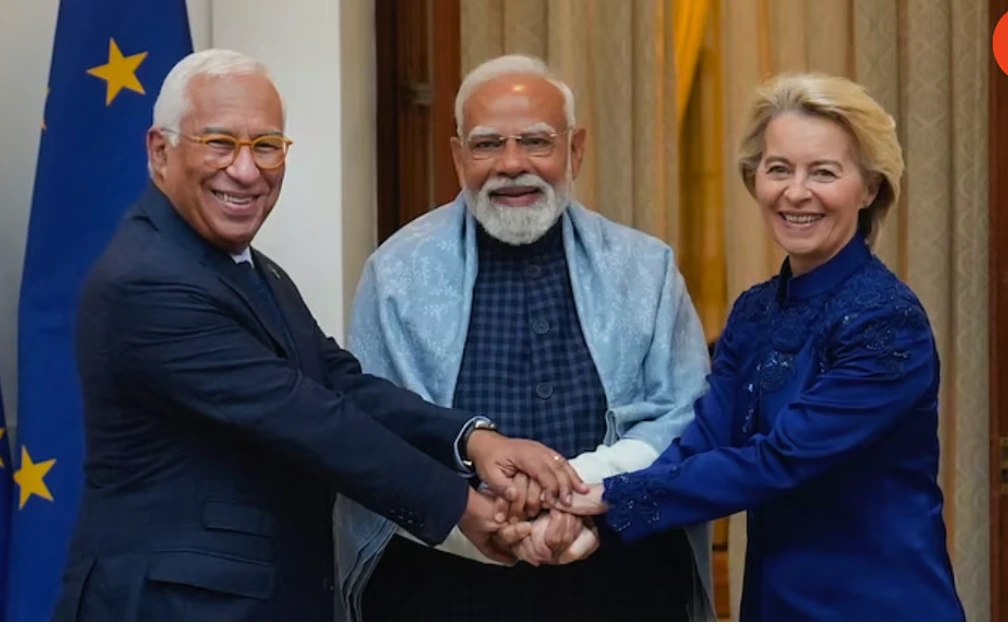
After nearly two decades of negotiations, India and the European Union have sealed a Free Trade Agreement that is expected to significantly reduce prices of several European products in India while expanding export opportunities for Indian manufacturers.

Described by European Commission President Ursula von der Leyen as the “mother of all trade deals”, the pact aims to deepen economic cooperation by easing tariffs and improving market access on both sides.

Luxury cars likely to become more affordable

One of the most noticeable impacts of the agreement will be in the premium automobile segment. Imported European cars such as Mercedes, BMW and Audi currently face import duties exceeding 100 per cent in India.

Under the new agreement, vehicles priced above 15,000 euros (around Rs 16 lakh) will see duties reduced to 40 per cent initially, with a further cut to 10 per cent planned over time. This is expected to bring down prices by several lakh rupees.

The concessions will operate under a quota system to safeguard India’s domestic automobile industry. Officials clarified that smaller, mass-market cars — which dominate India’s auto sector — will not be directly exported by European manufacturers, though local manufacturing remains an option.

Imported wines and spirits to get cheaper gradually

European wines from countries such as France, Italy and Spain are also set to become more affordable. India currently levies an import duty of 150 per cent on wines. Under the pact, this will be reduced to 20 per cent, though the change will be phased in over five to ten years to limit disruption to domestic producers.

The agreement is expected to reduce prices of premium spirits such as cognac, high-end gins and vodkas. However, wines priced below 2.5 euros will not receive duty concessions, a move aimed at protecting Indian manufacturers. Indian wines, meanwhile, will gain improved access to European markets.

Cheaper medicines and medical equipment

The trade deal is expected to benefit India’s healthcare sector by lowering the cost of imported medicines, particularly for cancer and other critical illnesses. Advanced medical equipment sourced from Europe is also likely to become cheaper.

At the same time, pharmaceuticals manufactured in India will gain access to all 27 EU member countries, strengthening India’s position as a global supplier of affordable medicines.

Electronics, steel and chemicals to benefit

The agreement removes tariffs on aircraft spare parts, mobile phone components and other high-tech electronic items imported from Europe. This could reduce manufacturing costs for electronic devices in India, potentially benefiting consumers.

Additionally, proposals for zero tariffs on iron, steel and chemical products may lower raw material costs for industries such as construction, with possible downstream benefits for homebuyers and infrastructure projects.

Overall, the India-EU Free Trade Agreement is being seen as a major boost for Indian exports, particularly in sectors such as garments, leather and jewellery, while offering Indian consumers access to more competitively priced European goods.

Continue Reading
Click to comment

Leave a Reply

Your email address will not be published. Required fields are marked *

Latest world news

India plans sharp cut in car import tariffs under proposed EU trade pact

India is planning a sharp reduction in car import tariffs as part of a proposed free trade agreement with the European Union, potentially opening up its auto market to European brands.

Published

on

India is planning a significant reduction in import tariffs on cars from the European Union as part of a proposed free trade agreement, according to sources familiar with the discussions. The move could mark the biggest opening yet of India’s tightly protected automobile market.

Under the plan, import duties on a limited number of cars priced above 15,000 euros are set to be reduced to 40% from the current levels that go as high as 110%. Over time, these duties could be lowered further to 10%, the sources said.

The decision is expected to benefit European automakers including Volkswagen, Renault and Stellantis, along with luxury manufacturers Mercedes-Benz and BMW, which have long raised concerns over high import taxes in India.

Trade pact announcement expected soon

India and the European Union are expected to announce the conclusion of negotiations for the long-pending free trade agreement as early as Tuesday. The pact has already been described by officials as a landmark deal, with final details to be worked out and ratified subsequently.

The agreement could significantly expand bilateral trade and provide relief to Indian exporters of products such as textiles and jewellery, which have been impacted by steep tariffs in recent months.

Limited quota, phased reduction

Sources indicated that India has proposed an immediate tariff cut for around 200,000 combustion-engine cars annually. While the quota could still see last-minute changes, it represents the most aggressive step yet by New Delhi to open up its auto sector.

Battery electric vehicles will not be included in the duty reductions for the first five years. This exemption is aimed at safeguarding investments made by domestic manufacturers such as Tata Motors and Mahindra & Mahindra in the developing EV segment. After the five-year period, EVs are expected to follow a similar tariff-cut path.

European brands see growth opportunity

India is currently the world’s third-largest car market after the United States and China, with annual sales of about 4.4 million units. However, European carmakers hold less than a 4% share of the market, which is dominated by Japanese and Indian manufacturers.

Lower import taxes could allow global brands to introduce a wider range of models at more competitive prices and assess consumer demand before committing to additional local manufacturing.

With the Indian car market projected to grow to 6 million units annually by 2030, several European automakers are already planning new investments, seeing India as a key growth destination beyond their traditional markets.

Continue Reading

Latest world news

Trump warns Canada of 100% tariffs over proposed China trade deal

Donald Trump has warned Canada it will face 100% tariffs on exports to the US if it proceeds with a trade agreement with China.

Published

on

donald trump

US President Donald Trump has threatened to impose sweeping tariffs on Canadian imports if Ottawa goes ahead with a trade agreement with China, escalating tensions over trade and supply chain concerns.

In a post on Truth Social, Trump strongly criticised Canadian Prime Minister Mark Carney, warning that Canada would face serious consequences if it allowed itself to be used as a transit point for Chinese products entering the United States.

Trump said that if Canada believed it could become a “drop off port” for Chinese goods bound for the US, it was “sorely mistaken”. He added that any such agreement with China would immediately trigger a 100 per cent tariff on all Canadian goods and products imported into the United States.

The remarks underline Washington’s growing concerns about China’s trade practices and its efforts to prevent indirect entry of Chinese products through third countries.

Canada, meanwhile, has been working to reduce its dependence on the US market. The country recently announced a “landmark deal” with China as part of a new strategic partnership aimed at expanding trade ties beyond North America.

The proposed partnership has now drawn sharp scrutiny from the US, with Trump signalling that any move seen as undermining American trade interests would be met with aggressive tariff action.

Continue Reading

Latest world news

Trump warns Canada of China threat after opposing Golden Dome defence plan

Donald Trump criticised Canada for opposing the Golden Dome missile defence system and expanding trade with China, warning that the move could weaken regional security.

Published

on

US President Donald Trump has launched a sharp attack on Canada after it rejected his proposed “Golden Dome” missile defence project over Greenland, warning that Beijing could quickly dominate the country as it deepens economic engagement with China.

In a post on Truth Social, Trump said Canada opposed the Golden Dome despite it being designed to protect North America, including Canadian territory. He accused Ottawa of choosing closer business ties with China over US-backed security arrangements, claiming China would “eat them up” within a year.

Trump’s remarks come amid rising diplomatic tensions between Washington and Ottawa, following comments made by Canadian Prime Minister Mark Carney at the World Economic Forum in Davos earlier this week.

Trump targets Carney over security and trade choices

Speaking at the WEF, Trump criticised Carney for what he described as a lack of gratitude towards the United States, asserting that Canada benefits significantly from US security protections. He said his proposed missile defence system would extend protection to Canada as well.

Trump also emphasised the strategic role played by the US in safeguarding its northern neighbour, warning that Canada’s security depended heavily on American military support.

The US President’s comments were aimed directly at Carney’s Davos speech, where the Canadian leader spoke of a shifting global order marked by intensified great power rivalry and expressed opposition to the use of tariffs as a coercive tool.

Canada defends China trade agreement

The dispute has been further fuelled by Canada’s recent announcement of a new trade agreement with China. Carney said the deal would unlock more than $7 billion in export opportunities for Canadian businesses and workers, highlighting China’s importance as the world’s second-largest economy.

According to official statements, the agreement is part of Canada’s effort to diversify trade partnerships and strengthen economic resilience in an increasingly uncertain global environment.

As part of the arrangement, Canada has agreed to reduce its tariff on Chinese electric vehicles in exchange for lower duties on Canadian agricultural exports. The agreement includes an annual cap on Chinese EV imports, which will gradually increase over five years. China, in turn, will significantly cut tariffs on Canadian canola seed exports.

Carney has stated that China has become a more predictable partner than the United States, citing recent progress in bilateral relations.

Tariffs add to US–Canada friction

Canada continues to face steep US tariffs, including levies on metals and non-US automobiles. Meanwhile, tensions between the US and China over tariff threats have eased temporarily following talks between Trump and Chinese President Xi Jinping, leading to partial tariff exemptions until November 2026.

The Golden Dome dispute now adds another layer to strained US–Canada relations, highlighting growing disagreements over defence priorities, trade diversification, and geopolitical alignment.

Continue Reading

Trending

© Copyright 2022 APNLIVE.com