English हिन्दी
Connect with us

India News

Galgotias University asked to vacate India AI Summit over Chinese robot dog row

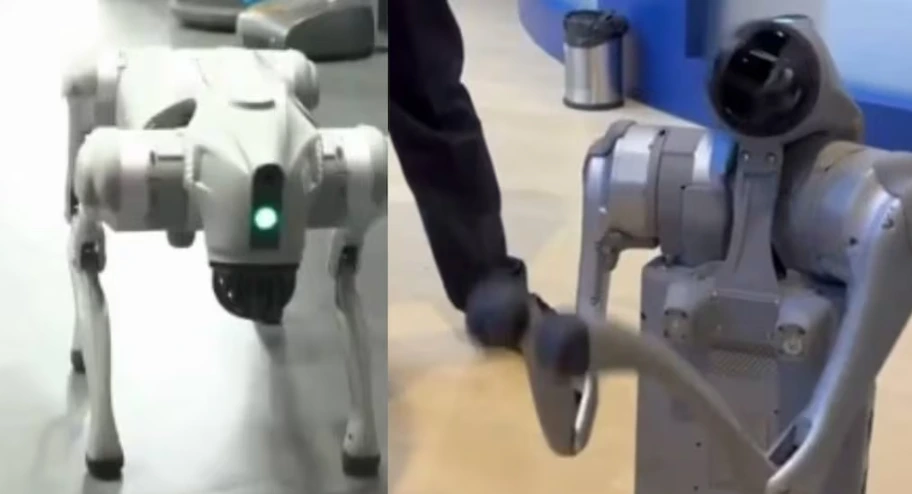
Galgotias University has reportedly been asked to vacate its stall at the India AI Impact Summit after a Chinese-made robotic dog was allegedly presented as a university innovation.

Published

on

Galgotias University has reportedly been asked to vacate its exhibition space at the India AI Impact Summit in New Delhi after a controversy erupted over the display of a robotic dog at the event.

The Greater Noida-based institution came under scrutiny after a video from the summit went viral on social media. In the clip, representatives of the university were seen presenting a robotic dog as a product developed by its Centre of Excellence.

Robot identified as Unitree Go2

The robotic dog displayed at the summit was identified as the Unitree Go2, a commercially available quadruped robot manufactured by Chinese robotics company Unitree. The model is available for purchase in India at a price ranging between Rs 2 lakh and Rs 3 lakh.

At the summit, the machine was introduced under the name “Orion”. In one of the widely circulated videos, a university representative claimed during a media interaction that the robot had been developed at Galgotias University’s Centre of Excellence.

Another clip showed a professor making a similar assertion, stating that the robot was built by the university team. Social media users later pointed out that the device matched the Unitree Go2 model and alleged that imported technology was being presented as an indigenous innovation.

University issues clarification

Following the backlash, Galgotias University released a statement on X, formerly Twitter, clarifying that the robotic dog had been procured from Unitree and was being used as a learning tool for students.

In its statement, the university said the robodog was acquired to help students experiment and expand their technical understanding. It further stated that it had not built the robot nor claimed to have done so.

However, the clarification drew further criticism online. A Community Note was added to the university’s post, stating that the claim of never presenting the robodog as its own was misleading. The note highlighted that the robot had been renamed “Orion” and that university representatives had explicitly claimed it was developed by their team during the event.

Faculty response amid reports of removal

Responding to the controversy, Neha, a communications faculty member at the School of Management who had earlier described the robot as a Galgotias innovation, said the issue may have stemmed from a misunderstanding during interaction with the media. She stated that she is not part of the AI department and that the robot was brought for projection purposes.

Meanwhile, amid reports that the university had been asked to vacate its stall at the summit, Professor Aishwarya Shrivastava said that they had no such information at that point.

Social media backlash intensifies

The controversy gained momentum after several users on X shared side-by-side comparisons of the robot displayed at the summit and promotional images of the Unitree Go2 available online.

One widely circulated post stated:

“This is Unitree Go2, a Chinese robot that can be ordered online. How is this being presented as developed by the university?”

Another user wrote:

“Renaming a commercial product ‘Orion’ doesn’t make it indigenous. This is a standard Unitree model.”

Multiple posts questioned how a commercially available imported product was described as a Centre of Excellence innovation during a national AI-focused summit.

The university later described the criticism as part of a “propaganda campaign” against it. Its post itself carried a Community Note stating that video evidence showed representatives claiming the robot was developed in-house.

The episode has sparked wider debate online over transparency, attribution and accurate representation of technology at innovation events.

India News

Union Cabinet approves Rs.10,000 crore jet fuel price stabilisation fund to support airlines

The Centre has approved a Rs. 10,000 crore Aviation Turbine Fuel Price Stabilisation Fund to support airlines and oil companies facing pressure from rising global fuel prices.

Published

on

The Union Cabinet on Wednesday approved a one-time budgetary support of up to Rs. 10,000 crore to help stabilise Aviation Turbine Fuel (ATF) prices for scheduled Indian airlines, offering relief to a sector grappling with elevated fuel costs amid global geopolitical tensions.

The government said the financial support will be provided to oil marketing companies (OMCs) to offset under-recoveries arising from supplying aviation fuel at moderated rates. The move is aimed at reducing the impact of sharp fuel price fluctuations on airlines and ensuring continuity of air services.

Why the government approved the fund

The decision comes as aviation fuel prices remain under pressure due to the ongoing crisis in West Asia, which has pushed up global energy costs. Fuel is one of the largest operating expenses for airlines and can account for up to 40% of total operating costs.

According to the government, the fund is intended to help maintain stable aviation operations and protect domestic and international air connectivity from disruptions caused by fuel price volatility.

How the fund is expected to help airlines and passengers

By cushioning the impact of rising fuel prices, the stabilisation mechanism is expected to ease financial pressure on airlines and limit the extent of fare increases that could otherwise be passed on to passengers. The support will be routed through OMCs, which have been bearing the burden of moderated fuel pricing.

Reports indicate that the fund has been designed as a stabilisation mechanism that can help the aviation sector manage periods of extreme fuel price volatility triggered by international crises.

Part of broader Cabinet decisions

The ATF Price Stabilisation Fund was among several key decisions approved by the Cabinet on Wednesday as part of a wider package covering aviation, transport and infrastructure initiatives.

The government said the measure is aimed at safeguarding the aviation ecosystem and ensuring that air services remain sustainable despite global market uncertainties.

Continue Reading

India News

Virat Kohli’s advice to Vaibhav Sooryavanshi after IPL 2026 final wins fans online

Virat Kohli’s motivational message to teenage star Vaibhav Sooryavanshi after the IPL 2026 final has gone viral, with fans praising the veteran’s support for the young batter.

Published

on

virat vaibhav

A brief conversation between Virat Kohli and teenage batting sensation Vaibhav Sooryavanshi after the IPL 2026 final has captured the attention of cricket fans across social media.

Following Royal Challengers Bengaluru’s title-winning campaign, Kohli was seen sharing words of encouragement with the Rajasthan Royals youngster, who emerged as one of the biggest stars of the season. A video of the interaction was later shared by RCB and quickly went viral.

During the conversation, Kohli praised Sooryavanshi’s achievements and reminded him that his success was built on hard work and self-belief. The veteran batter also advised the youngster not to be distracted by public opinions or outside commentary.

One line from Kohli’s message particularly resonated with fans. Referring to the Bihar-born cricketer, he said, “Ek Bihari, sab pe bhaari,” while encouraging him to continue aiming higher in his career.

Sooryavanshi enjoyed a remarkable IPL 2026 season for Rajasthan Royals. The teenage opener finished as the tournament’s leading run-scorer with 776 runs and secured the Orange Cap. His aggressive batting approach and consistency made him one of the standout performers of the competition.

While Kohli celebrated another IPL title with Royal Challengers Bengaluru, Sooryavanshi walked away with several individual accolades after a breakthrough season that established him as one of India’s most exciting young cricket talents.

Continue Reading

India News

Mamata Banerjee seeks to steady Trinamool as party faces post-election challenges

Trinamool Congress faces growing internal challenges after its West Bengal election defeat, with rebellion claims, leadership disputes and organisational restructuring adding pressure on the party leadership.

Published

on

The Trinamool Congress (TMC) is grappling with a series of political and organisational challenges following its defeat in the West Bengal Assembly election, increasing pressure on party chief Mamata Banerjee and the leadership.

The setback has triggered intense political activity within the party, with questions emerging over leadership, organisational control and the future direction of the TMC as it seeks to recover from the loss.

Leadership dispute fuels uncertainty

The party’s troubles have been compounded by a controversy involving alleged forged signatures and competing claims over leadership positions within the legislature party. The dispute has highlighted divisions among lawmakers and added to concerns about maintaining unity within the organisation.

Political observers view the developments as one of the most significant internal challenges faced by the party in recent years.

Rebel claims add to pressure

The situation escalated after expelled leader Ritabrata Banerjee claimed recognition for a rebel faction and asserted that his group represented the “real” opposition within the Assembly. The claims have intensified speculation about divisions within the party and raised concerns about possible defections.

TMC leaders, however, have continued to maintain that the party remains united despite the ongoing controversy.

Mamata Banerjee calls it a ‘do or die’ fight

Addressing the crisis, Mamata Banerjee described the situation as a “do or die” battle for the party and accused opponents of attempting to weaken the Trinamool Congress.

The leadership has also undertaken organisational changes in an effort to strengthen the party structure. As part of the exercise, several committees and frontal organisations have been dissolved for restructuring.

Road ahead for TMC

With internal disputes and rebellion claims dominating political discussions, the coming weeks are expected to be crucial for the Trinamool Congress. The party leadership faces the challenge of maintaining unity while rebuilding its organisation following the electoral setback.

How effectively the TMC addresses these issues could play a significant role in shaping its future political strategy in West Bengal.

Continue Reading

Trending

© Copyright 2022 APNLIVE.com