English हिन्दी
Connect with us

Latest world news

India and Switzerland strengthen AI governance, trade ties at Impact Summit

India and Switzerland discussed global AI rules, trade cooperation and future summits as PM Modi met Swiss President Guy Parmelin in New Delhi.

Published

on

AI Impact summit 3455

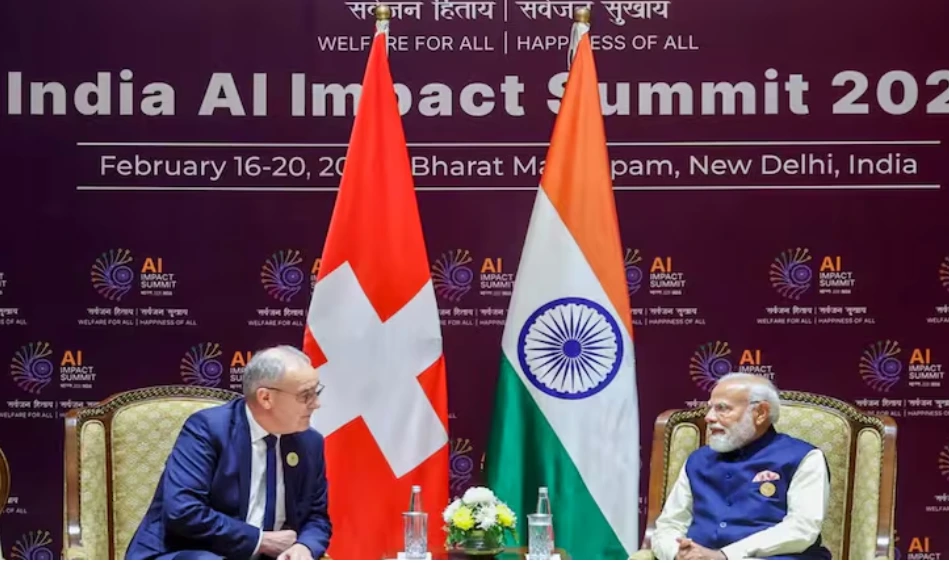
India and Switzerland placed artificial intelligence, innovation-led growth and expanding economic cooperation at the centre of bilateral discussions as Prime Minister Narendra Modi met Swiss President Guy Parmelin on the sidelines of the AI Impact Summit in New Delhi.

President Parmelin is on a two-day visit to India to participate in the summit, with both sides describing the relationship as friendly and multifaceted. The talks took place at a time when artificial intelligence is increasingly shaping global governance debates, economic competitiveness and social transformation.

AI governance and responsible innovation in focus

Speaking after his engagements at Bharat Mandapam, President Parmelin thanked India for hosting what he described as a landmark gathering. He said artificial intelligence holds transformative potential across sectors such as education, healthcare, work and communication.

He underlined that the benefits of AI are not automatic and depend on timely policy frameworks and safeguards. According to him, governing AI responsibly can help reduce inequality and ensure that technological progress benefits broader sections of society.

The Swiss President said India and Switzerland share similar values in balancing innovation with accountability. He noted that artificial intelligence presents an opportunity to shape a more equitable technological transition than earlier industrial revolutions, provided governments act proactively.

Trade and economic partnership reviewed

Beyond AI, the two leaders reviewed the full spectrum of India-Switzerland ties, including trade and investment, science and technology, innovation, skill development, and people-to-people exchanges.

Economic cooperation featured prominently in the discussions. Both sides welcomed the momentum following the implementation of the India-European Free Trade Association Trade and Economic Partnership Agreement. Switzerland is a member of the European Free Trade Association, and the agreement is expected to boost trade and investment flows between India and EFTA countries.

President Parmelin said economic relations have gained fresh dynamism since the agreement’s rollout. He also indicated that a bilateral investment treaty could further encourage Swiss investment in India while supporting sustainable job creation.

Swiss companies are already present in sectors such as engineering, pharmaceuticals and financial services, with both governments identifying opportunities in advanced manufacturing, clean technologies and research collaboration.

Future AI summits and multilateral cooperation

Artificial intelligence remained the central theme of the engagement. Prime Minister Modi welcomed Switzerland’s decision to host the next global AI Summit in Geneva in 2027. President Parmelin said the event would reinforce Switzerland’s role in digital policy discussions and highlight Geneva’s position as a hub of international diplomacy and law.

He added that the 2027 summit would be followed by the 2028 AI Summit to be hosted by the United Arab Emirates, with Switzerland working in partnership.

Referring to previous AI-focused gatherings held in Bletchley Park, Seoul and Paris, Parmelin described the Delhi summit as part of a continuing global effort to shape common principles for AI governance.

Despite the brevity of his visit, the Swiss President said it was important to participate in discussions that would influence the shared future shaped by artificial intelligence.

The meeting reflected India’s growing role in global technology governance debates, while reinforcing Switzerland’s identity as both an innovation hub and a proponent of multilateral cooperation.

Latest world news

Trump reiterates India-Pak ceasefire claim, says 11 jets were shot down

Donald Trump has renewed his claim that he mediated the 2025 India-Pakistan ceasefire, alleging he threatened 200% tariffs and that 11 jets were shot down. India continues to deny any third-party role.

Published

on

Donald Trump

US President Donald Trump has once again asserted that he played a decisive role in halting last year’s military confrontation between India and Pakistan, claiming he warned both countries of steep trade penalties if they did not de-escalate tensions.

Speaking at his “Board of Peace” event, Trump said he threatened to impose 200 per cent tariffs on the two countries during the 2025 standoff. He further alleged that 11 fighter jets were shot down during the confrontation, raising the number from his earlier claim of seven aircraft losses.

India, however, has consistently rejected assertions of third-party mediation and has denied any aircraft losses during the conflict.

Trump’s remarks at event

During the event, Trump asked Pakistan’s Prime Minister Shehbaz Sharif to stand up while recounting what he described as his diplomatic intervention. He repeated his claim that Sharif had credited him with saving “25 million lives” by brokering a truce between New Delhi and Islamabad.

“That war was raging. Planes were being shot down,” Trump said, adding that he personally contacted leaders from both nations and warned them against continuing hostilities.

He claimed that trade leverage played a crucial role in persuading both sides to step back. “If you fight, I’m going to put 200 per cent tariffs on each of your countries,” Trump said, adding that economic consequences prompted them to agree to what he described as a deal.

The US President has repeatedly stated that he prevented multiple global conflicts during his second term, including the India-Pakistan standoff, and has mentioned his role in the matter more than 80 times since May 10 last year.

India maintains no external mediation

India has firmly maintained that the cessation of hostilities in May 2025 followed direct communication between the Directors General of Military Operations (DGMOs) of the two countries.

The confrontation followed India’s launch of Operation Sindoor on May 7, targeting terror infrastructure in Pakistan and Pakistan-occupied Kashmir. The operation was carried out in response to the April 22 Pahalgam attack, in which 26 civilians were killed.

New Delhi has consistently denied claims of foreign intervention in the de-escalation process as well as assertions regarding the loss of fighter jets during the military engagement.

Continue Reading

Latest world news

Sam Altman calls for urgent AI regulation at India AI Impact Summit

OpenAI chief Sam Altman calls for urgent regulation of artificial intelligence at the India AI Impact Summit, as global leaders debate safeguards, investments and job impact.

Published

on

Sam altman ai impact summit

OpenAI chief Sam Altman has said the world urgently needs to regulate artificial intelligence, warning that unchecked centralisation of the technology could have serious consequences.

Speaking at the AI Impact Summit in New Delhi on Thursday, Altman highlighted both the opportunities and risks associated with rapidly advancing AI systems.

“Centralisation of this technology in one company or country could lead to ruin,” Altman said, adding that regulation and safeguards are urgently required, much like other powerful technologies developed in the past.

Frenzied global demand for generative AI tools has significantly boosted company profits, while also raising concerns over societal disruption, misinformation and environmental impact.

Leaders call for inclusive and responsible AI

Addressing the gathering, Prime Minister Narendra Modi emphasised that AI should serve the broader public good.

“We must democratise AI. It must become a medium for inclusion and empowerment,” he said, noting that humans and intelligent systems are entering a phase of co-creation and collaboration. He urged stakeholders to ensure AI benefits the global community.

UN Secretary-General Antonio Guterres echoed similar sentiments, calling for the creation of a $3 billion global fund to promote open access to AI technologies. He said AI should not be controlled by a limited number of nations or individuals.

French President Emmanuel Macron, who hosted last year’s summit, stressed the need for safe oversight while encouraging innovation. Meanwhile, Google CEO Sundar Pichai and Anthropic CEO Dario Amodei were among the industry leaders who addressed the event.

Microsoft co-founder Bill Gates cancelled his scheduled appearance shortly before the summit began. His foundation said the move was to keep the focus on the summit’s key priorities. Gates has recently expressed regret over past interactions with Jeffrey Epstein, though the mention of a name in related files does not imply wrongdoing.

Big investments and infrastructure push

India is positioning itself as a major AI hub and expects over $200 billion in investments over the next two years. During the summit week, major announcements were made by global technology firms.

OpenAI and Indian IT major Tata Consultancy Services said they will jointly build hyperscale AI data centre capacity in India. Google announced plans to lay subsea cables connected to its broader $15 billion AI infrastructure initiative. Chipmaker Nvidia also revealed partnerships with Indian cloud firms to supply advanced processors for AI data centres.

The rapid expansion of power-intensive AI data centres worldwide has raised environmental concerns, particularly over electricity and water consumption as countries work toward decarbonising energy grids.

Job concerns and India’s ambitions

India rose to third place in a global AI competitiveness ranking compiled by Stanford researchers last year, though experts say it still trails the United States and China significantly.

One key concern remains the potential disruption of jobs, especially in India’s large call centre and technology support sector. However, Reliance Group chairman Mukesh Ambani said AI would generate new high-skilled employment opportunities rather than eliminate work.

World leaders are expected to release a joint statement on Friday outlining their approach to managing the fast-evolving AI landscape.

Continue Reading

Latest world news

PM Modi, Macron, Sundar Pichai to address India AI Impact Summit 2026 in New Delhi

PM Modi, Emmanuel Macron and leading tech CEOs including Sundar Pichai and Sam Altman address the India AI Impact Summit 2026 in New Delhi.

Published

on

PM Modi with French President Emmanuel Macron

Prime Minister Narendra Modi, French President Emmanuel Macron, and leading global technology executives including Sundar Pichai and Sam Altman are set to address the India AI Impact Summit 2026 in New Delhi.

The six-day summit began on Monday at Bharat Mandapam and carries the theme “Sarvajan Hitaya, Sarvajan Sukhaya”, meaning welfare for all and happiness for all.

Fourth edition of international AI gathering

This year marks the fourth annual global AI summit. Previous editions were held in the UK in 2023, South Korea in 2024, and France in 2025. The 2026 edition is being described as the largest so far.

More than 20 heads of state and over 500 global AI leaders are expected to participate. The summit will also host nearly 100 CEOs and founders from leading technology firms.

Among prominent speakers scheduled to participate are Anthropic CEO Dario Amodei, Google DeepMind chief Demis Hassabis, Adobe CEO Shantanu Narayen, and Wipro executive chairman Rishad Premji.

Modi highlights human-centric AI vision

Prime Minister Modi said the summit’s theme reflects India’s commitment to ensuring that artificial intelligence drives inclusive and human-focused progress.

In a message posted on X, he said AI is reshaping key sectors such as healthcare, education, agriculture, governance, and enterprise. He expressed confidence that discussions around innovation, collaboration, and responsible use would help define a progressive and opportunity-driven future.

He also noted that India, supported by its 1.4 billion citizens, is emerging as a key force in AI transformation, citing digital public infrastructure, a growing startup ecosystem, and advanced research efforts.

Investment outlook and global partnerships

Union IT Minister Ashwini Vaishnaw stated that India expects investments exceeding $200 billion over the next two years in the technology space.

Sundar Pichai said India is on track for an “extraordinary trajectory” in artificial intelligence. He added that Google intends to strengthen its partnership with India, including plans to build subsea cables under its existing $15 billion AI infrastructure investment.

Reflecting on his roots, Pichai said India has witnessed significant transformation since his childhood in Chennai. He also met Prime Minister Modi during the summit.

Meanwhile, US chipmaker Nvidia announced collaborations with Indian cloud service providers to supply advanced processors for AI-focused data centres capable of training and running AI systems.

Focus on responsible AI governance

At the conclusion of the summit, world leaders are expected to release a joint statement outlining approaches to governing AI technologies.

Experts have underlined the need for stronger safeguards to address challenges such as sexualised deepfakes, AI-driven online fraud, and concerns related to surveillance.

Continue Reading

Trending

© Copyright 2022 APNLIVE.com