English हिन्दी
Connect with us

India News

Climate changed already? Monsoon refuses to end, rains wreak havoc in Bihar, other parts

Torrential rains wreaked havoc in Bihar, submerging the state capital of Patna and flooding several districts as the monsoon refused to retreat – yet another phenomenon signalling that climate change is here and brings with it a retribution in which those least responsible for it suffer the most.

Published

on

Climate changed already? rains wreak havoc in Bihar

[vc_row][vc_column][vc_column_text]Torrential rains wreaked havoc in Bihar, submerging the state capital of Patna and flooding several districts as the monsoon refused to retreat – yet another phenomenon signalling that climate change is here and brings with it a retribution in which those least responsible for it suffer the most. 
Reports said 29 lives have been lost in Bihar alone and over 130 across India in rain-related incidents since the last weekend. Bihar has suffered massive damages to infrastructure in many districts till Sunday and was in for another spell of battering as the Indian Meteorological Department (IMD) has retained its ‘red colour’ warning of heavy to very heavy rainfall in the state. 

Monsoon, which normally withdraws around September-end, will continue to stay around till mid-October, said IMD director general M Mohapatra on Sunday.

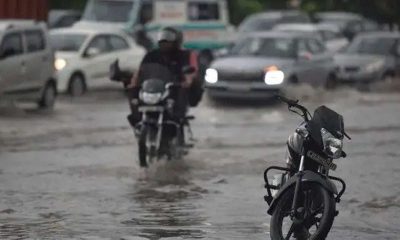
Patna, reeling under knee-deep water on Sunday due to the sudden spurt in late monsoon rainfall and reported to be the worst hit, might face more misery if the water level in Punpun river rises further. 

At least 134 people have died in rain-related incidents across the country in the past three days, with Uttar Pradesh reporting the maximum cases, said reports citing data from the state disaster relief departments. 

Twenty-two interstate trains have been cancelled in as many days due to rain, an Indian Railways spokesperson said.

The latest spell of rainfall is due to extended low pressure areas creating monsoon trough in different parts of the country, which would result in more showers in the next five days, according to the IMD.

Rivers were in spate following heavy showers. In UP, according to the state’s Flood Management and Information System Centre (FMICS), the Ganga was flowing above the danger level in Ghazipur and Ballia districts while Kuano river was flowing above the danger mark in Gonda district.Flood warning has been issued in 28 districts.

In Bihar, deaths were reported from the worst-affected Patna, Bhagalpur and Kaimur districts in the last 24 hours. Several areas in the state capital were inundated on Sunday, with the city receiving 152mm of rain the night before. Government hospitals and buildings — including the city’s second largest medical facility, the Nalanda Medical College Hospital — were waterlogged.

A bird’s eye view of Patna made the city appear like a huge lake dotted with concrete structures, said a NDTV report. Posh low-lying areas like Rajendra Nagar and Pataliputra Colony were flooded. Private hospitals, medical stores and other shops were submerged in waist-deep water. Visuals showed flooding at Nalanda Medical College Hospital, the second largest healthcare facility in the city.

The state disaster response force was deployed for rescue efforts and installed additional pumps across the city to flush out water, officials said.

According to the weather department, the state capital has received more than 200 mm of rainfall since Friday evening, which was described by principal secretary, disaster management department, Pratyay Amrit as “totally unexpected”.

Amrit said 15 districts where more rain is expected in the next 24 hours have been put on alert and all schools have been closed till Tuesday.

Other states

In the desert state of Rajasthan, three students were killed when a government school’s wall collapsed after excessive rainfall in Udaipur district. The incident occurred early on Friday morning in Government Middle School, Thobwara. The school, which is situated on the foothills, was waterlogged due to excessive rainfall on Friday night, the police said.

Madhya Pradesh has been witnessing heavy rainfall over the last couple of weeks. Three persons, including a police constable, were swept away in the strong currents of a swollen nullah in Seoni district, police said. The incident occurred on Ghansor-Kedarpur Road on Friday night. The three bodies were recovered about a kilometre away from the place of the incident.

In Jammu and Kashmir’s Samba district, a 22-year-old woman was killed after she was struck by lightning. Heavy rains lashed wide parts of the Jammu province, causing waterlogging and traffic jams at many places in the city disrupting normal life.

In Himachal Pradesh, parts of the state received light rainfall on Saturday which brought the maximum temperature down by two to three notches below the season’s average. Mandi received the maximum rainfall at 36 mm in the 24 hours ending at 5:30 pm on Saturday, followed by Kufri (28 mm), Salooni (25 mm), Kandaghat and Bakloh (22 mm each), Baijnath (19 mm), Solan (13 mm), Shimla (12.3 mm) and Manali (11 mm).

In the South, the Krishna river is in spate again following heavy rain in the upper catchment areas in Maharashtra and Karnataka. Consequently, the crest gates of major dams that were already full to the brim in Andhra Pradesh had to be opened for the third time in the last couple of months to let out floodwater into the Bay of Bengal.[/vc_column_text][/vc_column][/vc_row]

India News

Nobody can browbeat judiciary, Chief Justice warns over Rahul Gandhi’s march

The Supreme Court issued notices to opposition leaders, including Rahul Gandhi and Akhilesh Yadav, over their march to the court on October 12 concerning irregularities in the Special Intensive Revision of electoral rolls.

Published

on

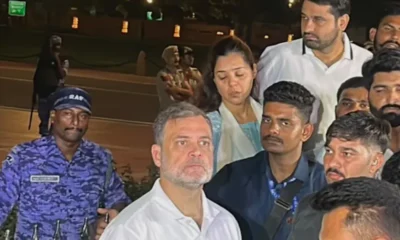
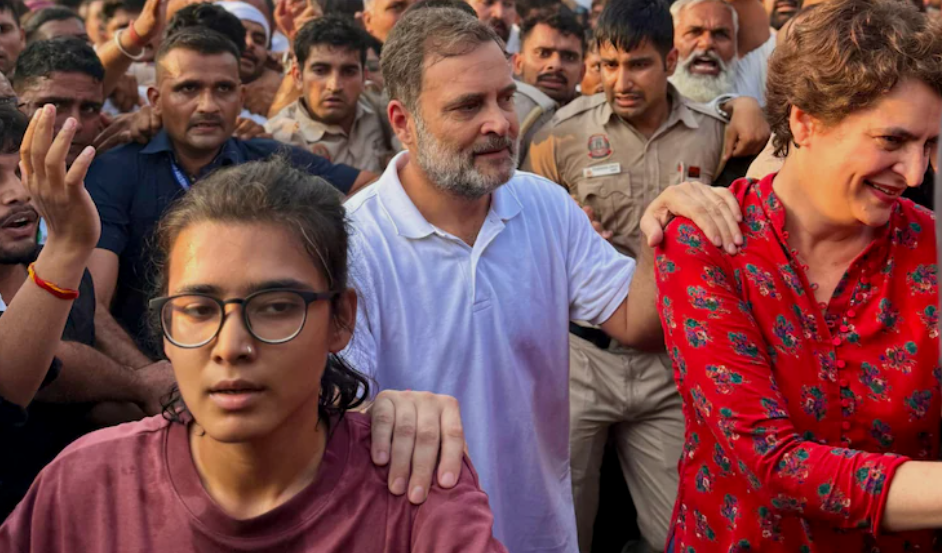
The Supreme Court has issued notices to Congress leader Rahul Gandhi, Samajwadi Party chief Akhilesh Yadav and other protesters over the opposition’s October 12 march to the apex court. The march was organised to raise concerns about alleged irregularities in the Special Intensive Revision (SIR) of electoral rolls.

The court’s remarks that nobody can browbeat the judiciary have brought the focus back to the dispute over the opposition’s protest and the appropriate way to raise grievances before the court.

Why the opposition marched to the Supreme Court

The march was part of the opposition’s campaign against what it described as irregularities in the voter-list revision process. The opposition has raised concerns over alleged electoral malpractice and demanded action concerning the Election Commission and the revision of electoral rolls.

Rahul Gandhi had led the march to the Supreme Court after Chief Justice of India Surya Kant declined a request to meet opposition leaders, including Gandhi and Congress president Mallikarjun Kharge.

The Chief Justice had advised the leaders to approach the court through the judicial process rather than seek an administrative meeting to discuss issues already pending before the Supreme Court.

Chief Justice’s position on approaching the court

The Chief Justice had said that the Supreme Court’s doors were open to every citizen and that people could approach it through petitions. He also indicated that matters affecting citizens would be considered in accordance with the law.

The distinction between the administrative and judicial functions of the court was central to the disagreement over the opposition leaders’ request for a meeting. The Chief Justice’s position was that pending legal issues should be addressed through judicial proceedings.

Supreme Court issues notices over the march

The Supreme Court issued notices to Rahul Gandhi, Akhilesh Yadav and other protesters concerning the October 12 march. The proceedings relate to the protest over irregularities in the Special Intensive Revision of electoral rolls.

The opposition’s allegations about the voter-list revision remain allegations and should not be treated as established findings merely because the matter has reached the court.

The developments have placed the opposition’s protest, its concerns over electoral rolls and the judiciary’s role in addressing such disputes at the centre of the ongoing debate.

Continue Reading

India News

Dhruv Rathee gets fresh summons in 2018 BJP IT cell video case

YouTuber Dhruv Rathee has received fresh summons from a Delhi court in a 2018 criminal defamation case filed by Vikas Pandey over a video concerning the BJP IT Cell. The matter will next be heard on October 17.

Published

on

Dhruv Rathi

YouTuber Dhruv Rathee has received fresh summons from a Delhi court in a criminal defamation case linked to his 2018 video titled “BJP IT Cell Part 2”. The complaint was filed by Vikas Pandey, who alleged that the video contained defamatory claims about him.

The latest court action follows renewed efforts to serve Rathee with the summons while he is in India. The matter is scheduled to be heard next on October 17.

Judicial Magistrate Rahul Jain of the Saket District Court passed the order on October 12. The fresh summons were issued after the complainant’s lawyer informed the court that Rathee, who usually resides abroad, was in India in connection with the ongoing Cockroach Janta Party (CJP) protests in Delhi.

What is the case against Dhruv Rathee?

The criminal defamation complaint concerns Rathee’s video, “BJP IT Cell Part 2”, which was published in 2018.

Pandey, who founded the social media page “I Support Narendra Modi”, alleged that Rathee’s video accused him of being associated with the BJP IT Cell and offering Rs 50 lakh through an intermediary to Mahavir Prasad. According to the complaint, the money was allegedly offered to persuade Prasad to withdraw allegations that the BJP IT Cell spreads fake news.

These claims form part of the complainant’s allegations. The court’s issuance of summons does not establish that the allegations against Rathee are true or amount to a finding of guilt.

Why has the court issued fresh summons?

According to the court proceedings, the complainant’s side had been attempting to serve Rathee with summons for several years. The court had initially summoned him through an order dated July 23, 2019, but the process of serving the summons had faced delays.

The complainant’s lawyer sought an earlier hearing after learning that Rathee was in India. The application argued that his presence in the country offered an opportunity to complete the service of summons without further delay.

The court subsequently directed that fresh summons be issued. The latest report states that the summons were served at Rathee’s Gurugram residence during his visit to India.

How is Arvind Kejriwal linked to the case?

The case also involved Aam Aadmi Party (AAP) leader Arvind Kejriwal, who had re-shared Rathee’s video on X, then known as Twitter, in 2018.

Pandey filed a separate complaint against Kejriwal over the re-sharing of the video. The Delhi High Court later declined to quash the summons issued to Kejriwal.

In February 2024, the Supreme Court stayed the trial court proceedings against Kejriwal in the matter. During the proceedings, his lawyer told the court that Kejriwal acknowledged making a mistake by re-tweeting the video.

The proceedings against Rathee continued, leading to the fresh summons issued by the Saket court.

What happens next?

The case is scheduled for its next hearing on October 17. The proceedings concern the pending criminal defamation complaint and the steps taken to serve Rathee with the court’s summons.

The allegations in the complaint remain allegations unless established through the legal process.

Continue Reading

India News

Supreme Court questions EC over missing records in Sringeri election dispute

The Supreme Court questioned the Election Commission over missing video footage of the 2023 counting in Karnataka’s Sringeri constituency. The case involves a revised result following a recount of postal ballots.
Published

on

The Supreme Court on Wednesday questioned the Election Commission of India (ECI) over its inability to locate video recordings of the original vote counting in Karnataka’s Sringeri Assembly constituency in 2023. The court said it would not accept what it described as “lame excuses” and directed the poll body to produce whatever records are available at the next hearing.

A bench of Justices Sanjay Kumar and Sanjeev Sachdeva expressed displeasure after the Election Commission’s counsel informed it that the footage of the original counting could not be traced.

The bench also warned that it could draw an adverse inference if the required documents were not produced.

Questioning how the poll body could lose records relating to an election it had conducted, the judges stressed that maintaining election documentation was central to its responsibilities.

“How can the Election Commission of India say that it has lost the records? Your whole purpose is to hold an election, and you need to have a document. Where is the question of you saying we are trying to trace it?” the bench asked.

“We will not accept these kinds of lame excuses,” it added.

What is the Sringeri election dispute?

The case stems from the 2023 Karnataka Assembly election in Sringeri, where Congress leader TD Rajegowda was initially declared the winner.

The result was challenged by BJP candidate Jeevaraj before the Karnataka High Court. The High Court later ordered a recount of postal ballots, including the reverification of 279 rejected postal votes.

Following the recount, the Returning Officer declared a revised result in which Jeevaraj was declared the winner. Rajegowda then approached the Supreme Court to challenge the revised outcome.

In May, the Supreme Court granted interim relief to Rajegowda, directing that he continue as the Member of the Legislative Assembly while his plea remained pending.

Rajegowda seeks counting records and observer’s report

Rajegowda has sought access to the election observer’s report and video recordings of both the original counting conducted in 2023 and the recount held this year.

The missing original counting footage became a point of concern during Wednesday’s hearing, with the bench questioning the Election Commission’s inability to trace the recording.

The court directed the Commission to submit whatever records it possesses at the next hearing. Its warning about a possible adverse inference underscores the importance the bench attached to the production of the requested documents.

The court has scheduled the next hearing for February 15, 2027.

Continue Reading

Trending

© Copyright 2022 APNLIVE.com