English हिन्दी
Connect with us

Economy news

Build an Effective Investment Plan

To make a strong investment plan, you need to know why you are contributing. When you know the target, sorting out which decisions are well on the way to get you there gets simpler.

Published

on

To make a strong investment plan, you need to know why you are contributing. When you know the target, sorting out which decisions are well on the way to get you there gets simpler. The 5 inquiries beneath will assist you with building a sound investment plan dependent on your objectives.

Which Purpose Are You Pursuing?

the investment plan must be picked in light of the primary objective: security, pay or development. The main thing you have to choose is which of those three attributes is generally significant. Do you need a current salary to live on in your retirement years, development so the plan can give pay later, or is wellbeing (saving your chief worth) your main concern?

On the off chance that you are 55 or more established, before you make a investment plan, you definitely should make a particular kind of budgetary arrangement which I call a retirement pay plan. This sort of plan extends your future wellsprings of salary and costs, at that point extends your budgetary record esteems including any stores and withdrawals. It encourages you recognize the point in time where you should utilize your cash. When you make some unmistakable memories outline you realize whether to utilize short, mid, or long haul plan.

The amount Can You Realistically Set Aside for Investing?

Numerous venture decisions have least speculation sums, so before you can spread out a strong investment plan, you need to decide the amount you can contribute. Do you have a single amount, or would you say you are ready to make customary month to month commitments?

Some file shared assets permit you to open a record with low or no base speculation sums, and afterward set up a programmed investment plan which would move assets from your financial records to your venture account. Putting month to month in this manner is called dollar-cost-averaging, and it decreases market hazard.

In the event that you have a bigger aggregate to contribute, clearly more choices are accessible to you. All things considered, you’ll need to utilize an assortment of plan, so you can limit the danger of picking only one. The most significant choice you’ll make is the amount to allot to stock versus bonds. Another key choice is whether to fabricate your portfolio or work with a budgetary guide.

When Will You Need This Money Again?

Building up a period frame,d you can stay with is absolutely critical. In the event that you need the cash to purchase a vehicle in a year or two, you will make an alternate investment plan than if you are placing cash into a 401(k) plan consistently for what’s to come.

In the main case, your essential concern is wellbeing—not losing cash before the future buy. In the subsequent case, you are contributing for retirement, and expecting retirement is numerous years away then it is immaterial what the record esteem is worth following one year. What you care about is the thing that decisions are well on the way to enable your record to merit the most when you arrive at retirement age. Truly, noteworthy development ordinarily requires at any rate 5 years or a greater amount of time in the market.

The amount Should Risk?

A few ventures involve what I call a level five speculation hazard; the danger that you can lose all your cash. These speculations are excessively unsafe for the vast majority. One simple approach to decrease speculation hazard is to broaden. By doing so you may in any case encounter swings in venture esteem. Be that as it may, you can diminish the danger of a total misfortune because of terrible planning or other tragic conditions.

Be careful about purchasing just for high return investment. There is nothing of the sort as exceptional yields with okay. Preferred to gain moderate returns over swing for the wall. On the off chance that you choose to swing, recall, it can reverse discharge, and you can encounter huge misfortunes.

What Should You Invest In?

An excessive number of individuals purchase the primary venture item introduced to them. Better to spread out a careful rundown of the apparent multitude of decisions that meet your expressed objective. At that point set aside the effort to comprehend the upsides and downsides of each. Next, tight your last venture decisions down to a not many that you feel certain about. A few investment plans are extraordinary for long haul retirement cash. Others are more theoretical, which implies perhaps you can put some “play cash” or “take a risk” cash into them, however not the entirety of your retirement investment funds.

Read Also: What are the best ways to money investment?

Assembling It All

Suppose you are 50 years of age and have $100,000 spared in an IRA. Your arrangement may look as follows:

Reason: development for age 65 retirement.

Sum to contribute: $100,000 in addition to $15,000 per year to my 401(k).

Time period: first foreseen withdrawal at age 65, for $10,000. At that point $10,000 every year from there on.

Danger level: Risk level three and four investment plan zeroed in on development are fine, however as you get inside 10 years of retirement, every year you will move $10,000 to safe speculations.

What to put resources into: Index shared assets in your 401(k) or IRA will bode well. They have low expenses and fit the target you have illustrated.

When you have an arrangement, stay with it! That is the way to contributing achievement.

Economy news

ITR filing last date today: What taxpayers must know about penalties and delays

The deadline for ITR filing ends today, September 15. Missing it may lead to penalties, interest charges, refund delays, and loss of tax benefits.


Published

on

Income Tax Return

The deadline to file Income Tax Returns (ITR) for most taxpayers, including salaried individuals, pensioners, and small businesses not requiring audit, ends today, September 15. Those who miss the due date face penalties, interest charges, and loss of certain tax benefits.

Penalties for late filing

If the return is not filed by the deadline, taxpayers can still file a belated return until December 31. However, under Section 234F of the Income Tax Act, late filing attracts penalties.

  • For income up to Rs5 lakh: penalty is capped at Rs1,000.
  • For income above Rs5 lakh: penalty increases to Rs5,000.

Additionally, if any tax remains unpaid, Section 234A imposes an interest of 1% per month (or part thereof) until the return is filed.

Consequences of missing deadline

  • Loss of certain tax benefits: Belated filers cannot carry forward specific losses such as business or capital losses.
  • Restrictions on tax regime change: Taxpayers lose the option to switch between old and new tax regimes after the deadline.
  • Refund delays: Those eligible for refunds will face delays compared to timely filers.

Steps to file before time runs out

  • Gather documents: Form 16, Form 26AS, Annual Information Statement (AIS), bank interest certificates, and proofs of investments or deductions.
  • Use the e-filing portal: File immediately to avoid last-minute portal congestion.
  • Verify your return: Ensure the ITR is verified electronically or physically for it to be considered valid.

Continue Reading

Economy news

India’s GDP surges 7.8% in Q1, outpaces estimates and China

India’s GDP surged 7.8% in Q1 2025-26, the highest in five quarters, driven by strong services and agriculture sector growth, according to NSO data.

Published

on

GDP Growth

India’s economy recorded a sharp growth of 7.8% in the April-June quarter (Q1) of 2025-26, surpassing the earlier estimate of 6.5% and outpacing China’s 5.2% growth in the same period. The figure also marks a notable rise from the 6.5% growth in the corresponding quarter last year, making it the fastest expansion in the last five quarters.

Strong performance across key sectors

According to data released by the National Statistical Office (NSO), the surge was driven primarily by the services sector, which expanded 9.3% compared to 6.8% a year ago, and the agriculture sector, which rose 3.7% against 1.5% last year.

The construction sector, however, witnessed a slowdown, growing 7.6% compared to 10.1% in the same quarter of the previous fiscal.

RBI’s earlier forecast

Earlier this month, the Reserve Bank of India (RBI) had projected a more modest Q1 growth of 6.5%, with overall real GDP growth for 2025-26 expected at 6.5%. RBI Governor Sanjay Malhotra attributed the positive outlook to favorable conditions, including a good monsoon, lower inflation, and strong government capital expenditure.

He said, “The above normal southwest monsoon, lower inflation, rising capacity utilisation and congenial financial conditions continue to support domestic economic activity. The supportive monetary, regulatory and fiscal policies, including robust government capital expenditure, should also boost demand. The services sector is expected to remain buoyant, with sustained growth in construction and trade in the coming months.”

India remains fastest-growing major economy

With China reporting 5.2% growth in April-June, India has retained its position as the world’s fastest-growing major economy. The latest figures highlight resilience in the face of external pressures, including recent US tariffs on Indian imports.

Continue Reading

Economy news

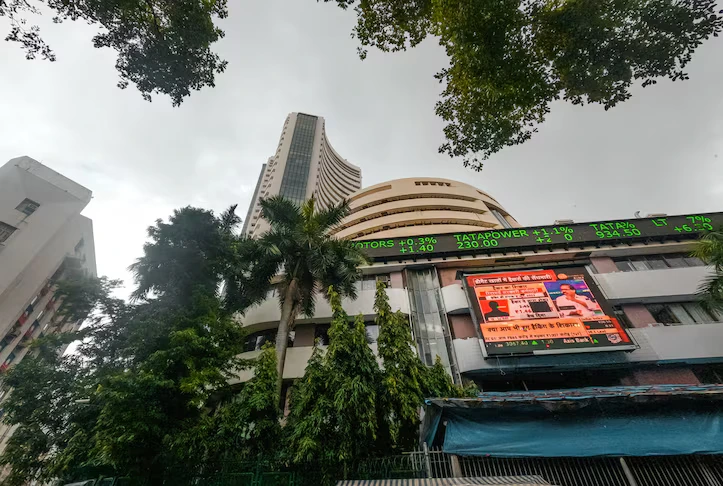
Sensex falls 600 points, nifty slips 180 as US tariffs hit Indian markets

Indian equity markets witnessed sharp declines as US tariffs on Indian imports took effect. Sensex dropped over 600 points, while Nifty fell nearly 180 points in early trade.
Published

on

Stock market crash

Indian stock markets opened lower on Thursday, reeling under the pressure of fresh US tariffs imposed on Indian goods.

At 9:17 am, the BSE Sensex dropped over 600 points to trade at 80,315, while the Nifty 50 declined nearly 180 points to 24,583. This comes a day after Washington enforced an additional 25% duty on Indian imports, raising the total tariff to 50%.

Broad-based sell-off across sectors

Market sentiment remained weak with 14 of the 16 major sectors posting losses. Small-cap and mid-cap indices also dipped, losing 0.2% and 0.1%, respectively.

The fall follows a steep correction earlier this week. On Tuesday, before the tariff announcement, both Nifty and Sensex fell by around 1% — their sharpest single-day decline in three months. Domestic markets remained closed on Wednesday for a local holiday.

Analysts warn of near-term pressure

According to market experts, Indian equities are likely to witness further volatility as investors digest the impact of the US action. The tariffs were imposed in retaliation for India’s continued crude oil imports from Russia, a move that has escalated trade tensions between the two nations.

Continue Reading

Trending

© Copyright 2022 APNLIVE.com