English हिन्दी
Connect with us

India News

Delhi elections: AAP announces door-to-door registeration drive for Mahila Samman Yojana, Sanjeevani Yojana 

“Make sure your voter ID is active. If it has been canceled, let us know immediately, and we will arrange for its reinstatement,” he stated.

Published

on

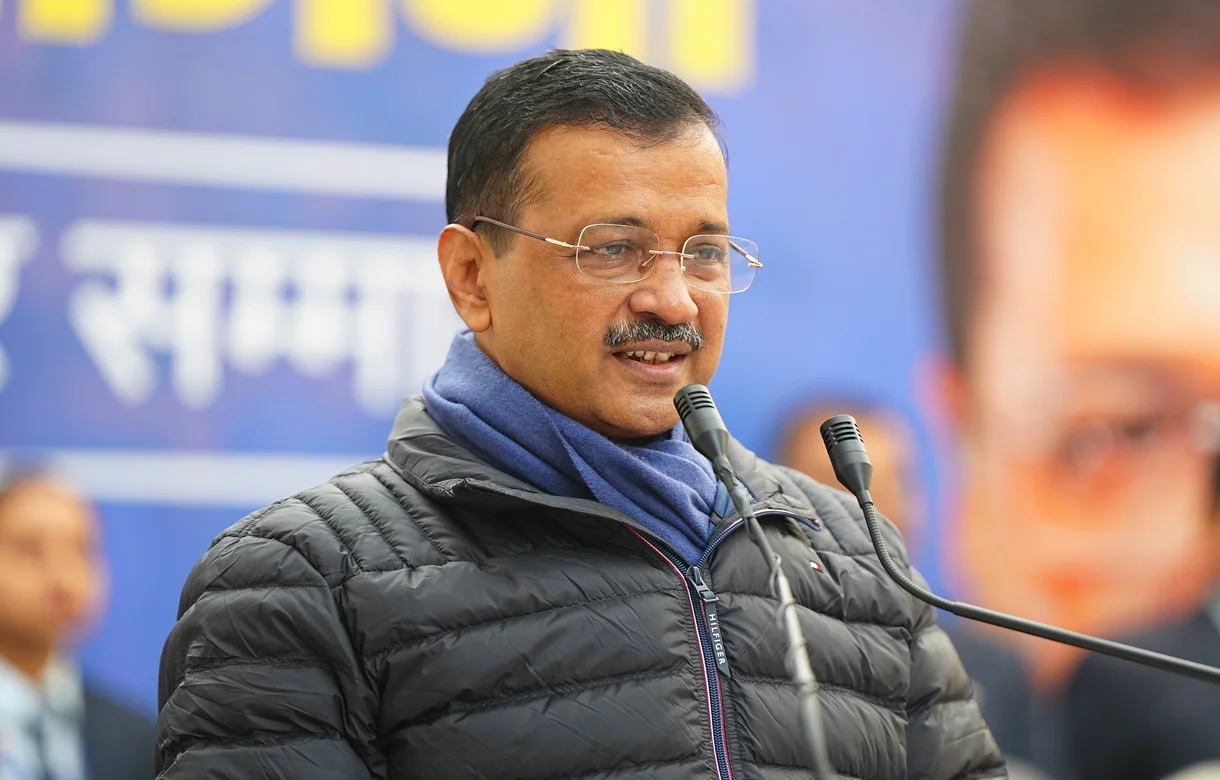
Arvind Kejriwal, the National Convenor of the Aam Aadmi Party (AAP) and former Chief Minister of Delhi, on Sunday announced that registrations for two new welfare schemes—Mahila Samman Yojana and Sanjeevani Yojana—will begin on December 23.

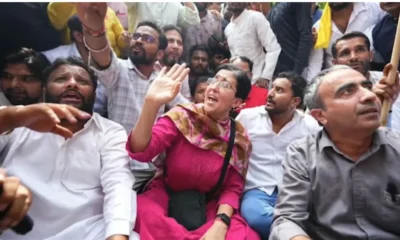
During a press conference with current Delhi Chief Minister Atishi and former Deputy Chief Minister Manish Sisodia, Kejriwal detailed the benefits of these initiatives and the door-to-door registration effort that AAP volunteers will execute to maximize participation.

The Mahila Samman Yojana provides a monthly financial assistance of RS 2,100 to every woman in Delhi. This scheme is designed to help women manage household expenses and pursue higher education.

Kejriwal emphasised the significance of supporting women, stating, “We recognize the hard work of mothers and sisters who balance household responsibilities with jobs. This Rs 2,100 will aid daughters in completing their college education and enable housewives to cope with rising costs or fulfill personal desires, like purchasing a saree or suit.”

Kejriwal announced that, due to high interest in the program, registration would start the following day. He urged potential participants to avoid long lines, assuring them that AAP teams would come directly to their homes to carry out the registration and provide a registration card for safekeeping.

The Sanjeevani Yojana is another initiative aimed at offering free healthcare for senior citizens aged 60 and above, covering all medical expenses in both government and private hospitals, regardless of income.

“The middle class, which plays a crucial role in our country’s growth through tax contributions, often feels overlooked in retirement. Healthcare costs in old age are a major concern for many. I want to reassure senior citizens that the AAP government will handle all your medical expenses,” Kejriwal declared.

Registrations for both schemes will launch simultaneously, with AAP teams ensuring that eligible voters in Delhi can enroll easily. Kejriwal urged participants to have their voter IDs ready and made a pointed remark about the opposition, alleging they cancel voter IDs to strip people of their welfare entitlements.

“Make sure your voter ID is active. If it has been canceled, let us know immediately, and we will arrange for its reinstatement,” he stated.

Kejriwal, together with Atishi and Manish Sisodia, announced plans to personally visit several neighborhoods to kick off the registration process.

“This is a major stride towards empowering women and ensuring access to healthcare for the elderly. Tomorrow, the registration drive will commence vigorously throughout Delhi,” he said.

India News

PM Modi returns to SRCC after 13 years, revisits 2013 glass full speech

PM Narendra Modi returned to SRCC after 13 years for its centenary celebrations, revisiting themes from his landmark 2013 address.

Published

on

PM Narendra Modi

Prime Minister Narendra Modi returned to Delhi University’s Shri Ram College of Commerce (SRCC) on Saturday, 13 years after his previous visit to the institution as Gujarat chief minister. 

His latest visit came as SRCC marked its centenary celebrations. Modi’s 2013 address at the college had attracted significant attention as he spoke about India’s youth, governance and the country’s demographic potential.

In 2013, Modi was Gujarat chief minister and had not yet been named the BJP’s prime ministerial candidate. He returned to the same campus this year as Prime Minister, having completed 12 years as Prime Minister and serving his third consecutive term. 

What PM Modi said at SRCC in 2013

The 2013 lecture was titled Emerging Business Models in the Global Scenario. The address also covered governance and India’s young population.

He described India’s youth as a source of national strength rather than simply a group of new-age voters. He also highlighted India’s demographic advantage and argued that the country needed to make better use of its young population.

One of the notable moments from the speech involved a glass of water.  Modi contrasted the conventional descriptions of a glass as half full or half empty and said he viewed it as full, with half containing water and the other half air.

The speech also included his remarks on technology and young Indians. Referring to an anecdote from a visit to Taiwan, Modi used the phrase “mouse-charmers” to describe Indians using computers and suggested that young Indians had the ability to influence the world through technology.

‘Minimum government, maximum governance’

Modi’s 2013 address also touched on governance. He spoke about the role of government and the need for better governance.

He also spoke about India’s potential in the 21st century. 

Modi returns as PM for SRCC centenary

The September 5 visit coincided with Teachers’ Day and SRCC’s 100th anniversary. The Prime Minister’s Office had announced that Modi would participate in the college’s centenary celebrations and address the gathering. SRCC was established in 1926 by industrialist and philanthropist Sir Shri Ram.

Earlier this year, Modi also met the SRCC governing body at his residence in April in connection with the college’s centenary celebrations and released a commemorative postage stamp marking the occasion. 

The return to SRCC came 13 years after his 2013 appearance at the college, when he addressed students as Gujarat chief minister.

Continue Reading

India News

Supreme Court judge calls police assault on CJP protesters very distressing

Supreme Court judge Justice Ujjal Bhuyan criticised alleged police assaults on CJP protesters and raised concerns over excessive force.

Published

on

Supreme Court

Supreme Court judge Justice Ujjal Bhuyan has criticised the assault of protesters by police personnel during the recent CJP demonstrations in Delhi, describing the conduct as “very, very distressing” and a matter of serious concern.

Speaking at the launch of retired IPS officer Yashovardhan Azad’s book Policing the Republic, Justice Bhuyan said the detachment expected from police officers appeared to be diminishing.

He expressed concern over young Indian Police Service officers personally participating in the assault of protesters and demonstrators.

Justice Bhuyan stresses need for responsible policing

Justice Bhuyan said effective policing does not require excessive use of force or infringement of human rights. He emphasised that the police play an important role in maintaining public confidence because citizens generally approach the police when they feel they have been wronged.

He said maintaining the credibility of the police force was therefore of “utmost importance”.

The judge’s remarks come amid continuing scrutiny of the police and paramilitary response to the CJP protests in Delhi.

Supreme Court panel to examine police action

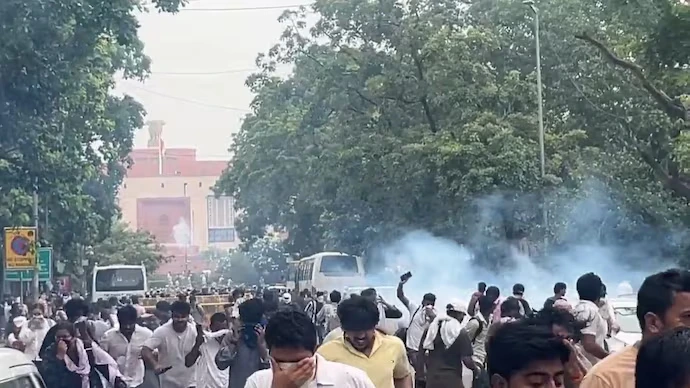
The Supreme Court has constituted a high-level panel to investigate allegations concerning the use of force by Delhi Police during the July 20 student protests at Jantar Mantar and the subsequent Parliament march.

The panel, headed by former Supreme Court judge Justice R Subhash Reddy, will examine complaints relating to lathi charges, tear gas, pellet guns and electronic batons. It will also look into allegations of targeted harassment or molestation of female protesters and review available CCTV and video footage.

The police response during the protests has faced criticism, while Delhi Police has maintained that its personnel were also attacked during the clashes.

Judge raises concern over custodial deaths and torture

Justice Bhuyan also spoke about custodial torture and deaths, describing custodial death as one of the gravest crimes in a society governed by the rule of law.

He stressed that torture and cruel, inhuman or degrading treatment cannot be accepted, regardless of whether such conduct takes place during investigation, interrogation or other circumstances.

The judge further warned that when government functionaries themselves become lawbreakers, it can undermine respect for the law and encourage lawlessness.

He questioned whether citizens lose their fundamental rights simply because they have been arrested by police.

‘Fake encounters’ cannot be part of policing

Justice Bhuyan also addressed allegations of extra-judicial killings, commonly referred to as “fake encounters”. Referring to a 2011 Supreme Court judgment, he said such encounters undermine the rule of law.

He stressed that an “encounter philosophy” cannot become part of legitimate policing and said proven fake encounters involving serving police officers must be treated with the utmost seriousness.

The Supreme Court’s panel will now examine the allegations surrounding the police action during the July 20 protests as scrutiny of the events continues.

Continue Reading

India News

8 Tamil Nadu engineering students killed in Kerala car-lorry crash

Eight engineering students from Tamil Nadu were killed after their car collided with a parked lorry on NH-66 in Kerala’s Thrissur district.

Published

on

Eight engineering students from Tamil Nadu were killed after the car they were travelling in crashed into a parked lorry on NH-66 in Kerala’s Thrissur district late Friday night, police said.

The accident took place at around 11.40 pm at Panambikkunnu in Kaipamangalam. The students were travelling from Guruvayur towards Kodungallur when their car collided with the rear of the lorry.

What happened in the Thrissur accident

According to the FIR, the lorry was parked illegally on the right side of the highway near a barricaded section where traffic had been diverted because of ongoing construction work.

Police said the car was travelling at high speed and its driver apparently failed to notice the diversion barricade before the vehicle crashed into the rear of the lorry.

The lorry was registered in Maharashtra.

Six students died at the accident spot, while two others were declared dead on arrival at a nearby hospital, police said.

Six victims identified

The victims were students of an engineering college in Dindigul and were travelling towards Kodungallur along NH-66.

Police have identified six of the eight victims. Four of them — Surya, Yuvasanjith, Vishva and Johua — were from Dindigul. The other two identified victims were Santhosh and Prasanna from Madurai.

The identities of the remaining two students are yet to be confirmed.

Residents, fire and rescue personnel and police took part in the rescue operation and pulled the students from the badly damaged car. The bodies were subsequently taken to the mortuary of Thrissur Medical College.

Case registered against lorry driver

Kaipamangalam police have registered a case against the lorry driver under Section 105 of the Bharatiya Nyaya Sanhita for culpable homicide.

Police said the driver went into hiding shortly after the accident.

The families of the victims were contacted using student identity cards recovered from the bodies. Police said some families were unaware that their children had travelled to Kerala.

Postmortem examinations will begin after the families reach Thrissur Medical College, police said.

Continue Reading

Trending

© Copyright 2022 APNLIVE.com