English हिन्दी
Connect with us

India News

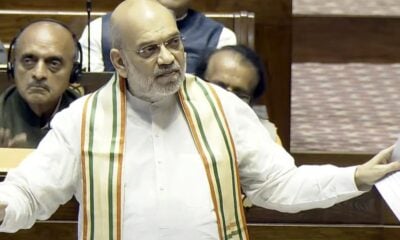
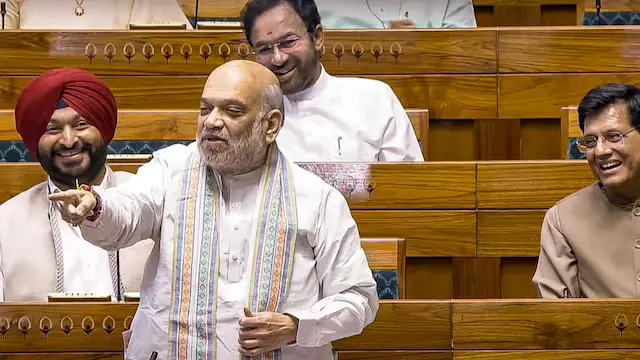
Amit Shah counters Priyanka Gandhi’s remark on Vande Mataram debate in Parliament

Amit Shah refuted Priyanka Gandhi’s claim that the Vande Mataram debate was politically motivated, while Congress leaders countered his remarks with historical references.

Published

on

Amit Shah

Union Home Minister Amit Shah firmly rebutted Congress leader Priyanka Gandhi Vadra’s criticism over the ongoing parliamentary discussion on Vande Mataram, asserting that the national song transcends electoral politics and holds significance beyond any regional context.

Shah says linking Vande Mataram to Bengal polls is “unfortunate”

Responding to Priyanka Gandhi’s allegation that the government initiated the discussion with an eye on next year’s Bengal polls, Shah said the national song belongs to the entire nation and has been a symbol of courage for freedom fighters across the world.

He remarked that questioning the relevance of the debate reflects a lack of understanding of the song’s historic and emotional value. According to him, the contribution of Bankim Chandra Chattopadhyaya should not be viewed through a political lens.

Shah emphasised that the discussion was necessary when the song was written, during Independence, today, and even in 2047.

Shah targets Nehru, Indira Gandhi over past decisions

The Home Minister also criticised former Prime Ministers Jawaharlal Nehru and Indira Gandhi, alleging that appeasement politics led to restricting Vande Mataram to two stanzas. He claimed that decisions taken then contributed to the political climate that eventually resulted in Partition.

Shah further said that during the Emergency, those who raised the Vande Mataram slogan were imprisoned, reflecting suppression of democratic voices.

Kharge responds, starts speech with Vande Mataram

Congress president Mallikarjun Kharge countered Shah’s remarks, beginning his speech with Vande Mataram and reminding the House that the Congress popularised the slogan during the freedom struggle.

He asked why Nehru was being singled out when the Congress Working Committee, not just Nehru, approved singing only the first two stanzas at national events in 1937.

Kharge also accused the government of pushing the debate to divert attention from current issues and said the true tribute to the nation would be constructive parliamentary work.

India News

BJP calls Congress anti-Hindu after Rahul Gandhi questions G-RAM-G scheme

The BJP has accused the Congress of being anti-Hindu after Rahul Gandhi said he was unfamiliar with the new G-RAM-G employment guarantee scheme that replaces MNREGA.

Published

on

Rahul-Gandhi

The Bharatiya Janata Party on Wednesday accused the Congress of being “anti-Hindu” after senior leader Rahul Gandhi said he was unfamiliar with the name of the newly introduced G-RAM-G employment guarantee scheme, which has replaced the Mahatma Gandhi National Rural Employment Guarantee Act.

Speaking at a conference held at Delhi’s Jawahar Bhavan, Rahul Gandhi remarked, “I don’t know what G-RAM-G is,” while addressing an event focused on MNREGA, the flagship rural employment programme launched during the Congress-led government. Congress president Mallikarjun Kharge made similar comments at the event.

BJP response and political backlash

The BJP reacted sharply, alleging that Rahul Gandhi’s remarks reflected hostility towards Lord Ram. Party leaders claimed the comments had “exposed the Congress’ anti-Hindu mindset,” a charge that intensified the political confrontation over the new legislation.

Several opposition leaders have argued that one of the core concerns with the G-RAM-G scheme is the replacement of Mahatma Gandhi’s name with that of a religious figure, a move they say politicises a welfare programme that was previously secular in identity.

Congress alleges attempt to weaken employment guarantee

At the conference, Rahul Gandhi said MNREGA had given poor households a legal right to employment, which he claimed Prime Minister Narendra Modi was attempting to dismantle. He also referred to the now-repealed farm laws of 2020, saying sustained public pressure had earlier forced the government to withdraw them.

“If we stand together, the government will be forced to back down and MNREGA will be restarted,” Gandhi said, asserting that the employment guarantee programme could be revived through collective resistance.

Mallikarjun Kharge accused the BJP of trying to erase Mahatma Gandhi’s legacy from public memory and said the Congress would raise the issue again during the upcoming Budget session of Parliament.

States move to support MNREGA

As the political debate continues, at least two opposition-ruled states have taken steps to support MNREGA. Karnataka and Tamil Nadu have both indicated plans to pass Assembly resolutions backing the older scheme.

In Karnataka, proceedings were disrupted after Governor Thawar Chand Gehlot declined to read out portions of a government-prepared speech that criticised the G-RAM-G framework. In Tamil Nadu, Chief Minister MK Stalin said his government would also move a resolution in support of MNREGA.

What the G-RAM-G scheme changes

The new G-RAM-G law introduces several structural changes compared to MNREGA. The guaranteed number of workdays has been increased to 125 from 100, but employment is limited to areas officially notified as rural by the central government.

Under the revised funding structure, states are now required to bear 40 per cent of the scheme’s costs, while the Centre will contribute the remaining amount. Hill states and northeastern states will pay only 10 per cent, and Union Territories will continue to receive full central funding.

The Centre will also adopt a “normative” allocation model, deciding annual fund limits for states based on defined parameters, rather than demand. This gives the Centre greater control over fund releases and the authority to suspend allocations in cases of serious irregularities.

While the government has said the changes will encourage states to take financial ownership without imposing excessive burdens, the opposition has described the scheme as “anti-poor,” warning that it could reduce employment opportunities by straining state finances.

Continue Reading

India News

Congress seeks action against Udupi DC over saffron flag row

The Congress has sought action against Udupi deputy commissioner T K Swaroopa over allegations that she waved a saffron flag during the Paryaya procession, a charge she has denied, saying her participation was part of official duty.

Published

on

Paryaya' system in Udupi

The Congress has sought action against Udupi deputy commissioner T K Swaroopa over allegations that she waved a saffron flag during the Paryaya procession held on January 18, triggering a political controversy in coastal Karnataka.

The issue surfaced after the Legal and Human Rights Cell of the Udupi District Congress Committee wrote to Chief Minister Siddaramaiah, demanding an inquiry into Swaroopa’s conduct during the religious procession linked to the Udupi Sri Krishna Math.

DC denies political motivation

Responding to the allegations, Swaroopa said she attended the event strictly in her official capacity and denied any politically motivated participation.

In a statement issued on Wednesday, she said that at around 3 am on January 18, she flagged off the Puraprevesh programme of the Swamiji as part of the biennial Paryayotsava celebrations. She added that she did so in her role as the administrator of the Udupi City Council.

Swaroopa also said she attended the civic honour programme for the new paryaya swamiji and the durbar event held after the swamiji ascended the Sarvajna Peetha, reiterating that her presence was aligned with administrative responsibilities.

Congress seeks inquiry, alleges rule violation

In the letter addressed to the chief minister on Monday, Udupi District Congress Committee Legal and Human Rights Cell president Harish Shetty alleged that ahead of the procession from Jodu Katte to Krishna Math, a BJP MLA handed over a saffron flag to the deputy commissioner, which she allegedly raised and waved in public.

The letter claimed that such an act violated service rules governing civil servants and went against the constitutional principle of secularism. The Congress has demanded a formal inquiry and appropriate action in accordance with law.

About the Paryaya system

The Paryaya or Paryayotsava marks the ceremonial transfer of ritual and administrative control of the Udupi Sri Krishna Temple. On January 18, Shiroor Matha assumed charge for the 2026–28 term, with Sri Vedavardhana Tirtha Swamiji taking over as the pontiff-administrator.

Under the centuries-old Paryaya system, the temple is managed on a rotational basis by the Ashta Mathas—Pejavara, Puttige, Adamaru, Krishnapura, Shiroor, Sodhe, Kaniyoor and Palimaru—each for a period of two years. The system was instituted by 13th-century philosopher-saint Sri Madhwacharya, the founder of the Dvaita school of philosophy.

Continue Reading

India News

Congress protests after Supreme Court raps Madhya Pradesh over Vijay Shah case

Congress workers protested in Bhopal after the Supreme Court asked the Madhya Pradesh government to decide within two weeks on prosecuting minister Vijay Shah for his remarks against Colonel Sofiya Qureshi.

Published

on

The Congress staged a protest in Bhopal on Tuesday, escalating pressure on the Madhya Pradesh government after the Supreme Court sharply criticised the delay in taking action against state minister Kunwar Vijay Shah over his derogatory remarks against Indian Army officer Colonel Sofiya Qureshi.

The demonstration followed the apex court’s direction to the Mohan Yadav-led government to take a decision within two weeks on granting sanction for Shah’s prosecution. The court observed that the state had been sitting on the report submitted by a special investigation team for several months.

Led by Congress state general secretary Amit Sharma, party workers carried out a symbolic protest by parading a man wearing a mask resembling Vijay Shah, with his hands tied, outside the Pradesh Congress office. The protesters later marched to a nearby police station and symbolically “handed over” the masked man, demanding immediate legal action against the minister.

Addressing reporters, Sharma accused the government of shielding Shah despite the gravity of his remarks. He said Colonel Qureshi was a “daughter of the nation” who brought honour to the country and alleged that the BJP government was protecting a minister who insulted a woman officer of the Indian Army. Sharma demanded Shah’s immediate removal from the cabinet.

Background of the controversy

Vijay Shah came under fire in May last year for making derogatory and discriminatory remarks while speaking at a public event in Indore. Referring to Operation Sindoor, Shah said, “They stripped and killed our Hindus, and Modi ji sent their sister to their house to teach them a lesson.” The comment triggered widespread outrage, with critics accusing him of disrespecting Colonel Qureshi.

Shah later described the remark as a “linguistic mistake” and said he was prepared to apologise multiple times. A Supreme Court-appointed team investigated the matter and submitted its report, but the state government has yet to grant sanction for prosecution.

During a recent hearing, the Supreme Court told the Madhya Pradesh government that it had been holding on to the SIT report since August 19, 2025, despite the statute placing an obligation on it to act.

Congress leaders described the court’s remarks as a moral and political setback for the ruling dispensation. Sharma said the Supreme Court’s order showed that the truth had prevailed and accused the government of deliberately delaying action to protect a minister.

Protests intensify in Bhopal

Separately, Youth Congress workers protested outside Vijay Shah’s bungalow in Bhopal, smearing black paint on the nameplate and raising slogans against him.

Reacting to the developments, Leader of the Opposition in the state assembly Umang Singhar said on social media that the issue went beyond a single statement and reflected an “insensitive and hateful mindset flourishing under the protection of power”. He added that there could be no compromise on the honour of the Indian Army and its women, and that the law must apply equally to ministers as well.

During the Supreme Court hearing, senior advocate Maninder Singh, appearing for Shah, informed the bench that the minister had apologised and was cooperating with the investigation. However, the bench rejected the apology, with Chief Justice of India Surya Kant remarking that it was delayed and inadequate, and that the court had already commented on its nature.

Neither Chief Minister Mohan Yadav nor the BJP has issued an official response to the Supreme Court’s observations so far.

Continue Reading

Trending

© Copyright 2022 APNLIVE.com