English हिन्दी
Connect with us

India News

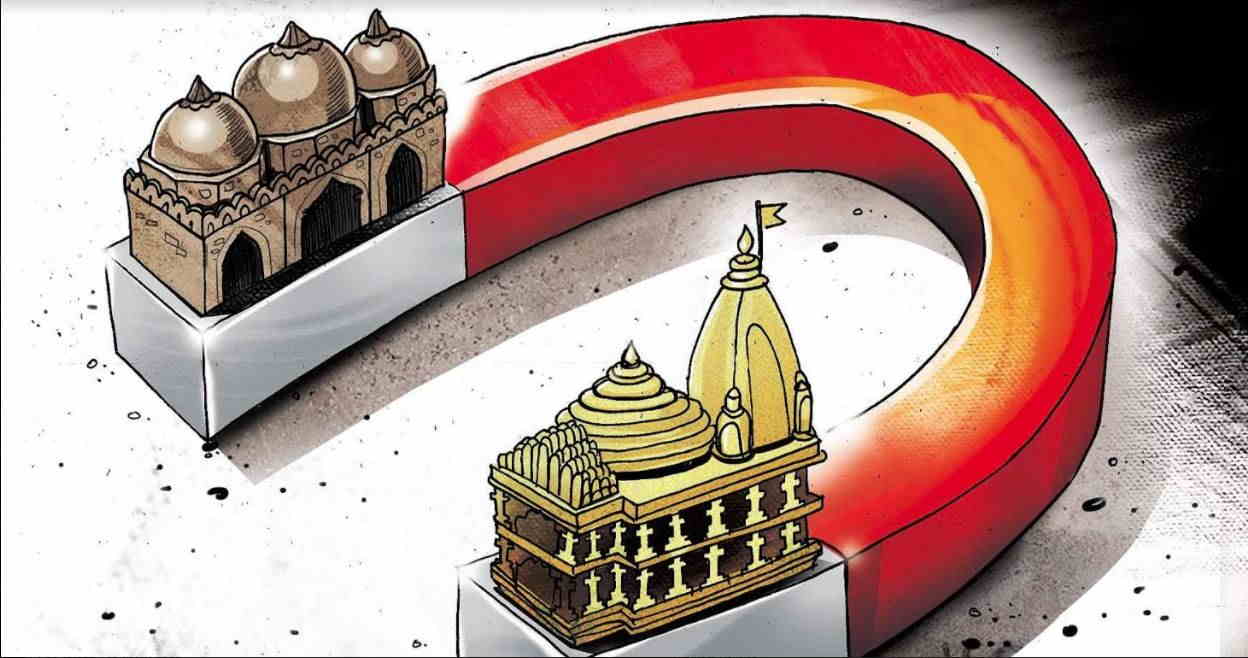
Ayodhya case hearing put off till February 8, 2018

Published

on

Ayodhya

[vc_row][vc_column][vc_column_text]The much-awaited final hearing in Supreme Court on the long-standing Ram Janmabhoomi-Babri Masjid title dispute on Tuesday, Dec 5, ended on expected lines with the next hearing put off till Feb 8, 2018.

Sunni Waqf Board counsel senior advocate Kapil Sibal had wanted it posted to July 15, 2019, after the Lok Sabha elections. Sibal told the apex court that there are serious repercussions outside the court whenever the matter is heard. He requested the court to take up the matter on July 15, 2019 once all the pleadings are complete. The plea was rejected.

The case was being heard by a bench headed by Chief Justice of India Dipak Misra and Justices Ashok Bhushan and S Abdul Nazeer. The bench is hearing a total of 13 appeals filed against the 2010 judgment of the Allahabad High Court in four civil suits.

The high court had ruled a three-way division of the disputed 2.77 acre area at Ayodhya among the parties between the Sunni Waqf Board, the Nirmohi Akhara and Ram Lalla.

The order was challenged before the Supreme Court on May 9, 2011, which in its verdict stayed the operation of the decree and ordered status quo of the land and other adjoining areas acquired by the Centre in 1993.

On August 11, 2017, the parties were given three months to translate all oral evidence and exhibited documents in various languages.

In the hearing on Tuesday, the court was to hear arguments and examine exhibits and documents likely to be relied upon. In pursuance to the apex court’s earlier direction, the Yogi Adityanath government had submitted English translation of exhibits and documents which were in eight different languages.

Senior advocate Kapil Sibal, reading out the details of exhibits filed by the contesting defendants before the Allahabad High Court, told the three-judge SC bench that all these exhibits had not been filed before the court.

Additional Solicitor General (ASG) Tushar Mehta, representing the state of Uttar Pradesh, rebutted Kapil Sibal’s claim and said that all the related documents and requisite translation copies were on record.

Sibal, questioning ASG Mehta’s claim, asked how could more than 19000 pages of documents be filed in such short time. Sibal also told the SC that he and other petitioners have not been provided with all relevant documents.

The SC bench asked the Advocates on Record of appeals to sit together and ensure that all the requisite documents are translated, filed and numbered before the apex court Registry. In case of any problem, the counsel were directed to consult the Registry.

Earlier, Kapil Sibal argued for deferment of the hearing on the ground that building a Ram temple at the disputed site is a part of the ruling BJP’s manifesto. “BJP leader Dr Subramanian Swamy had gone on record saying that Ram temple would be built before 2019 through legal means. They want to make it as an election manifesto and the court should not fall into the trap. These appeals are not ordinary property disputes as they go to the heart of secular fabric of the country,” Sibal said. He also said he needed time as there are 90,000 pages of documents to go through.

Senior lawyers Harish Salve and CS Vaidyanathan, representing Hindu organisations, objected, saying the court must treat the Ayodhya case like any other.

“We are shocked and surprised,” said Chief Justice of India Dipak Misra, adding that the judges were “not bothered about what’s happening outside.” He said that in August this year “all of you wanted the hearing in January and we posted today to hear the statement of facts. Now you want it to be postponed.”

On Sunday, BJP leader Subramanian Swamy had said that the construction of Ram Temple in Ayodhya will start soon and devotees will be able to celebrate the next Diwali there. Earlier, , RSS Chief Mohan Bhagwat had declared that only a mandir would come up at the disputed site and nothing else. “We will construct it. It is not a populist declaration but a matter of our faith. It will not change,” he had said.

On Tuesday, Ram Janmabhoomi Nyas chief Mahant Nritya Gopal Das said that in case the Supreme court order is not in their favour, the temple would still be built via Parliament, under Modi Narendra and Yogi Adityanath government.

“If the temple isn’t built during Modi, Yogi government then when it will be built,” said Mahant Nritya Gopal Das.

“Entire land belongs to Lord Ram,” he said.

The Vishwa Hindu Parishad (VHP), extreme Hindu wing of RSS, has declared that the construction will start from October 18, 2018. Assembly poll campaigns would be at peak at the time in BJP ruled Madhya Pradesh, Chhattisgarh and Rajasthan. It would also be only six months away from Lok Sabha polls.[/vc_column_text][/vc_column][/vc_row]

India News

Amit Shah counters delimitation concerns, says southern states to gain Lok Sabha seats

Amit Shah assures Parliament that southern states will gain Lok Sabha seats after delimitation, countering opposition criticism during the women’s reservation debate.

Published

on

Amit Shah

Union Home Minister Amit Shah on Thursday addressed concerns over the proposed delimitation exercise, asserting in the Lok Sabha that southern states will not lose representation but instead see an increase in their number of seats.

His remarks came during a heated debate linked to the implementation of women’s reservation, where opposition parties have raised fears that population-based delimitation could reduce the political weight of southern states.

Shah rejected these claims, calling them misleading, and said the proposed framework ensures fairness while expanding the overall strength of the Lok Sabha.

Seat count to rise with expansion of Lok Sabha

The government has indicated that the total number of Lok Sabha seats could increase significantly as part of the delimitation process. In this expanded House, the combined representation of southern states is expected to rise from 129 seats at present to around 195 seats.

Shah emphasised that no state will lose seats in absolute terms, and the exercise is designed to reflect population changes while maintaining balance across regions.

State-wise projections shared in Parliament

During his address, Shah also provided indicative figures for individual southern states, suggesting notable increases in representation. According to the projections:

  • Tamil Nadu could see its seats rise substantially
  • Kerala, Telangana, and Andhra Pradesh are also expected to gain additional seats
  • Karnataka’s representation may increase as well

These figures were presented to counter the argument that delimitation would disproportionately favour northern states.

Political debate intensifies over linkage with women’s quota

The delimitation exercise has been closely linked to the rollout of women’s reservation, which proposes one-third seats for women in Parliament and state assemblies.

Opposition leaders have questioned this linkage, arguing that tying reservation to delimitation could delay its implementation and raise federal concerns. Some leaders have also warned that the move could impact national unity if apprehensions among states are not addressed.

The government, however, maintains that the reforms are necessary to ensure equitable representation and to align the electoral system with demographic realities.

Centre dismisses ‘false narrative’ on southern states

Shah reiterated that concerns about southern states losing influence are unfounded. He said the delimitation process will increase representation across regions and described the criticism as a “false narrative” aimed at creating confusion.

The issue is expected to remain a key flashpoint as Parliament continues discussions on the women’s reservation framework and related legislative changes.

Continue Reading

India News

PM Modi assures no discrimination in women’s quota, delimitation debate intensifies in Parliament

PM Narendra Modi has assured that women’s reservation will be implemented without discrimination, amid a heated debate over delimitation in Parliament.

Published

on

PM modi

Prime Minister Narendra Modi has assured that there will be no discrimination in the implementation of women’s reservation, as Parliament witnessed a sharp debate over the proposed linkage between the quota and delimitation exercise.

During the ongoing special session, the government reiterated its commitment to ensuring fair representation while addressing concerns raised by opposition parties regarding the timing and structure of the legislation.

The proposed framework aims to reserve 33 percent of seats for women in the Lok Sabha and state assemblies. However, its implementation is tied to a fresh delimitation exercise, which is expected after the next census.

Opposition questions timing and intent

Opposition leaders have raised concerns that linking the women’s quota to delimitation could delay its implementation. They argue that the process of redrawing constituencies may push the actual rollout further into the future.

The issue has triggered a broader political confrontation, with multiple parties questioning whether the move could alter representation across states.

Some critics have also alleged that the delimitation exercise could disproportionately benefit certain regions based on population, a charge the government has rejected.

Government reiterates commitment to fair implementation

Responding to these concerns, the Centre has maintained that the reforms are necessary to ensure accurate and updated representation based on population data.

Leaders from the ruling side have repeatedly emphasized that the process will be carried out transparently and without bias. The assurance that there will be “no discrimination” is aimed at addressing fears among states and opposition parties.

The debate marks a key moment in Parliament, with both sides engaging in intense exchanges over one of the most significant electoral reforms in recent years.

Continue Reading

India News

Give all tickets to Muslim women, Amit Shah says, attacking Akhilesh Yadav on sub-quota demand

A sharp exchange between Amit Shah and Akhilesh Yadav in Parliament over sub-quota for Muslim women highlights key divisions on women’s reservation implementation.

Published

on

A heated exchange broke out in Parliament during discussions on the women’s reservation framework, with Union Home Minister Amit Shah and Samajwadi Party chief Akhilesh Yadav locking horns over the demand for a sub-quota for Muslim women.

The debate unfolded as the government pushed forward key legislative measures to implement 33% reservation for women in the Lok Sabha and state assemblies.

Akhilesh Yadav argued that the proposed reservation must ensure representation for women from marginalised communities, including Other Backward Classes (OBCs) and Muslim women. He said that without such provisions, large sections could remain excluded from political participation.

He also questioned the timing of the bill, alleging that the Centre was avoiding a caste census. According to him, a census would lead to renewed demands for caste-based reservations, which the government is reluctant to address.

Government rejects religion-based quota

Responding to the demand, Amit Shah made it clear that reservation based on religion is not permitted under the Constitution.

He stated that any proposal to provide quota to Muslims on religious grounds would be unconstitutional, firmly rejecting the idea of a separate sub-quota for Muslim women within the broader reservation framework.

The government has maintained that the existing framework already includes provisions for Scheduled Castes (SC) and Scheduled Tribes (ST) women within the overall reservation structure.

Wider political divide over implementation

The issue of sub-categorisation within the women’s quota has emerged as a major flashpoint, even as most opposition parties broadly support the idea of women’s reservation.

Samajwadi Party leaders reiterated that their support for the bill depends on inclusion of OBC and minority women, while the government continues to defend its constitutional position.

The debate is part of a broader discussion during the special Parliament session, where multiple bills linked to delimitation and implementation of the women’s quota are being taken up.

Continue Reading

Trending

© Copyright 2022 APNLIVE.com