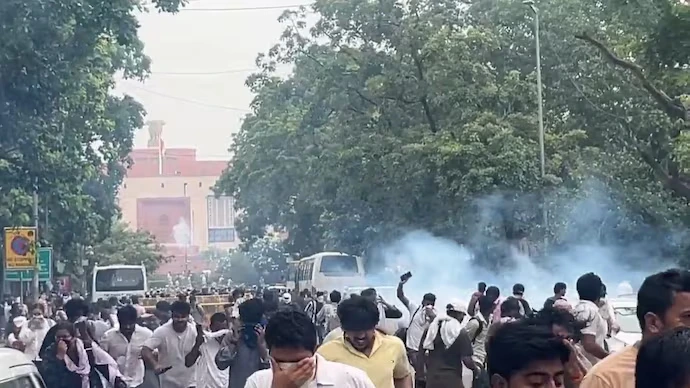
On a day when over 80 retired civil servants criticised Uttar Pradesh Chief Minister Yogi Adityanath for directing police to focus on cow slaughter rather than those who murdered police inspector Subodh Kumar Singh in the violence in Bulandshahr, the state police – as if establishing their point – claimed to have nabbed the main culprits of the cow slaughter incident about a fortnight ago, on Dec 3.
Along with the police inspector, a 20-year-old man who was also named as accused in the violence, was also killed in the violence that followed news of cow slaughter in the area.
Along with three nabbed on charges of cow slaughter, the police have arrested two others in connection with mob violence. The main accused in the cop’s murder, Yogesh Raj, district chief of Bajrang Dal, a Hindutva outfit affiliated to RSS, is still at large.
Also missing since the incident is another accused Shikhar Agrawal, a leader of the BJP Yuva Morcha in the area and the Vishwa Hindu Parishad’s former Syana town president Upendra Raghav.
Yogesh Raj even posted a video claiming he is innocent. Shikhar Aggarwal gave an interview to a news channel, but the police have not been able to track down either of them.
It was these circumstances that prompted the former bureaucrats –former Lt Governor of Delhi Najeeb Jung included – to also make a request to the Allahabad high court to “take suo motu cognizance of this incident and order a judicial enquiry supervised by them to uncover the true facts, expose the political collusion, fix responsibility and recommend action”. (See full letter below)
The police, focusing on alleged cow slaughter, said they arrested three persons near a local animal market in Bulandshahr after they intercepted a vehicle carrying the suspects based on a tip-off.
The arrested were Nadeem, Raees and Kala, all of the Syana region, police said. A fourth accused, Haroon, managed to flee.
A vehicle, double-barrelled licensed gun, a meat chopper, two knives and a butcher’s wooden block were recovered from them. The items were allegedly used in committing the crime.
The police even claimed that the accused were on course to committing another cow slaughter when they were arrested.
Circle Officer Syana Raghvendra Kumar Mishra said one of the accused, Kala, had in the past spent time in jail over cow slaughter, reported The Hindu. Asked about the alleged motive of the accused in committing the crime, since the BJP government had termed the discovery of the carcasses a ‘conspiracy’, Mishra said things were still being probed.
According to the Bulandshahr police, on the night of December 2-3, two accused Haroon and Nadeem used their weapons to shoot dead three cows in Mahav village in Syana. They then chopped the cows and distributed the meat among themselves, with Haroon carrying away the hide and some meat in his car.
They left the carcasses and the remaining meat in the sugar cane fields, a police statement said.
This was not the only cow slaughter committed by the accused, police said. On the night of December 1, they “hunted a cow” in the Naya forests nearby. The cow was allegedly shot with a licensed gun before being slaughtered, and distributed among the culprits.
On the complaint of Bajrang Dal member Yogesh Raj, police had registered a case under Sections 3, 5 and 8 of the Uttar Pradesh Prevention of Cow Slaughter Act, 1995 and Section 295 of the IPC.
Significantly, none of these persons were named in the original complaint of cow slaughter filed by Yogesh Raj, the Bajrang Dal leader who is the main accused in the killing of inspector Singh, reported NDTV.
There is also no evidence against four others initially arrested in the cow slaughter case, police sources told NDTV. Two of the four men – Sarfuddin and Sajid – were named in the FIR by Yogesh Raj, key accused in the incidents of mob violence and the murder of the inspector. The police say they will move court for the release of these men.
As for mob violence, the Special Task Force (STF) has arrested two more in the case – Sachin Singh or Cobra, 21, and Johnny Chaudhary, 19 – taking the total number of people in custody to 19. But the family of the Inspector says the real killers are still scot-free.
The police so far have named 27 people in the First Information Report and cases have been filed against another 50-60 unidentified persons for violence.
Evidence being destroyed: slain cop’s wife
Rajini Singh, inspector Singh’s wife, alleged that evidence in the case has been destroyed. Speaking to NDTV, she said, “They are protecting their own people and destroying all the evidence one by one. Nobody is there to tell what exactly happened there on that day.” She did not name anyone in particular.
Abhishek Singh, her son, stated that the politicians were protecting the accused. “What else explains the delay in arresting Yogesh Raj. What’s stopping the police? I just hope that my father’s murder doesn’t end up as a file covered in dust,” he said.
The family recently met UP chief minister Adityanath, who had initially said that the inspector’s death was an accident. “I met Yogi ji and told him about my pain. He assured me that my husband’s killers will be arrested soon. But the killers are still roaming free? I want to ask Yogi ji, why haven’t they been arrested?” she said.
Full text of open letter written by former civil servants:
We are a group of retired civil servants from the All India and Central Services who, having spent long years in the service of the Constitution of India, have come together to express ourselves on issues of governance and public policy that have a bearing on constitutional principles, conduct and ethics. Since June 2017, when we first came together, we have spoken out on several occasions when we felt that constitutional values were under threat and that it was incumbent on us to voice our concerns publicly. As a group we have no affiliations with any political party nor do we subscribe to any ideology other than the values enshrined in the Constitution.
It is a measure of the rapid erosion of constitutional values that we, as a group, have felt a compelling need to speak out as many as nine times in the last eighteen months. The pace of erosion has been frightening and with each slip we seem to sink further into a lawless abyss.
The mob violence in Bulandshahr in Uttar Pradesh (U.P), on 3 December 2018, instigated and engineered with malicious intent, which led to the cold blooded murder of a police officer brave enough to step forward single-handedly to pacify the mob, marks the most dangerous turn yet in the direction taken by the politics of hate in recent times. It shows that in India’s most populous state, Uttar Pradesh, fundamental principles of governance, of constitutional ethics and of humane social conduct stand perverted. The Chief Minister of the state acts as a high priest of the agenda of bigotry and majoritarian supremacy – an agenda which now seems to take precedence over everything else.
Why is this incident such a frightening indicator of the complete collapse of constitutional values? This is not the first instance of a situation intentionally created to foment communal tension. The history of U.P. is replete with such instances. This is not the first time that a policeman has been killed by a frenzied mob. This is also not the first time that the politics of cow protection has been used as a means of isolating and cornering the Muslim community and deepening the social divide.
All this we have seen before but, so far, we had the confidence that whenever a political party actually forms a Government it keeps its partisan political agenda at bay and begins to exercise power with a sense of responsibility so as to gain wider political acceptability. The Bulandshahr episode, which follows a succession of events aimed at isolating and intimidating Muslim communities in U.P., shows that, under Yogi Adityanath, that confidence is misplaced and that hooliganism and thuggery have been mainstreamed into governance not just to intimidate minorities but to teach a lesson to anyone, including police personnel and others in the administration, who dare to be even handed in their approach to minority communities.
While it may be premature to come to conclusions about the murder of Inspector Subodh Kumar Singh before the investigations are over, there is no doubt that there was nothing spontaneous about the violence that led to his killing, nor is there any doubt as to who the political elements were that aided and abetted the violence. This was a deliberate attempt to display majoritarian muscle and send a message to the Muslim communities living in the region that they have to live in fear, accept their subordinate status and conform to the cultural diktats of the majority community.
Inspector Subodh Kumar Singh’s reputation of being independent and even-handed and his refusal to act in haste on the complaint of illegal cow slaughter that allegedly took place under his watch, was obviously seen as defiance of the majoritarian will. The local BJP and Sangh Parivar elements had already complained about his anti-Hindu conduct and sought his transfer. He was an impediment to their communal plans and had to go. Much as the Chief Minister may try to mislead by calling it an accident, this was murder with intent. It was murder most foul.
As horrifying as the brazen, daylight murder of a courageous police officer is the response of the administration to the event. The Chief Minister refuses to acknowledge the gravity of the incident and its communal intent, condemn the perpetrators of violence or direct the police to take action against them but instead asks them to focus attention on those responsible for illegal cow slaughter. The police authorities themselves draw an equivalence between the killing of a police officer and the illegal slaughter of cows and claim that unless both crimes are investigated together it will not be possible to come to any conclusions about the violence of the mob and the murder of a colleague.
Ample videographed evidence exists to show that those engaged in violence and their leaders, as well as those who egged them on, are allowed to roam scot-free while, at the same time, alleged cow killers, against whom not a shred of evidence exists, are taken into custody, just because they are Muslims. Three of the main accused in the mob violence leading to the death of the police officer flaunt their affiliations to the Sangh Parivar and one of them openly declares that the slain police officer was corrupt, friendly with Muslims and anti-Hindu, implying thereby that he deserved his fate.
World over, in any civilized society, the killing of a policeman is a more serious offence than any other crime, because it represents an assault on the very basis of that civilisation. It brooks no tolerance and even the most fractious of social and political groups come together to ensure that the perpetrators of such a crime are given exemplary punishment so that no one ever dares to attack the authority of law. In U.P. on the other hand we are witness to the entire administration, presided over by a Chief Minister who flaunts his bigotry as his badge of identity, preparing the ground not for bringing the perpetrators to book but for protecting them as defenders of faith and culture. This is the Rule of Lawlessness.
Our colleagues in service, in the Police and the Civil Administration appear, with honourable exceptions, to have capitulated readily to this perverted political order. They seem to have forgotten that their primary allegiance is to the Constitution and the Rule of Law, and that their constitutional status provides them an armour of such extraordinary strength that, had they taken steps to check the growing menace of the Hindutva brigade, they could certainly have prevented the outbreak of violence. Instead they not only allowed these hooligans to grow in confidence and gather political strength, they helped them gain impunity in their lawless actions.
Even now if they – the Chief Secretary, the Director General of Police, the Home Secretary, the District Magistrate and the district police authorities – stand together to uncover the insidious political agenda, identify its masterminds and bring the hooligans involved in the violence to book, they stand a chance to redeem their pledge to the Constitution and live up to the expectations that citizens have of the higher civil services.
Our Prime Minister, who is so voluble in his election campaigns and who never tires of telling us of how the Constitution of India is the only holy book he worships, maintains stony silence even as he sees a Chief Minister handpicked by him treat that same Constitution with sheer contempt. It is evident that, for the Sangh Parivar, constitutional morality is of no value and is necessarily subordinate to the ideals of majoritarian supremacy.
Never before in recent history has the politics of hate, division and exclusion been so dominant and the poisonous ideology which informs it penetrated so deep into the body politic. Never before has hate been directed with such calculated intent against minority communities, hate which is nursed, aided and abetted by those in power. Violence has been given social and political sanction and perpetrators of violence have been treated with kid gloves while victims have been punished and harassed.
This is a critical moment and we cannot take it lying down anymore. We call upon all citizens to unite in a crusade against the politics of hate and division – a politics which aims to destroy the fundamental principles on which our Republic is founded. We ask all citizens to whom constitutional values matter to join us in reasserting our sovereignty as citizens to:
- Demand the resignation of the Chief Minister for his failure to abide by the Constitution to which he has sworn his allegiance. We know that this can happen, if together, we build a groundswell of public opinion by which we hold him accountable for his conduct and compel him to resign.
- Remind the Chief Secretary, the Director General of Police, the Home Secretary, and all other members of the higher civil services concerned, of their constitutional duty to fearlessly implement the Rule of Law rather than the perverse dictates of their political masters.
- Request the High Court at Allahabad to take suo motu cognizance of this incident and order a judicial enquiry supervised by them to uncover the true facts, expose the political collusion, fix responsibility and recommend action.
- Work towards a citizen-led national campaign against the politics of hate and violence – in particular, the structural violence directed against Muslims, Adivasis, Dalits and women – violence which finds sustenance in the structures of political power.
- Salute Inspector Subodh Kumar Singh for his bravery in standing up for constitutional values and refusing to yield to political pressure even at the cost of his life and for setting an example to his children and the younger generation that values matter more than career success. We also acknowledge and applaud the dignity with which his family has faced this crisis and their quiet resolve to uphold the principles for which Subodh Kumar
Singh sacrificed his life. His martyrdom will not be in vain.
- P. Ambrose IAS (Retd.), Former Additional Secretary, Ministry of Shipping & Transport, GoI
- L. Bajaj IAS (Retd.) Former Chairman, Administrative Reforms and Decentralisation Commission, Govt. of Uttar Pradesh
- Bala Baskar IAS (Retd.) Former Principal Adviser (Finance), Ministry of External Affairs, GoI
- Vappala Balachandran IPS (Retd.) Former Special Secretary, Cabinet Secretariat, GoI
- Gopalan Balagopal IAS (Retd.) Former Special Secretary, Govt. of West Bengal
- Chandrashekhar Balakrishnan IAS (Retd.) Former Secretary, Coal, GoI
- Meeran C. Borwankar IPS (Retd.) Former DGP, Bureau of Police Research and Development, GoI
- Ravi Budhiraja IAS (Retd.) Former Chairman, Jawaharlal Nehru Port Trust, GoI
- Sundar Burra IAS (Retd.) Former Secretary, Govt. of Maharashtra
- Kalyani Chaudhuri IAS (Retd.) Former Additional Chief Secretary, Govt. of West Bengal
- Anna Dani IAS (Retd.) Former Additional Chief Secretary, Govt. of Maharashtra
- Surjit K. Das IAS (Retd.) Former Chief Secretary, Govt. of Uttarakhand
- Vibha Puri Das IAS (Retd.) Former Secretary, Ministry of Tribal Affairs, GoI
- R. DasguptaIAS (Retd.) Former Chairman, Food Corporation of India, GoI
- Nareshwar Dayal IFS (Retd.)Former Secretary, Ministry of External Affairs and former High Commissioner to the United Kingdom
- Pradeep K. Deb IAS (Retd.) Former Secretary, Deptt. Of Sports, GoI
- Nitin Desai IES (Retd.) Former Secretary and Chief Economic Adviser, Ministry of Finance, GoI
- Keshav Desiraju IAS (Retd.) Former Health Secretary, GoI
- G. Devasahayam IAS (Retd.) Former Secretary, Govt. of Haryana
- Sushil Dubey IFS (Retd.) Former Ambassador to Sweden
- P. Fabian IFS (Retd.)Former Ambassador to Italy
- Prabhu Ghate IAS (Retd.) Former Addl. Director General, Department of Tourism, GoI
- Arif Ghauri IRS (Retd.) Former Commissioner of Income Tax, GoI
- Gourisankar Ghosh IAS (Retd.) Former Mission Director, National Drinking Water Mission, GoI
- Hirak Ghosh IAS (Retd.) Former Principal Secretary, Govt. of West Bengal
- Tuktuk Ghosh IAS (Retd.) Former Special Secretary and Financial Adviser, Ministry of Road Transport & Highways, Shipping & Tourism, GoI
- Meena Gupta IAS (Retd.) Former Secretary, Ministry of Environment & Forests, GoI
- Ravi Vira Gupta IAS (Retd.) Former Deputy Governor, Reserve Bank of India
- Deepa Hari IRS (Resigned)
- Vivek Harinarain IAS (Retd.) Govt. of Tamil Nadu
- Sajjad HassanIAS (Retd.) Former Commissioner (Planning), Govt. of Manipur
- M.A. Ibrahimi IAS (Retd.) Former Chief Secretary (rank), Govt. of Bihar
- Kamal Jaswal IAS (Retd.) Former Secretary, Department of Information Technology, GoI
- Jagdish Joshi IAS (Retd.) Former Additional Chief Secretary (Planning), Govt. of Maharashtra
- Najeeb Jung IAS (Retd.)Former Lieutenant Governor, Delhi
- John Koshy IAS (Retd.)Former State Chief Information Commissioner, West Bengal
- Ajai KumarIndian Forest Service (Retd.) Former Director, Ministry of Agriculture, GoI
- Arun KumarIAS (Retd.) Former Chairman, National Pharmaceutical Pricing Authority, GoI
- Brijesh Kumar IAS (Retd.) Former Secretary, Department of Information Technology, GoI
- Harsh ManderIAS (Retd.) Govt. of Madhya Pradesh
- Aditi Mehta IAS (Retd.) Former Additional Chief Secretary, Govt. of Rajasthan
- Shivshankar Menon IFS (Retd.) Former Foreign Secretary and Former National Security Adviser
- Sonalini Mirchandani IFS (Resigned) GoI
- Sunil Mitra IAS (Retd.) Former Secretary, Ministry of Finance, GoI
- Noor Mohammad IAS (Retd.) Former Secretary, National Disaster Management Authority, Govt. of India
- Deb MukharjiIFS (Retd.) Former High Commissioner to Bangladesh and former Ambassador to Nepal
- Shiv Shankar Mukherjee IFS (Retd.)Former High Commissioner to the United Kingdom
- Pranab S. Mukhopadhyay IAS (Retd.) Former Director, Institute of Port Management, GoI
- NagalswamyIAS (Retd.) Former Principal Accountant General, Tamil Nadu & Kerala
- Amitabha PandeIAS (Retd.) Former Secretary, Inter-State Council, GoI
- Niranjan Pant IA&AS (Retd.) Former Deputy Comptroller & Auditor General of India
- Alok PertiIAS (Retd.) Former Secretary, Ministry of Coal, GoI
- R. Raghunandan IAS (Retd.) Former Joint Secretary, Ministry of Panchayati Raj, GoI
- K. Raghupathy IAS (Retd.) Former Chairman, Staff Selection Commission, GoI
- P. RaiIAS (Retd.) Former Director General, National Skills Development Agency, GoI
- P. Raja IAS (Retd.) Former Chairman, Maharashtra Electricity Regulatory Commission
- Babu Rajeev IAS (Retd.) Former Secretary, GoI
- Y. Rao IAS (Retd.)
- Julio RibeiroIPS (Retd.) Former Adviser to Governor of Punjab & former Ambassador to Romania
- Aruna Roy IAS (Resigned)
- Manabendra N. RoyIAS (Retd.) Former Additional Chief Secretary, Govt. of West Bengal
- Deepak Sanan IAS (Retd.) Former Principal Adviser (AR) to Chief Minister, Govt. of Himachal Pradesh
- Shyam Saran IFS (Retd.)Former Foreign Secretary and Former Chairman, National Security Advisory Board
- C. Saxena IAS (Retd.) Former Secretary, Planning Commission, GoI
- Ardhendu SenIAS (Retd.) Former Chief Secretary, Govt. of West Bengal
- Aftab Seth IFS (Retd.) Former Ambassador to Japan
- Ashok Kumar Sharma IFS (Retd.)Former Ambassador to Finland and Estonia
- Navrekha SharmaIFS (Retd.)Former Ambassador to Indonesia
- Pravesh Sharma IAS (Retd.) Former Additional Chief Secretary, Govt. of Madhya Pradesh
- Raju SharmaIAS (Retd.) Former Member, Board of Revenue, Govt. of Uttar Pradesh
- Rashmi Shukla Sharma IAS (Retd.) Former Additional Chief Secretary, Govt. of Madhya Pradesh
- Ashok Vardhan Shetty IAS (Retd.) Former Vice Chancellor, Indian Maritime University, GoI
- Rajdip SinghIPS (Retd.) Former Special Director General, Border Security Force, GoI
- Sujatha SinghIFS (Retd.) Former Foreign Secretary, GoI
- Tirlochan Singh IAS (Retd.) Former Secretary, National Commission for Minorities, GoI
- Jawhar Sircar IAS (Retd.) Former Secretary, Ministry of Culture, GoI, & former CEO, Prasar Bharati
- Narendra Sisodia IAS (Retd.) Former Secretary, Ministry of Finance, GoI
- Thanksy Thekkekera IAS (Retd.) Former Additional Chief Secretary, Minorities Development, Govt. of Maharashtra
- S.S. Thomas IAS (Retd.) Former Secretary General, National Human Rights Commission
- Geetha Thoopal IRAS (Retd.) Former General Manager, Metro Railway, Kolkata
- Hindal Tyabji IAS (Retd.) Former Chief Secretary rank, Govt. of Jammu & Kashmir
- Ramani Venkatesan IAS (Retd.) Former Director General, YASHADA, Govt. of Maharashtra
- Arvind Verma IPS (Resigned)