English हिन्दी
Connect with us

India News

Callers outraged over gun salute for Kashmiri terrorist

Published

on

Callers outraged over gun salute for Kashmiri terrorist
[vc_row][vc_column][vc_column_text]They suggested tough action against Pakistan in live show on APN

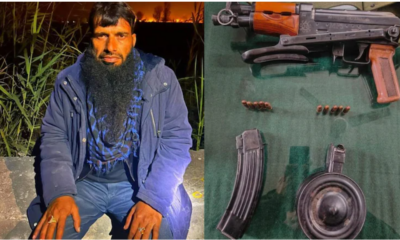
A group of Lashkar-e-Tayyeba terrorists is said to have offered a gunshot salute to their slain associate Fayaz Ahmed in Kulgam, Jammu and Kashmir on Sunday. Ahmed was killed in an abortive attempt to snatch a rifle from policemen during a shootout in Saturday in Anantnag.  Three civilians, one policeman and a terrorist died in the shootout.

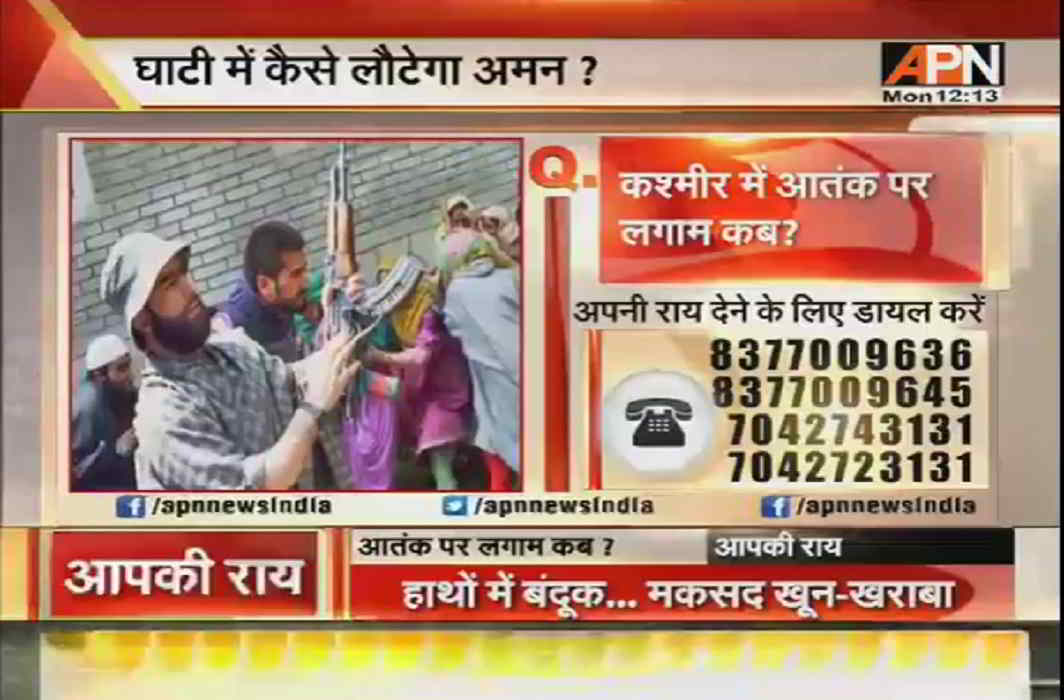
According to reports, a large number of people, including women and children, joined the funeral procession and chanted anti-India slogans. Four terrorists appeared on the scene, paid tribute by firing their AK-47s in the air and chanted slogans before leaving the scene.

APN tried to know the people’s reaction through its landmark show ‘Aap ki rai’ and raised questions as to what the Government of India should do to tackle rising terrorism in Jammu and Kashmir. A large number of callers contacted APN studio but due to paucity of time, only 14 could be accommodated.

The majority of callers including Hare Ram Yadav from Gurugram, Shiv Kumar Mishra from Noida, Dayanand from Hajipur, Bihar and Rajkumar from Kanpur expressed their views that Army should be given a free hand to tackle the problem. Hare Ram was more articulate in his views that government should not consider soft response of using pellet guns, instead it should allow the Army to shoot the terrorists directly.

Naresh Kumar from Delhi said that government should stop giving security and other benefits to the separatist leaders who are mainly responsible for the spread of terrorism in Jammu and Kashmir. He said he did not understand policy of nursing separatist leaders, who were the real enemies of the country.

Ram Kishore from Jammu and Kamlesh from Jaunpur were quite practical saying that they were ready to volunteering their services to cooperate with the Army and work shoulder to shoulder to fight against terrorists. They expressed grief over the deaths of army and paramilitary forces while fighting terrorists.

Satbir from Churu Rajasthan suggested that Article 370 providing special status to Jammu and Kashmir should be revoked to facilitate migration of people of other states to settle there. In his opinion, it will control terrorism. Jaiprakash from Mau, Uttar Pradesh was of the opinion that Kashmiri Pandits should be moved to a safer place.

Pankaj from Shamli said India should launch a war against Pakistan while Surendra from Rajasthan said that Pakistan’s agents were spreading terrorism in the state and hence India should take tough action against that country. All terrorists should be shot down by army, he said.[/vc_column_text][/vc_column][/vc_row]

India News

BJP’s Ritu Tawde set to become Mumbai mayor, Shiv Sena’s Sanjay Ghadi named deputy

BJP’s Ritu Tawde is set to take charge as Mumbai mayor, marking the first break in Shiv Sena’s 25-year dominance of the post. Shiv Sena’s Sanjay Ghadi will serve as deputy mayor.

Published

on

BJP corporator Ritu Tawde is set to take over as the next Mumbai mayor, marking a significant political shift in the Brihanmumbai Municipal Corporation (BMC). This will be the first time in 25 years that the mayor’s post will not be held by the Shiv Sena.

Tawde, who represents Ghatkopar, has previously served as chairperson of the BMC’s education committee. Her name was announced by BJP leader Amit Satam on Saturday.

Shiv Sena to hold deputy mayor’s post

Shiv Sena leader Sanjay Shankar Ghadi will be the Deputy Mayor of Mumbai. Elected from Ward No. 5 in the January 15 civic elections, Ghadi will serve a 15-month term. The Shiv Sena has decided to rotate the deputy mayor’s post among four of its corporators.

Ghadi was among the leaders who joined Maharashtra Deputy Chief Minister Eknath Shinde’s faction in 2022, a move that led to the collapse of the Maha Vikas Aghadi government.

The Shiv Sena announced Ghadi’s candidature through party leader Rahul Shewale.

BJP-led alliance crosses majority mark

In the 227-member civic body, the BJP emerged as the single largest party with 89 seats, while the Shiv Sena secured 29 seats. Together, the ruling alliance has 118 corporators, comfortably crossing the majority mark of 114 and ensuring control over the mayoral post.

The Shiv Sena (UBT), which governed the BMC continuously since 1997, won 65 seats. Its allies, the Maharashtra Navnirman Sena (MNS) and the Nationalist Congress Party (Sharad Pawar faction), secured six and one seats, respectively.

The Congress won 24 seats, AIMIM eight, the NCP (Ajit Pawar faction) three, and the Samajwadi Party two seats.

Civic polls held after nine-year gap

The high-stakes BMC elections were conducted after a nine-year gap. The civic body had been under a state-appointed administrator since March 7, 2022, following the end of the previous term.

The BMC remains the country’s richest civic body, with its budget for the 2025–26 financial year pegged at Rs 74,450 crore.

Continue Reading

India News

Trump lifts additional 25% tariff on India after deal on Russian oil imports

The United States has lifted an extra 25% tariff on Indian goods after India committed to stopping Russian oil imports as part of a new trade agreement.

Published

on

trump

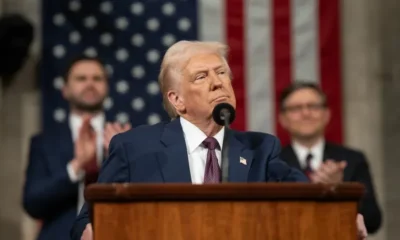
US President Donald Trump has moved to remove an additional 25 percent tariff imposed on Indian goods following a trade agreement between the two countries, according to an executive order signed on Friday.

The extra duty, which had been levied over India’s purchases of Russian oil, will be lifted at 12:01 am Eastern Time on Saturday. The order states that India has committed to stopping the direct or indirect import of oil from the Russian Federation.

The decision comes days after Trump announced a broader trade deal with India, saying Prime Minister Narendra Modi had assured Washington that New Delhi would halt Russian oil purchases amid the ongoing Ukraine war.

As part of the agreement, India has also committed to buying energy products from the United States. The executive order further noted that New Delhi has recently agreed to a framework aimed at expanding defence cooperation between the two countries over the next decade.

Tariff reduction still to be rolled out

While the additional 25 percent tariff is being removed immediately, the wider reduction in so-called reciprocal tariffs is yet to be implemented. Under the agreement, US duties on Indian products are expected to be reduced to 18 percent from the earlier level of 25 percent.

Other provisions of the deal include the removal of tariffs on certain aircraft and aircraft parts. A separate joint statement released by the White House said India intends to purchase goods worth $500 billion from the United States over the next five years. These purchases are expected to include energy products, aircraft and parts, precious metals, technology products and coking coal.

The move marks a sharp decline in US tariff levels on Indian goods, which had stood at as high as 50 percent late last year. The agreement also helps ease months of strain between the two countries over India’s oil imports, which Washington has argued help finance the conflict in Ukraine.

The deal signals a reset in ties between Trump and Prime Minister Modi, whom the US President has previously described as one of his closest friends.

Trade experts have noted that the proposed 18 percent tariff rate could offer Indian exporters a slight advantage in the US market compared to regional competitors facing duties of around 19 to 20 percent.

Continue Reading

India News

Centre reassures farmers as India-US trade deal nears completion

The Centre has assured farmers that the upcoming India-US trade deal will not harm agriculture or dairy, while creating new export opportunities for India.

Published

on

farmer

As India and the United States move closer to finalising a major bilateral trade agreement, the Centre has sought to reassure farmers that their interests remain fully protected. Senior ministers on Wednesday said the proposed pact does not compromise sensitive sectors such as agriculture and dairy, while opening new avenues for Indian exports.

Union Minister for Agriculture and Farmers’ Welfare Shivraj Singh Chouhan dismissed opposition allegations that the deal could adversely affect domestic farmers. Speaking to the media in New Delhi, he said the agreement poses no risk to staple food grains, millets, fruits or dairy products.

“Farmers’ interests are paramount and non-negotiable,” Chouhan said, asserting that the government has ensured no provision allows sudden or disruptive entry of foreign agricultural products into Indian markets. He added that safeguards for both small and large farmers remain firmly in place.

Chouhan underlined that key agricultural commodities continue to be protected and that existing measures shielding Indian farmers from unfair competition will remain unchanged. According to him, the agreement has been shaped under the leadership of Prime Minister Narendra Modi, with a clear focus on development and national interest.

Addressing concerns sparked by a recent social media post from a US official regarding greater access for American farm products, the Agriculture Minister said the matter had already been clarified in Parliament by Commerce Minister Piyush Goyal. He reiterated that India has not opened its markets in a way that would put pressure on domestic producers.

At the same time, the government highlighted potential gains for Indian exports. Reduced tariffs under the agreement are expected to benefit sectors such as rice, spices and textiles. Chouhan pointed out that India already exports rice to multiple countries, including the US, with shipments valued at around Rs 63,000 crore. Increased textile exports, he added, would directly support cotton-growing farmers and allied industries.

External Affairs Minister S Jaishankar also indicated that the trade agreement is now in its final stages. In a post on X following his visit to the United States, he described the negotiations as productive and said the deal would mark a new phase in bilateral relations. He noted progress in areas such as critical minerals, while signalling deeper engagement in defence, energy and strategic cooperation.

Officials view the agreement as part of a broader effort to strengthen India-US economic and strategic ties amid global uncertainty. While detailed provisions are yet to be made public, the Centre has reiterated that farmer welfare remains at the heart of the negotiations.

In an emotional appeal, Chouhan referred to farmers as the nation’s “Annadata” and said serving them was equivalent to worship. He assured that the government would continue to stand firmly with farmers as India charts a new course in its trade relationship with the United States.

Continue Reading

Trending

© Copyright 2022 APNLIVE.com