English हिन्दी
Connect with us

India News

Delhi-Mumbai Expressway: From Delhi to Jaipur in just 3.5 hours, know more about Delhi Mumbai Expressway here

Common public will be able ton use the new Delhi-Mumbai Expressway from February 15.

Published

on

Delhi-Mumbai Expressway: From Delhi to Jaipur in just 3.5 hours, know more about Delhi Mumbai Expressway here

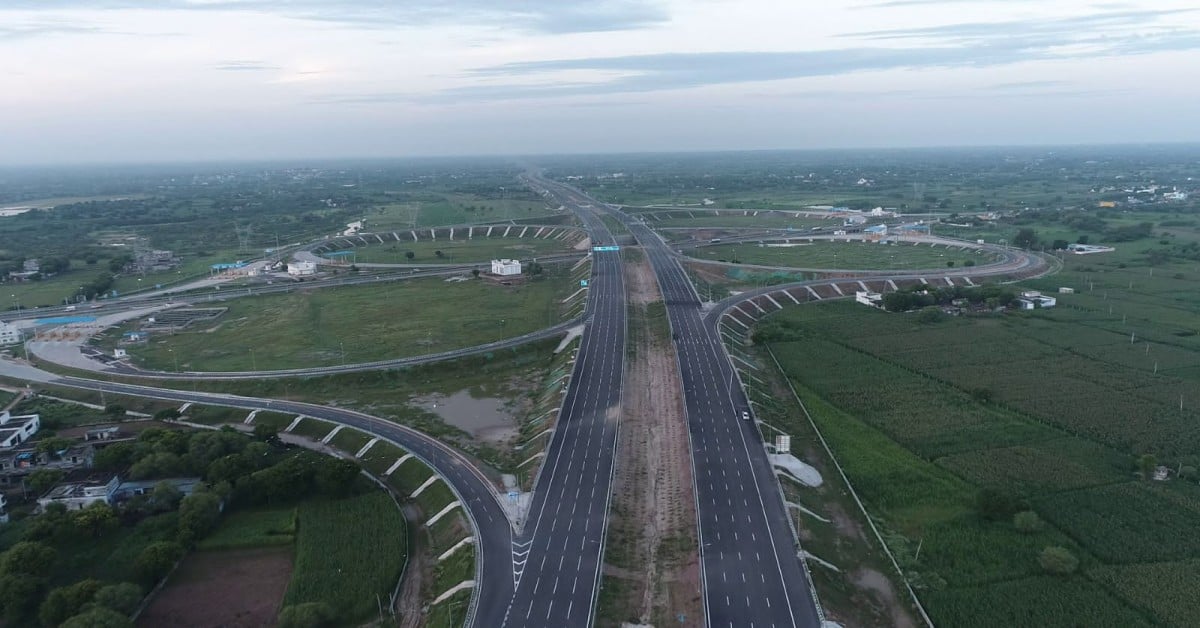
Prime Minister Narendra Modi on Sunday inaugurated the first section of the much-awaited Delhi-Mumbai Expressway. The first section of the 1,386-km expressway is 246 km long. This section between Delhi-Dausa-Lalsot will ease the journey from Delhi to Jaipur. After its construction, the five-hour journey from Delhi to Jaipur will be completed in just three and a half hours.

After the completion of this expressway, the travel time from Delhi to Mumbai will also be reduced from 24 hours to just 12 hours. Apart from this, the distance between the cities falling between the expressways will also become easier.

What is the cost of Delhi-Mumbai Expressway?

The foundation stone of the Delhi-Mumbai Expressway was laid on March 9, 2019. The 246-km Delhi-Dausa-Lalsot section of the Delhi-Mumbai Expressway has been built at a cost of over Rs 12,150 crore. With the commissioning of this section, the travel time from Delhi to Jaipur will come down from 5 hours to about 3.5 hours.

Apart from this, the government has also claimed to have given a big boost to the economic development of the entire region. Talking about the entire project, the 1,386 kilometer long expressway is being developed at a cost of Rs 98,000 crore.

What’s so special about this expressway?

The Delhi-Mumbai Expressway will be the longest expressway in India. It will enhance connectivity between the national capital, Delhi and Mumbai. The expressway will connect 93 PM Gati Shakti Terminal, 13 seaports, eight major airports and eight Multi-Modal Logistics Parks (MMLPs) as well as upcoming greenfield airports like Jewar Airport, Navi Mumbai Airport and Jawaharlal Nehru Port. Will also add

Apart from this, this expressway passing through six states of Delhi, Haryana, Rajasthan, Madhya Pradesh, Gujarat and Maharashtra, will pass through economic centers like Jaipur, Kishangarh, Ajmer, Kota, Chittorgarh, Udaipur, Bhopal, Ujjain, Indore, Ahmedabad, Vadodara, Surat.

The new expressway is expected to reduce the travel time between Delhi and Mumbai from about 24 hours to 12 hours and reduce the distance by 130 km. This will lead to annual fuel savings of over 32 crore liters and reduction in carbon dioxide (CO2) emissions by 85 crore kg, which is equivalent to planting 4 crore trees. The National Highways Authority of India (NHAI) also has plans to plant more than 40 lakh trees and shrubs along the highways.

This expressway is the first in Asia and the second in the world to have an animal bridge (underpass) to facilitate unhindered movement of wildlife. It will have 3 wildlife and 5 air bridges (overpasses) with a total length of 7 km. The expressway will also include two large 8-lane tunnels. Delhi-Mumbai Expressway passes through many diverse terrains like various forests, dry land, mountains, rivers. Rigid pavement design has been adopted for the Vadodara-Mumbai section with high rainfall.

The Delhi-Vadodara-Mumbai Expressway will not only facilitate travel, but fighter planes can also be landed on it in case of emergency. This road is being developed as a road runway. Between Alipur in Sohna to Mumbai, such parts are being developed at about 55 places where fighter planes can be landed easily. There are about 10 parts in the stretch of about 296 kilometers from Alipore to Dausa, where fighter planes can be landed easily.

When will this expressway be open for public?

The National Highways Authority of India (NHAI) has not been able to complete the preparations for toll collection, that’s why even after the inauguration on Sunday, the drivers will have to wait till February 15 to start their journey via Delhi-Mumbai Expressway. According to Mudit Garg, Project Director, NHAI, the preparations are underway for the launch.

India News

Lt Gen Dhiraj Seth appointed next Army chief, to take charge on June 30

The government has appointed Lt Gen Dhiraj Seth, currently the Vice Chief of Army Staff, as the next Army chief. He will succeed General Upendra Dwivedi on June 30.

Published

on

The Centre has appointed Lieutenant General Dhiraj Seth as the next Chief of the Army Staff (COAS), paving the way for a leadership transition in the Indian Army later this month. Lt Gen Seth, who currently serves as the Vice Chief of the Army Staff, will succeed General Upendra Dwivedi upon the latter’s retirement on June 30, 2026.

The appointment was announced on Saturday, with the government confirming that Lt Gen Seth will assume office from the afternoon of June 30. He will take over command after General Dwivedi completes his tenure as the Army’s 30th chief.

Veteran Armoured Corps officer

An officer of the Armoured Corps, Lt Gen Seth was commissioned into the Indian Army in December 1986 after graduating from the National Defence Academy. Over nearly four decades of service, he has held a range of operational, command, staff and strategic appointments across the Army.

Before becoming Vice Chief on April 1, 2026, he served in several senior leadership roles, including heading the Southern Command and South Western Command. He has also commanded formations such as the Delhi Area and the XXI Corps during his military career.

Leadership transition in the Army

Lt Gen Seth’s elevation comes as the Army prepares for a change of command at the highest level. His appointment follows his move to Army Headquarters as Vice Chief earlier this year, a role he assumed on April 1.

The Ministry of Defence said the incoming Army chief brings extensive experience from command, operational and strategic assignments across diverse military domains.

With the appointment, Lt Gen Seth is set to lead the Indian Army through the next phase of its modernisation and operational preparedness efforts after taking charge at the end of the month.

Continue Reading

India News

IAF AN-32 aircraft crashes while landing at Assam’s Jorhat airbase, five personnel killed

Five Indian Air Force personnel were killed after an AN-32 transport aircraft crashed while landing at Jorhat Air Force Station in Assam. The IAF has ordered a court of inquiry into the accident.

Published

on

An Indian Air Force (IAF) AN-32 transport aircraft crashed while attempting to land at Jorhat Air Force Station in Assam on Saturday, resulting in the deaths of five Air Force personnel. The accident occurred during a routine sortie and triggered an emergency response at the airbase.

According to the IAF, the aircraft met with the accident during the landing phase at Jorhat. The force later confirmed the loss of five personnel and expressed condolences to their families. A court of inquiry has been ordered to determine the circumstances that led to the crash.

Court of inquiry ordered

The Indian Air Force said a formal investigation will examine the cause of the accident. Officials have not yet disclosed what may have led to the crash, and the inquiry is expected to review technical, operational and environmental factors.

Reports indicated that the co-pilot survived the accident and is undergoing medical treatment.

Personnel who lost their lives

The IAF identified the five personnel killed in the accident as:

  • Squadron Leader Prashant Singh
  • Flight Lieutenant Shubham Kumar
  • Sergeant Jitendra Sharma
  • Agniveervayu Khemaram Kumawat
  • Agniveervayu Danish Alam

The Air Force said it stands with the bereaved families during this difficult time.

AN-32’s role in the Air Force

The AN-32 is a twin-engine transport aircraft that has been a key part of the Indian Air Force’s logistics operations for decades. It is widely used to transport personnel, equipment and supplies, particularly in remote and high-altitude regions. India remains one of the largest operators of the aircraft type.

The crash comes months after a Sukhoi Su-30MKI fighter aircraft accident in Assam that claimed the lives of two IAF pilots.

Continue Reading

India News

Delhi records coolest day of June so far as rain and thunderstorms bring relief from heat

Delhi recorded its coolest day of June after rain and thunderstorms caused a sharp drop in temperatures. IMD has forecast more showers and gusty winds before temperatures begin rising again.

Published

on

Delhi weather today

Delhi witnessed its coolest day of June so far after widespread rain and thunderstorm activity caused temperatures to drop significantly across the national capital. The change in weather provided much-needed relief from the intense summer heat that had gripped the region in recent weeks.

According to the India Meteorological Department (IMD), rain and thunderstorms over the past 24 hours brought a noticeable decline in both maximum and minimum temperatures. Official weather observations showed that Delhi’s maximum temperatures fell well below normal levels, while several areas experienced strong winds and rainfall.

More rain and thunderstorms likely

The IMD has forecast additional thunderstorms, light to moderate rain and gusty winds for Delhi and nearby areas through Saturday. A yellow alert remains in place, with weather conditions expected to stay unsettled before gradually improving.

Weather experts have attributed the recent change to the influence of a western disturbance and associated weather systems affecting northwestern India. While the disturbance is gradually moving away, its impact is expected to continue for a short period.

Temperatures may rise again next week

Meteorologists expect the pleasant conditions to last for another couple of days. After that, temperatures are likely to begin rising again as rainfall activity decreases. The IMD’s latest forecast also indicates a gradual increase in temperatures by the middle of next week.

Recent weather systems have brought relief not only to Delhi but also to parts of Uttar Pradesh, Rajasthan and other northern states, where thunderstorms and rain have helped ease heatwave conditions.

Continue Reading

Trending

© Copyright 2022 APNLIVE.com