English हिन्दी
Connect with us

India News

Ex-Chhattisgarh CM’s son Amit Jogi arrested for false details in poll affidavit

Published

on

Amit Jogi

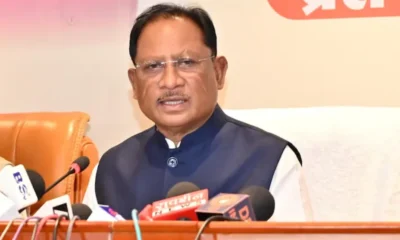
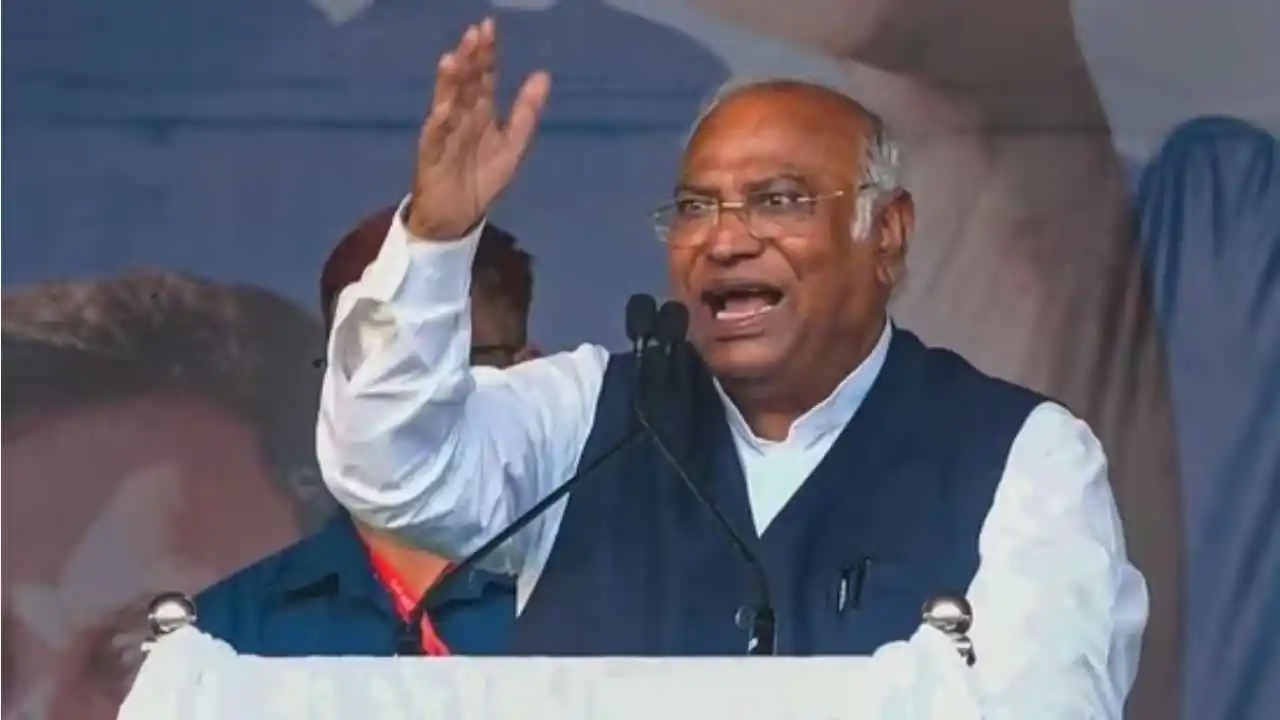
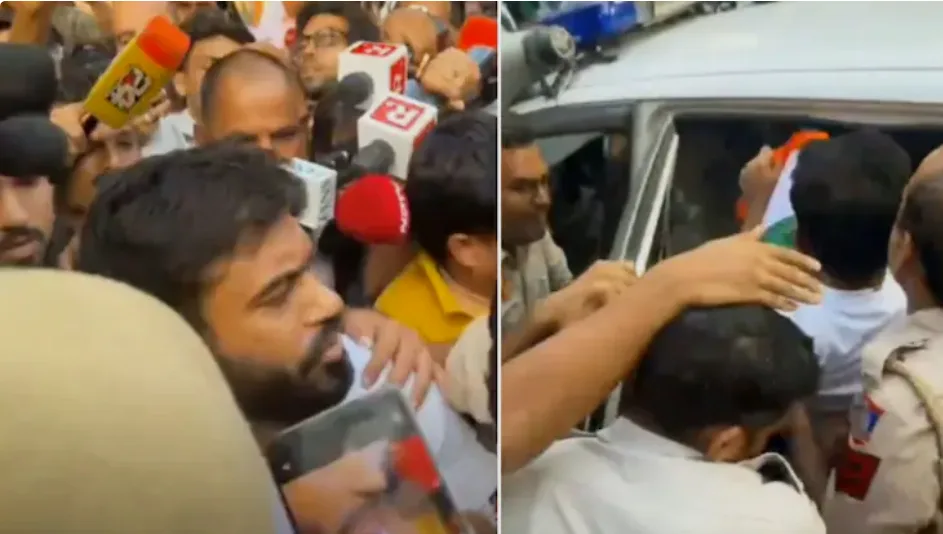
Chhattisgarh police arrested Amit Jogi, son of former state chief minister Ajit Jogi, today (Tuesday, Sep 3) for cheating and furnishing false details in his affidavit in the 2013 assembly election.

He was to be produced before a local court today, said reports.

“We have arrested Amit Jogi in a case which was lodged against him in February under Sections 420, 467, 468 and 471 with Gaurela police station of Bilaspur by Sameera Paikra, BJP candidate against him in 2013,” SP Bilaspur, Prashant Agarwal, told Hindustan Times.

The SP said that Paikra had alleged that Amit submitted false information regarding his birth certificate while filing nomination during 2013 state polls. “The case was investigated by Bilaspur police and on Tuesday morning he was arrested,” said the SP.

Amit won 2013 assembly elections from Marwahi, a ST seat, which comes under Bilaspur district.Amit had defeated Paikra by a margin of nearly 50,000 votes.

In 2014, after losing the election, Sameera Paikra filed a writ petition with Bilaspur high court challenging Amit Jogi’s caste and place of birth.According to Paikra, he mentioned his place of birth as Sarbahara village in Gaurela area of Bilaspur whereas, she claimed, he was born in the US

The HC dismissed the petition in January this year on the ground that Chhattisgarh assembly session had already ended.

Also Read: PM Modi to receive an award for ‘Swachh Bharat Abhiyan’

Meanwhile, Ajit Jogi, Janta Congress Chhattisgarh party (JCC) supremo and former CM, speaking to mediapersons said that jungle-raj is going on in Chhattisgarh.

“This is vendetta politics and they are framing my son and me in false cases. Not a single case will stand in the court of law,” Jogi said.

On Friday, Bilaspur police registered a case against Ajit Jogi after his claim to tribal status was rejected by a government-appointed committee.The committee led by Secretary to the Government of Chhattisgarh DD Singh, had submitted a report which said that Jogi had not been able to prove himself to be a member of the Kanwar tribe. They had also recommended the cancellation of his tribal certificates.

Subsequently, Ajit Jogiwas booked for allegedly fraudulently obtaining caste certificates, the police said.

The case was registered under section 10-1 of Chhattisgarh Scheduled Castes, Scheduled Tribes and Backward Classes (Regulation of Certification of Social Status) Rules, 2013 with Civil Lines police station on Thursday night. The offense involving senior Jogi is non-bailable and carries a punishment of two years.

The Jogis had alleged that the case was registered at the behest of a “vindictive chief minister”, and that none of these charges will stick in the court.

Jogi’s claim of being a tribal was rejected multiple times in the past too.

India News

15 Maoists killed in Jharkhand encounter, top leader with Rs 1 crore bounty among dead

Fifteen Maoists, including a top leader carrying a Rs 1 crore bounty, were killed in a gunfight with security forces in Jharkhand’s Saranda forest during an ongoing anti-Maoist operation.

Published

on

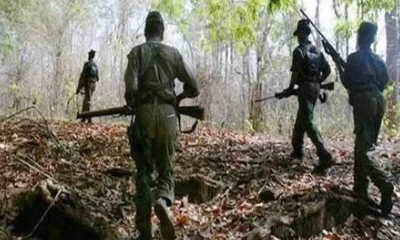
Fifteen Maoists, including a senior leader carrying a reward of Rs 1 crore, were killed in an encounter with security forces in Jharkhand’s West Singhbhum district on Thursday, according to police officials.

The exchange of fire took place in the Kumdi area of the Saranda forest under the Kiriburu police station limits, where a large-scale anti-Maoist operation has been underway for several days. Around 1,500 personnel of the Central Reserve Police Force’s CoBRA unit are involved in the operation.

Police said the bodies of 15 Maoists have been recovered so far, including that of Patiram Majhi, also known as Anal Da, who was considered one of the most wanted Maoist leaders in the region. A substantial quantity of arms and ammunition was also seized from the encounter site.

The gunfight began around 6 am on Thursday and was still continuing at the time of the latest official update. While the broader operation in Saranda forest started earlier this week, officials said the exchange of fire broke out after security forces acted on specific intelligence inputs.

Inspector General of Police (Operations) Michael Raj S said the operation was launched following a tip-off regarding the presence of Anal Da along with his armed squad in the forest area. A resident of Pirtand in Giridih district, Anal Da had been active in Maoist activities since 1987 and had been evading arrest for decades.

The CRPF Director General visited Chaibasa, the district headquarters of West Singhbhum, earlier this week to review the security situation amid intensified operations in the region.

Officials said Kolhan and Saranda remain among the last Maoist strongholds in Jharkhand, with security forces having significantly reduced insurgent activity in areas such as Buda Pahad, Chatra, Latehar, Gumla, Lohardaga, Ranchi and Parasnath.

Reacting to the development, the leader of the opposition in the Jharkhand Assembly described the encounter as a major success against Maoist violence and praised the personnel involved in the operation. He reiterated the Centre’s stated resolve to eliminate Maoism from the country by March 2026.

Union Home Minister Amit Shah has repeatedly stated that the government aims to eradicate Maoist violence nationwide by March 31, 2026.

According to official data, more than 11,000 Maoists have been arrested in Jharkhand between 2001 and 2025, while around 250 have been killed and over 350 have surrendered. During this period, security forces have also recovered a large cache of weapons and ammunition.

Continue Reading

India News

BJP calls Congress anti-Hindu after Rahul Gandhi questions G-RAM-G scheme

The BJP has accused the Congress of being anti-Hindu after Rahul Gandhi said he was unfamiliar with the new G-RAM-G employment guarantee scheme that replaces MNREGA.

Published

on

Rahul-Gandhi

The Bharatiya Janata Party on Wednesday accused the Congress of being “anti-Hindu” after senior leader Rahul Gandhi said he was unfamiliar with the name of the newly introduced G-RAM-G employment guarantee scheme, which has replaced the Mahatma Gandhi National Rural Employment Guarantee Act.

Speaking at a conference held at Delhi’s Jawahar Bhavan, Rahul Gandhi remarked, “I don’t know what G-RAM-G is,” while addressing an event focused on MNREGA, the flagship rural employment programme launched during the Congress-led government. Congress president Mallikarjun Kharge made similar comments at the event.

BJP response and political backlash

The BJP reacted sharply, alleging that Rahul Gandhi’s remarks reflected hostility towards Lord Ram. Party leaders claimed the comments had “exposed the Congress’ anti-Hindu mindset,” a charge that intensified the political confrontation over the new legislation.

Several opposition leaders have argued that one of the core concerns with the G-RAM-G scheme is the replacement of Mahatma Gandhi’s name with that of a religious figure, a move they say politicises a welfare programme that was previously secular in identity.

Congress alleges attempt to weaken employment guarantee

At the conference, Rahul Gandhi said MNREGA had given poor households a legal right to employment, which he claimed Prime Minister Narendra Modi was attempting to dismantle. He also referred to the now-repealed farm laws of 2020, saying sustained public pressure had earlier forced the government to withdraw them.

“If we stand together, the government will be forced to back down and MNREGA will be restarted,” Gandhi said, asserting that the employment guarantee programme could be revived through collective resistance.

Mallikarjun Kharge accused the BJP of trying to erase Mahatma Gandhi’s legacy from public memory and said the Congress would raise the issue again during the upcoming Budget session of Parliament.

States move to support MNREGA

As the political debate continues, at least two opposition-ruled states have taken steps to support MNREGA. Karnataka and Tamil Nadu have both indicated plans to pass Assembly resolutions backing the older scheme.

In Karnataka, proceedings were disrupted after Governor Thawar Chand Gehlot declined to read out portions of a government-prepared speech that criticised the G-RAM-G framework. In Tamil Nadu, Chief Minister MK Stalin said his government would also move a resolution in support of MNREGA.

What the G-RAM-G scheme changes

The new G-RAM-G law introduces several structural changes compared to MNREGA. The guaranteed number of workdays has been increased to 125 from 100, but employment is limited to areas officially notified as rural by the central government.

Under the revised funding structure, states are now required to bear 40 per cent of the scheme’s costs, while the Centre will contribute the remaining amount. Hill states and northeastern states will pay only 10 per cent, and Union Territories will continue to receive full central funding.

The Centre will also adopt a “normative” allocation model, deciding annual fund limits for states based on defined parameters, rather than demand. This gives the Centre greater control over fund releases and the authority to suspend allocations in cases of serious irregularities.

While the government has said the changes will encourage states to take financial ownership without imposing excessive burdens, the opposition has described the scheme as “anti-poor,” warning that it could reduce employment opportunities by straining state finances.

Continue Reading

India News

Congress seeks action against Udupi DC over saffron flag row

The Congress has sought action against Udupi deputy commissioner T K Swaroopa over allegations that she waved a saffron flag during the Paryaya procession, a charge she has denied, saying her participation was part of official duty.

Published

on

Paryaya' system in Udupi

The Congress has sought action against Udupi deputy commissioner T K Swaroopa over allegations that she waved a saffron flag during the Paryaya procession held on January 18, triggering a political controversy in coastal Karnataka.

The issue surfaced after the Legal and Human Rights Cell of the Udupi District Congress Committee wrote to Chief Minister Siddaramaiah, demanding an inquiry into Swaroopa’s conduct during the religious procession linked to the Udupi Sri Krishna Math.

DC denies political motivation

Responding to the allegations, Swaroopa said she attended the event strictly in her official capacity and denied any politically motivated participation.

In a statement issued on Wednesday, she said that at around 3 am on January 18, she flagged off the Puraprevesh programme of the Swamiji as part of the biennial Paryayotsava celebrations. She added that she did so in her role as the administrator of the Udupi City Council.

Swaroopa also said she attended the civic honour programme for the new paryaya swamiji and the durbar event held after the swamiji ascended the Sarvajna Peetha, reiterating that her presence was aligned with administrative responsibilities.

Congress seeks inquiry, alleges rule violation

In the letter addressed to the chief minister on Monday, Udupi District Congress Committee Legal and Human Rights Cell president Harish Shetty alleged that ahead of the procession from Jodu Katte to Krishna Math, a BJP MLA handed over a saffron flag to the deputy commissioner, which she allegedly raised and waved in public.

The letter claimed that such an act violated service rules governing civil servants and went against the constitutional principle of secularism. The Congress has demanded a formal inquiry and appropriate action in accordance with law.

About the Paryaya system

The Paryaya or Paryayotsava marks the ceremonial transfer of ritual and administrative control of the Udupi Sri Krishna Temple. On January 18, Shiroor Matha assumed charge for the 2026–28 term, with Sri Vedavardhana Tirtha Swamiji taking over as the pontiff-administrator.

Under the centuries-old Paryaya system, the temple is managed on a rotational basis by the Ashta Mathas—Pejavara, Puttige, Adamaru, Krishnapura, Shiroor, Sodhe, Kaniyoor and Palimaru—each for a period of two years. The system was instituted by 13th-century philosopher-saint Sri Madhwacharya, the founder of the Dvaita school of philosophy.

Continue Reading

Trending

© Copyright 2022 APNLIVE.com