English हिन्दी
Connect with us

India News

Five states get new Governors, Admiral (retd) DK Joshi made Lt Governor of Andaman and Nicobar Islands

Published

on

Five states got new governers

[vc_row][vc_column][vc_column_text]Madhya Pradesh and Telangana remain under additional charge of Gujarat and Andhra Pradesh governors respectively

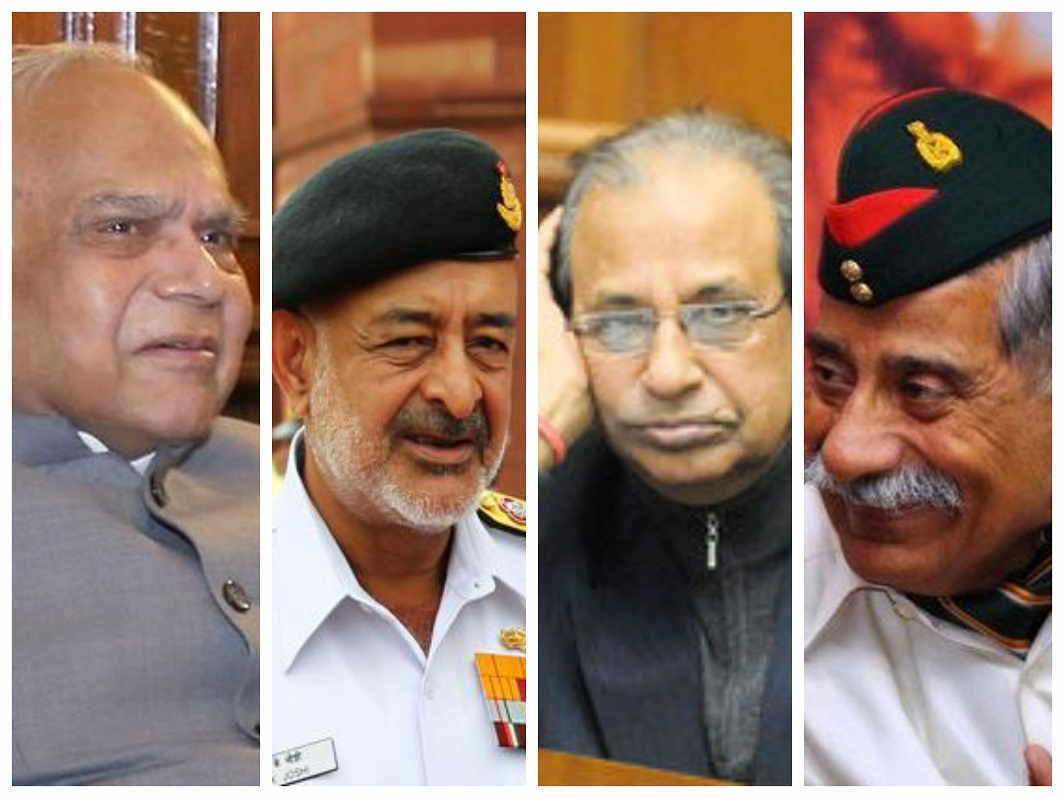
President Ram Nath Kovind, on Saturday, appointed governors for five states and lieutenant governor for Andaman and Nicobar Islands. The appointments were necessitated as most of these states did not have full-time Governors and the charge was being shared by individuals holding the office in other states.

Banwari Lal Purohit, who was serving as Governor of Assam, has now been appointed as the governor of Tamil Nadu, reliving his Maharashtra counterpart of additional charge of the southern state that he had been holding since August 2016.

Prof. Jagdish Mukhi, who is currently serving as the Lt. Governor of the Andaman and Nicobar Islands will replace Purohit in the Raj Bhawan of Assam. Decorated Naval officer, Admiral Devendra Kumar Joshi who retired Chief of the Naval Staff in 2014 will take over from Mukhi as the new Lieutenant Governor of the Andaman and Nicobar Islands.

Other new gubernatorial appointments include those of BJP leaders Satya Pal Malik who gets charge of the Raj Bhawan in Bihar and former Bihar legislative council member Ganga Prasad who has been appointed as Governor of Meghalaya, Brigadier (retd) BD Mishra will be the new Governor of Arunachal Pradesh.

Madhya Pradesh and Telangana remain under additional charge of the Gujarat and Andhra Pradesh governors respectively and the vacancies are likely to be filled soon.

Banwarilal Purohit

A three-time former Lok Sabha MP from Nagpur (twice as a Congress candidate and once on a BJP ticket), Purohit has also served a minister in the Maharashtra government from 1982 to 1984. He is credited with revival of the English daily ‘The Hitavada’, a newspaper founded by freedom fighter Gopal Krishna Gokhale, which under Purohit’s stewardship in recent years saw new editions being started from Bhopal and Jabalpur in Madhya Pradesh.

Ganga Prasad

Prasad was a key face of the BJP in Bihar, having been a member of the state’s Legislative Council for 18 years after being first elected as an MLC in 1994. Prasad also served as the leader of opposition in the legislative council during the RJD regime of Lalu Prasad Yadav and as leader of the council during the Nitish Kumar-BJP led coalition government.

Admiral (retd) Devendra Kumar Joshi

Admiral DK Joshi was Chief of Naval Staff from August 31, 2012 to February 26, 2014. As Lt Governor of the Andaman and Nicobar Islands, Joshi returns to the union territory for a second stint, having served earlier as the Commader-in-chief of the Andaman and Nicobar Island Command. A highly decorated Naval officer, Joshi is the recipient of Param Vishisht Seva Medal (PVSM), Ati Vishisht Seva Medal (AVSM) and several other honours. He has also previously served as Defence Adviser in the Indian High Commission in Singapore from 1996 to 1999 when former Prime Minister Atal Bihari Vajpayee led the NDA regime in New Delhi.

Jagdish Mukhi

Formerly a BJP strongman in Delhi, Mukhi had joined active politics during the Emergency and worked. He was a member of the BJP’s previous avatar – the Jana Sangh – and had worked closely with leaders like Atal Bihari Vajpayee, LK Advani and VK Malhotra in strengthening the BJP in Delhi. Mukhi represented the Janak Puri constituency in the Delhi assembly for a record seven terms between 1980 and 2015. Mukhi faced his lone electoral defeat since becoming an MLA, in 2015 when he lost to Aam Aadmi Party’s candidate Rajesh Rishi in the state polls in which AAP won a record 67 of Delhi’s 70 seats. Mukhi had served as leader of opposition in the Delhi assembly and the state finance minister under BJP chief ministers Madan Lal Khurana, Sahib Singh Verma and Sushma Swaraj but was never considered by his party to lead as its chief ministerial candidate in Delhi despite his personal winning streak as an MLA.

Brigadier (retd)) BD Mishra

Brigadier Mishra began his stint in the Indian Army as an infantry officer in 1961 and retired from the force as a brigadier in 1995. During his 34-year-long career in the forces, he served in several wars and major operations. He had earned then Prime Minister PV Narsimha Rao’s appreciation for his role in the counter-hijack Operation Ashwamedh conducted on April 24 and 25, 1993 that saw 141 hostages aboard and Indian Airlines Boeing 737 aircraft being rescued by NSG Commandos at the Amritsar airport. The lone hijacker, an alleged Hizbul Mujahideen operative identified as Yunus Shah, had been injured in the operation and succumbed to his bullet wounds while being taken to a hospital.

Satya Pal Malik

A former Member of Parliament from the BJP, the 71-year-old Malik has also served as Union Minister of State for Parliamentary Affairs and Tourism. He was a member of the Rajya Sabha for two terms – from 1980 to 1984 and from 1986 to 1989 – and a Lok Sabha MP for a little over a year, between 1989 and 1990.[/vc_column_text][/vc_column][/vc_row]

India News

Amit Shah counters delimitation concerns, says southern states to gain Lok Sabha seats

Amit Shah assures Parliament that southern states will gain Lok Sabha seats after delimitation, countering opposition criticism during the women’s reservation debate.

Published

on

Amit Shah

Union Home Minister Amit Shah on Thursday addressed concerns over the proposed delimitation exercise, asserting in the Lok Sabha that southern states will not lose representation but instead see an increase in their number of seats.

His remarks came during a heated debate linked to the implementation of women’s reservation, where opposition parties have raised fears that population-based delimitation could reduce the political weight of southern states.

Shah rejected these claims, calling them misleading, and said the proposed framework ensures fairness while expanding the overall strength of the Lok Sabha.

Seat count to rise with expansion of Lok Sabha

The government has indicated that the total number of Lok Sabha seats could increase significantly as part of the delimitation process. In this expanded House, the combined representation of southern states is expected to rise from 129 seats at present to around 195 seats.

Shah emphasised that no state will lose seats in absolute terms, and the exercise is designed to reflect population changes while maintaining balance across regions.

State-wise projections shared in Parliament

During his address, Shah also provided indicative figures for individual southern states, suggesting notable increases in representation. According to the projections:

  • Tamil Nadu could see its seats rise substantially
  • Kerala, Telangana, and Andhra Pradesh are also expected to gain additional seats
  • Karnataka’s representation may increase as well

These figures were presented to counter the argument that delimitation would disproportionately favour northern states.

Political debate intensifies over linkage with women’s quota

The delimitation exercise has been closely linked to the rollout of women’s reservation, which proposes one-third seats for women in Parliament and state assemblies.

Opposition leaders have questioned this linkage, arguing that tying reservation to delimitation could delay its implementation and raise federal concerns. Some leaders have also warned that the move could impact national unity if apprehensions among states are not addressed.

The government, however, maintains that the reforms are necessary to ensure equitable representation and to align the electoral system with demographic realities.

Centre dismisses ‘false narrative’ on southern states

Shah reiterated that concerns about southern states losing influence are unfounded. He said the delimitation process will increase representation across regions and described the criticism as a “false narrative” aimed at creating confusion.

The issue is expected to remain a key flashpoint as Parliament continues discussions on the women’s reservation framework and related legislative changes.

Continue Reading

India News

PM Modi assures no discrimination in women’s quota, delimitation debate intensifies in Parliament

PM Narendra Modi has assured that women’s reservation will be implemented without discrimination, amid a heated debate over delimitation in Parliament.

Published

on

PM modi

Prime Minister Narendra Modi has assured that there will be no discrimination in the implementation of women’s reservation, as Parliament witnessed a sharp debate over the proposed linkage between the quota and delimitation exercise.

During the ongoing special session, the government reiterated its commitment to ensuring fair representation while addressing concerns raised by opposition parties regarding the timing and structure of the legislation.

The proposed framework aims to reserve 33 percent of seats for women in the Lok Sabha and state assemblies. However, its implementation is tied to a fresh delimitation exercise, which is expected after the next census.

Opposition questions timing and intent

Opposition leaders have raised concerns that linking the women’s quota to delimitation could delay its implementation. They argue that the process of redrawing constituencies may push the actual rollout further into the future.

The issue has triggered a broader political confrontation, with multiple parties questioning whether the move could alter representation across states.

Some critics have also alleged that the delimitation exercise could disproportionately benefit certain regions based on population, a charge the government has rejected.

Government reiterates commitment to fair implementation

Responding to these concerns, the Centre has maintained that the reforms are necessary to ensure accurate and updated representation based on population data.

Leaders from the ruling side have repeatedly emphasized that the process will be carried out transparently and without bias. The assurance that there will be “no discrimination” is aimed at addressing fears among states and opposition parties.

The debate marks a key moment in Parliament, with both sides engaging in intense exchanges over one of the most significant electoral reforms in recent years.

Continue Reading

India News

Give all tickets to Muslim women, Amit Shah says, attacking Akhilesh Yadav on sub-quota demand

A sharp exchange between Amit Shah and Akhilesh Yadav in Parliament over sub-quota for Muslim women highlights key divisions on women’s reservation implementation.

Published

on

A heated exchange broke out in Parliament during discussions on the women’s reservation framework, with Union Home Minister Amit Shah and Samajwadi Party chief Akhilesh Yadav locking horns over the demand for a sub-quota for Muslim women.

The debate unfolded as the government pushed forward key legislative measures to implement 33% reservation for women in the Lok Sabha and state assemblies.

Akhilesh Yadav argued that the proposed reservation must ensure representation for women from marginalised communities, including Other Backward Classes (OBCs) and Muslim women. He said that without such provisions, large sections could remain excluded from political participation.

He also questioned the timing of the bill, alleging that the Centre was avoiding a caste census. According to him, a census would lead to renewed demands for caste-based reservations, which the government is reluctant to address.

Government rejects religion-based quota

Responding to the demand, Amit Shah made it clear that reservation based on religion is not permitted under the Constitution.

He stated that any proposal to provide quota to Muslims on religious grounds would be unconstitutional, firmly rejecting the idea of a separate sub-quota for Muslim women within the broader reservation framework.

The government has maintained that the existing framework already includes provisions for Scheduled Castes (SC) and Scheduled Tribes (ST) women within the overall reservation structure.

Wider political divide over implementation

The issue of sub-categorisation within the women’s quota has emerged as a major flashpoint, even as most opposition parties broadly support the idea of women’s reservation.

Samajwadi Party leaders reiterated that their support for the bill depends on inclusion of OBC and minority women, while the government continues to defend its constitutional position.

The debate is part of a broader discussion during the special Parliament session, where multiple bills linked to delimitation and implementation of the women’s quota are being taken up.

Continue Reading

Trending

© Copyright 2022 APNLIVE.com