English हिन्दी
Connect with us

India News

Hindu houses torched in Bangladesh amid fresh attacks on minorities

Several houses of a Hindu family were reduced to ashes in Bangladesh’s Pirojpur district as police arrested five suspects and launched a probe into the suspected targeted attack.

Published

on

hindu houses set on fire in bangladesh

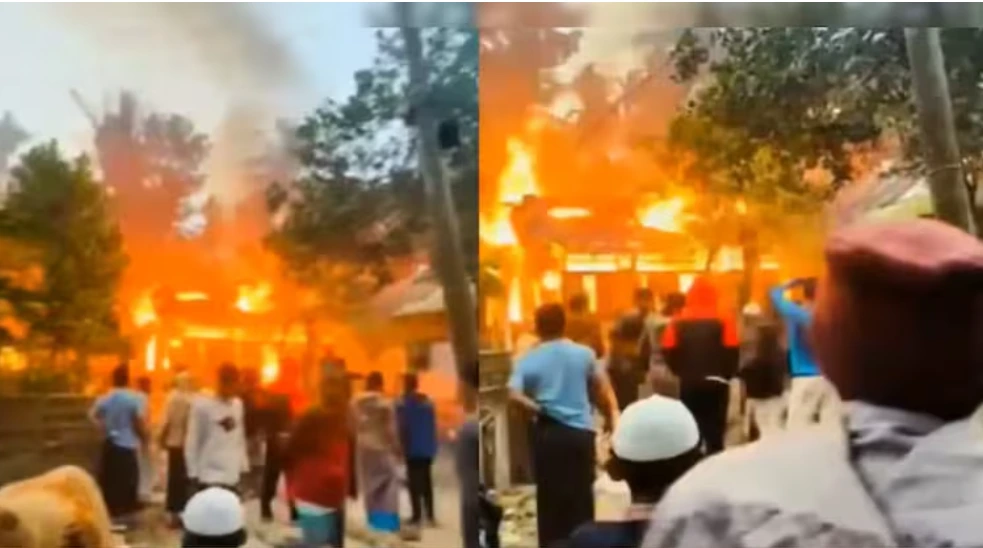
At least five houses belonging to a Hindu family were set on fire in Dumritala village of Bangladesh’s Pirojpur district, triggering fresh concerns over the safety of religious minorities in the country. The incident took place on December 28 in the Muslim-majority nation, where authorities suspect the attack may have been targeted.

Local officials said the exact cause of the fire is still under investigation. According to reports, attackers allegedly stuffed cloth into one of the rooms and set it ablaze, after which the flames spread rapidly to neighbouring houses.

Family members told police they were initially trapped inside their homes as the doors had been locked from outside when the fire broke out in the early hours. All eight members of the two affected families managed to escape by cutting through tin sheets and bamboo fencing. However, their houses and belongings were completely reduced to ashes. Several pets also died in the fire.

The village is located around 240 kilometres from the capital Dhaka.

Arrests made, probe underway

Police confirmed that five suspects have been arrested in connection with the incident, while efforts are ongoing to trace others involved. Mohammad Manzur Ahmed Siddiqui, Superintendent of Police of Pirojpur, visited the site and assured the affected families that the matter would be investigated promptly.

A video of the fire incident has circulated widely on social media, showing local residents attempting to douse the flames as they engulfed multiple houses.

The affected Saha family, currently staying in Dhaka, told media over the phone that they remain fearful and are unsure how the fire started. They declined to go on record, stating only that police are examining the cause.

Rising pattern of blasphemy-related violence

The incident comes amid a reported rise in violence linked to blasphemy allegations against Hindu minorities in Bangladesh. A report by the Human Rights Congress for Bangladesh Minorities (HRCBM) documented at least 71 such incidents between June and December this year.

According to the report, cases were recorded across more than 30 districts, including Chandpur, Chattogram, Dinajpur, Lalmonirhat, Sunamganj, Khulna, Comilla, Gazipur, Tangail and Sylhet. The rights group said the similarity and spread of these incidents indicate systemic vulnerability of minorities rather than isolated events.

The report noted that blasphemy allegations in Bangladesh often lead to police action, mob violence and forms of punishment outside legal processes.

Earlier this month, garment worker Dipu Chandra Das was lynched by a mob in Mymensingh district on December 18 over alleged blasphemy, with his body later set on fire. Around 12 people have been arrested in that case so far.

Another Hindu man, Amrit Mondal, also known as Samrat, was killed by a mob in Rajbari town on December 24. The Bangladesh government later said Mondal was facing multiple criminal charges, including murder and extortion, and maintained that the incident was not communal in nature.

Concerns amid political uncertainty

Bangladesh has been witnessing political uncertainty following the ouster of former Prime Minister Sheikh Hasina. During this period, there have been reports of growing religious conservatism and sporadic violence against minorities.

Several anti-India statements have emerged from political platforms in the country, including remarks related to India’s northeast, which were triggered by comments made by Muhammad Yunus. Rights groups have warned that radical elements may be using the prevailing sentiment to justify attacks on minorities.

With the country heading towards elections under the interim administration, recent incidents have raised concerns among rights organisations and minority communities about their safety.

Continue Reading
Click to comment

Leave a Reply

Your email address will not be published. Required fields are marked *

India News

Ajit Pawar and Sharad Pawar factions reunite for Pimpri-Chinchwad civic polls

Ajit Pawar and Sharad Pawar-led NCP factions have reunited for the Pimpri-Chinchwad municipal elections after a two-year split.

Published

on

Sharad Pawar and Ajit pawar

More than two years after a high-profile political split, the Ajit Pawar-led and Sharad Pawar-led factions of the Nationalist Congress Party (NCP) have decided to come together for the Pimpri-Chinchwad Municipal Corporation elections.

Addressing an election rally, Maharashtra Deputy Chief Minister Ajit Pawar said the two factions had united specifically for the civic polls. Referring to their election symbols, he stated that the ‘clock’ and the ‘tutari’ had come together, signalling a reunion of the Pawar family for the local body elections.

The ‘clock’ symbol is used by Ajit Pawar’s faction, which has been recognised by the Election Commission as the original NCP, while Sharad Pawar’s group contests elections under the ‘tutari’ or curved trumpet symbol.

How the NCP split unfolded

The NCP was founded by Sharad Pawar in 1999 and remained a major force in Maharashtra politics for over two decades. Ajit Pawar, his nephew, emerged as one of the party’s most influential leaders and served multiple terms as Deputy Chief Minister.

The party split in 2023 when Ajit Pawar, along with several senior leaders, broke away to join the BJP-Shiv Sena-led ruling coalition in Maharashtra. At the time, Ajit Pawar questioned Sharad Pawar’s continuation as party chief, citing the need for generational change within leadership.

Following the split, Ajit Pawar was sworn in as Deputy Chief Minister, aligning his faction with the ruling alliance, while Sharad Pawar’s faction chose to remain in the opposition.

Reasons cited for the breakaway

Explaining his decision during an NCP conclave in Nagpur, Ajit Pawar said he had separated from the undivided party to ensure political stability and development in the state, even if it strained personal and family relationships. He maintained that his move was not driven by power or position.

Ajit Pawar also publicly criticised Sharad Pawar’s age at the time, questioning when leadership responsibilities would be passed on. In response, Sharad Pawar asserted that age did not diminish his effectiveness and said he remained active regardless of whether he was in his eighties or nineties.

Two factions, two paths

After the split, the Election Commission recognised Ajit Pawar’s faction as the official NCP, allowing it to retain the ‘clock’ symbol. Sharad Pawar’s faction continued independently as NCP (SP), adopting the ‘tutari’ symbol.

Both groups contested subsequent elections separately. After the 2024 Lok Sabha elections, Ajit Pawar acknowledged that distancing himself from family members had been a mistake, setting the stage for the current reconciliation ahead of the Pimpri-Chinchwad civic polls.

Continue Reading

India News

Supreme Court pauses revised Aravalli definition, orders fresh expert review

The Supreme Court has paused its earlier order on the Aravalli range definition and set up a new expert committee to review concerns over mining and ecological impact.

Published

on

Supreme Court

The Supreme Court on Monday put on hold its own earlier order that had accepted a revised definition of the Aravalli mountain range near Delhi, and decided to seek a fresh assessment from an independent panel of experts. The move comes amid concerns raised by environmental activists and scientists that the new definition could weaken protections and allow illegal or unregulated mining in ecologically sensitive areas.

A vacation bench led by Chief Justice Surya Kant said the court considered it necessary to keep both the recommendations of the earlier committee and the court’s previous directions in abeyance until further examination. The bench underlined that an impartial and independent expert opinion was essential before any implementation of the revised definition.

The court ordered the constitution of a new high-powered committee to examine issues linked to the updated definition of the Aravalli range. This panel will assess whether the revised description has expanded non-Aravalli areas in a manner that could facilitate continued unregulated mining and whether such exclusions risk ecological degradation.

Notices have been issued to the Union government and the four concerned states — Rajasthan, Gujarat, Delhi, and Haryana. The matter will be taken up again on January 21.

The issue gained momentum after protests erupted over the Centre’s notification of the new definition, with critics alleging that it was framed without adequate scientific assessment or public consultation. On Saturday, the Supreme Court had taken suo motu cognisance of the controversy surrounding the change.

During the hearing, the Centre pointed out that the court had earlier accepted a comprehensive plan for sustainable mining, prepared in compliance with a November direction that barred new mining activity without such a framework. However, the Chief Justice observed that parts of the committee report and the court’s observations appeared to be misconstrued, making clarifications necessary before any step forward.

The bench said the new committee would carry out a detailed identification of territories proposed to be excluded from the Aravalli area and evaluate whether this could compromise the ecological integrity of the range.

On Christmas Day, the Centre had announced a complete ban on granting new mining leases in the Aravallis. For mines already in operation, state governments have been directed to ensure strict adherence to environmental safeguards in line with Supreme Court orders.

Stretching about 670 kilometres from near Delhi through Haryana, Rajasthan and Gujarat, the Aravalli range is considered India’s oldest fold-mountain system, with origins dating back nearly two billion years.

Continue Reading

India News

Supreme Court stays bail of ex-MLA Kuldeep Sengar in Unnao rape case, orders him to remain in jail

The Supreme Court has stayed the bail granted to former MLA Kuldeep Sengar in the Unnao rape case, keeping him in jail while hearing a challenge filed by the investigating agency.

Published

on

former BJP MLA Kuldeep Singh Sengar

The Supreme Court on Monday stayed the Delhi High Court’s order that had suspended the life sentence of former BJP MLA Kuldeep Sengar in the 2017 Unnao rape case. With this decision, Sengar will continue to remain in jail.

The apex court passed the order while hearing a plea filed by the Central Bureau of Investigation, which is the investigating and prosecuting agency in the case. The agency had challenged the High Court’s decision to suspend Sengar’s sentence and grant him conditional bail.

Bail order put on hold after CBI challenge

Earlier, the Delhi High Court had suspended Sengar’s life term awarded for the rape of a woman who was a minor at the time of the crime. Although bail was granted, Sengar was not expected to be released immediately as he is also serving a separate sentence in connection with the custodial death of the survivor’s father.

While staying the High Court order, the Supreme Court observed that it has a responsibility towards the survivor. The court issued notice on the CBI’s petition and granted four weeks’ time to Sengar to respond.

Survivor allowed to intervene

The Supreme Court also allowed the Unnao rape survivor to intervene in the proceedings through her petition. This ensures that her concerns will be formally heard during the hearing of the case.

The matter will now be examined further by the apex court after replies are filed by the concerned parties.

Continue Reading

Trending

© Copyright 2022 APNLIVE.com

Left Menu Icon