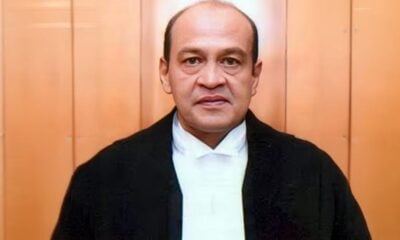
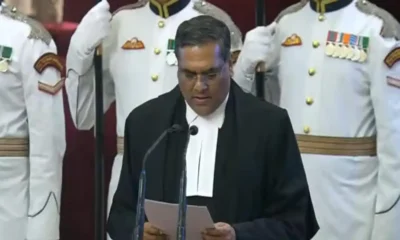
As criticism from various sections, including judges and the Bar Council of India (BCI), mounted over Supreme Court Collegium’s recommendation for their appointment, with the BCI even threatening nationwide protests on the issue, Narendra Modi government moved swiftly to notify the elevation of Karnataka High Court Chief Justice Dinesh Maheshwari and Delhi High Court judge, Justice Sanjiv Khanna, as Supreme Court judges.
Their swearing-in ceremony is likely to take place by the end of this week. The two appointments will take the strength of the top court to 28, with three vacancies.
Controversy rages over the Supreme Court Collegium’s recommendation of Justice Khanna on January 10, 2019.
The Collegium led by Chief Justice of India Ranjan Gogoi unanimously recommended Justice Khanna’s name along with Justice Maheshwari’s on January 10, despite objections raised by sitting apex court judge, Justice Sanjay Kishan Kaul.
Justice Kaul had written a note to Justice Gogoi and fellow judges in the collegium — Justices AK Sikri, SA Bobde, NV Ramana and Arun Mishra — about how Justice Khanna’s elevation would be ignoring the seniority of chief justices of the high courts of Rajasthan and Delhi, Pradeep Nandrajog and Rajendra Menon, respectively. Justice Khanna was ranked 33 in the High Court judges’ seniority list.
The January 10 decision of the Collegium overturned the December 12 recommendation of the Collegium, when it had decided to recommend Chief Justice of Rajasthan High Court Pradeep Nandrajog and Delhi High Court Chief Justice Rajendra Menon to the Supreme Court.
At a meeting of the five-member Collegium on December 12 last year, the names of Delhi Chief Justice Rajendra Menon and Rajasthan Chief Justice Pradeep Nandrajog had been considered. But the collegium of Chief Justice Ranjan Gogoi and Justices Madan B Lokur, AK Sikri, SA Bobde and NV Ramana had not taken the final decision, sources said. A Collegium statement earlier this week merely noted that the meeting was “incomplete” and no decision was taken. In the meantime, Justice Lokur had superannuated during the Christmas vacation. The reconstituted collegium, with the induction of Justice Arun Mishra as the fifth member, decided on January 10 to elevate Justices Khanna and Maheshwari.
In its resolution dated January 10, the Collegium reportedly said “certain decisions” were indeed taken on December 12. However, it said, there was no time for the “required consultation” on the decisions taken on December 12 due to the intervening Winter vacations for the court and retirement of Justice Madan Lokur, which changed its composition.
The Collegium said “fresh” and “extensive” deliberations were held after the vacations by the newly constituted Collegium, in which Justice Arun Mishra replaced Justice Lokur. The Collegium said it had “deemed it appropriate to have a fresh look at the matter and also to consider the proposals in the light of the additional material that became available”.
The Collegium records that it found Justices Maheshwari and Khanna “more deserving and suitable in all respects than other Chief Justices and senior puisne judges of the High Courts”.
The Collegium’s decision was questioned and criticised by many. A former Delhi High Court judge, Justice Kailash Gambhir, has written to the President, saying the “earth-shattering” decision to recommend Justice Khanna by superseding 32 senior judges amounts to “casting aspersions on their intellect, merit and integrity.”
Pointing out that the constitution has made the judiciary “accountable to the public”, the Bar Council of India (BCI) said they could hold protests if the two judges are appointed. “Our delegation will go and meet the Collegium to ask them to reconsider and recall this decision. If they don’t do it, we’ll go and sit on a dharna,” Bar Council chairman MK Mishra was quoted as saying by news agency ANI.(See below for detailed BCI reaction)
Former CJI RM Lodha said a Collegium decision is an “institutional decision” and cannot be changed because one Collegium member retired in the short interval between December 12 and January 10.
“When a decision is once taken, it has to be taken to its logical conclusion,” Justice Lodha said.
Justice Lodha said the Collegium has to be transparent about “why it dropped Justice Nandrajog and why Justice Maheswari, who was superseded a while ago by Justice Ajay Rastogi, is now once again the front-runner for the Supreme Court? Why was Justice Nandrajog picked first and then dropped?”
Justice Lodha said the unprecedented January 12, 2018 press conference by four senior-most judges including Gogoi before he became the CJI has not served the purpose for which it was held and instead the concerns raised including the functioning of collegium for appointment of judges for higher judiciary have aggravated.
“Looking at the overall reaction and perception, it would be better if the matter (of Khanna) is recalled and considered threadbare but this seems to be unlikely to me,” he said.
“The concerns remain the same. Rather, they seem to have aggravated by this exercise (recent recommendations). I don’t think there is any change. At least it is not visible to the public at large. It has not served its purpose because we don’t find the changes which the press conference wanted to have really taken place,” Justice Lodha said.
Former attorney General Soli Sorabjee admitted he was upset over the decision.
Former CJI KG Balakrishnan said it is quite irregular that the Collegium has sidelined the seniority and merit of three judges from the Delhi High Court — Justices Gita Mittal, Nandrajog and Ravindra Bhat — to recommend Justice Khanna.
“The Collegium does not usually overlook the seniority of three judges from the same high court to choose a fourth judge,” Justice Balakrishnan said.
“Collegium decisions are not just child’s play. Five judges of the Supreme Court have taken a decision on the appointment of a judge. What are the reasons for dropping that decision taken on December 12,” the retired CJI asked.
The former CJI said seniority is the prime consideration of the Collegium while recommending judges for the Supreme Court.
Justice Maheshwari was the subject of a letter written by Justice JS Chelameswar, now retired, to then Chief Justice Dipak Misra early in March 2018. Justice Chelameswar, in his letter, had questioned an enquiry initiated by Justice Maheshwari, on the basis of a government letter, against a judge recommended by the Supreme Court Collegium for elevation to the High Court.
A retired Supreme Court judge, who preferred anonymity, pointed out that Justice Khanna’s legendary uncle, Justice HR Khanna, chose to resign in 1977 when he was superseded by another as Chief Justice of India after his historic dissent in the ADM Jabalpur case.
Bar Council of India’s reaction
Shortly before the government notified the appointments, the Bar Council of India (BCI), which regulates the professional conduct of advocates in the country, criticised the Collegium’s January 10 decision. The BCI said it was “whimsical and arbitrary” and will lead to “humiliation and demoralisation” of the superseded judges. It said the decision of the collegium was viewed by the Bar and the common man as “unjust and improper”.
The bar body said it was watching the “strong resentment and reaction of the Indian Bar” as well as keeping a tab on the comments of intellectuals, social activists and general public “which shows that the faith of the people has abruptly eroded from our collegiums system in recent past”.
While maintaining that the BCI was hard-pressed to raise these issues, it said even the Bar Council of Delhi also adopted a resolution against the decision of the collegium.
Further, the statement said that several state bar councils, high courts, bar associations and other bar associations of the country have written to the BCI, pressing it to raise this issue and agitate the matter before the government and the collegium judges.
“Most of the councils and associations have even proposed to sit on a dharna and/or organise some nationwide protest on this serious issue,” the BCI said, adding that the recent trend adopted by the collegium has completely eroded the faith of the Bar and the people.
In a statement, BCI chairman Manan Kumar Mishra said the supersession of several senior judges and chief justices of the country cannot be tolerated by the people. He said the revocation of the earlier decision recommending the names of Justices Nandrajog and Menon is viewed as “whimsical and arbitrary”.
“They are men of integrity and judicial competence; nobody can raise a finger against these judges on any ground. The decision will certainly lead to humiliation and demoralisation of such judges and also of several other deserving senior judges and Chief Justices of high courts,” Mishra said.
The BCI said: “We have no grievance against Justice Khanna. But he can wait for his turn. There is no hurry to elevate him ignoring the merit and seniority of several chief justices and puisne judges of the country.”
“The Bar will request the collegiums and the government not to encourage such supersession. The appointments, in complete derogation of seniority principle, has evoked strong reactions from all corners of the society,” the BCI said.