English हिन्दी
Connect with us

India News

Indian Air Force repulses Pakistani jets, shoots down F16; says all IAF jets and pilots safe

Published

on

Indian Air Force repulses Pakistani jets, shoots down F16; says all IAF jets and pilots safe

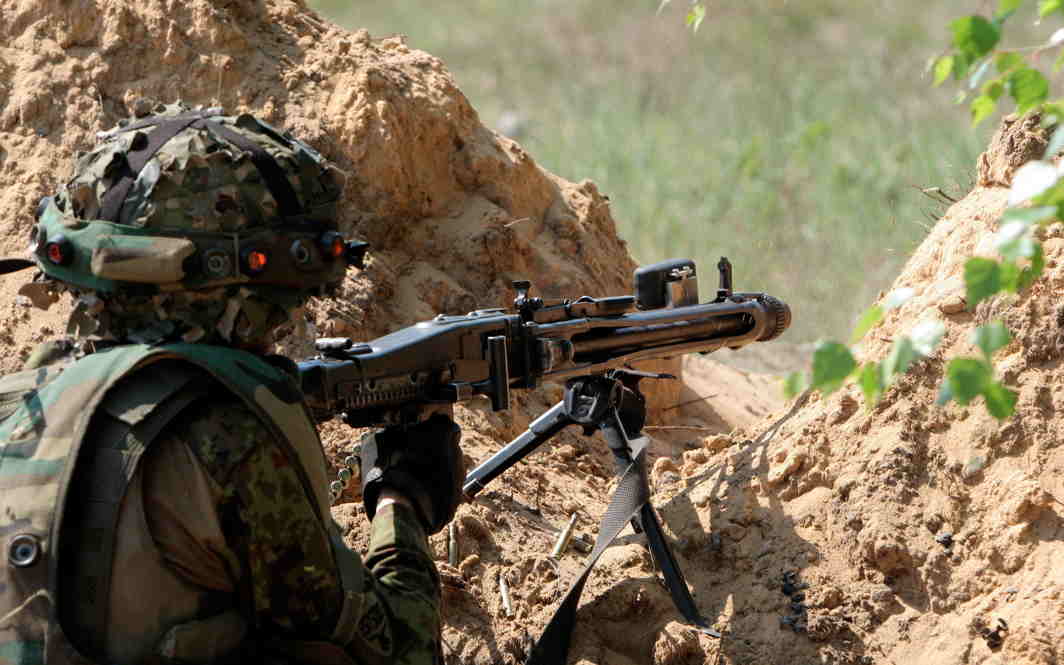
Indian Air Force today (Wednesday, Feb 27) repulsed Pakistani attempt at a retaliatory strike and shot down its F16 when three of its jets reportedly intruded into Indian air space in the Nowshera sector at around 10.30 am.

The pilot of the F-16 that was shot down ejected in Pakistani territory. The Pakistani aircraft were intercepted by Indian Air Force jets on combat patrol as a precaution against just such a venture by Pakistan to hit back after India’s strike at Jaish-e-Mohammad camp at Balakot in Pakistan yesterday.

India has also denied Pakistani claims of shooting down Indian jets and capturing one of the pilots, saying “all our pilots are accounted for”.

Also Read: IAF chopper crashes in J&K’s Budgam, two pilots dead

“In response to PAF strikes this morning as released by MoFA, IAF crossed LOC,” Pakistan’s Director-General Inter-Services Public Relations, Major-General Asif Ghafoor, tweeted.

“PAF shot down two Indian aircrafts inside Pakistani airspace. One of the aircraft fell inside AJ&K while other fell inside IOK. One Indian pilot arrested by troops on ground while two in the area.”

‘AJ&K’ means ‘Azad Jammu and Kashmir’, Pakistani name for Pak-Occupied Kashmir, while IOK – India Ocuupied Kashmir – is how it refers to Jammu and Kashmir.

MoFA, the Pakistani ministry of foreign affairs, issued a statement earlier on Wednesday saying Pakistan Air Force jets had hit targets across the Line of Control in Jammu and Kashmir while flying within Pakistani airspace.

“Today, Pakistan Air Force undertook strikes across Line of Control from within Pakistani airspace,” the statement said.

Also Read: Indian Air Force repulses Pakistani jets, shoots down F16; says all IAF jets and pilots safe
In a press release titled “Pakistani Strikes Back”, Pakistan said, “This was not a retaliation to continued Indian belligerence. Pakistan has therefore, taken strikes at non military target, avoiding human loss and collateral damage. Sole purpose being to demonstrate our right, will and capability for self defence. We have no intention of escalation, but are fully prepared to do so if forced into that paradigm. That is why we undertook the action with clear warning and in broad daylight.”

The Pakistani statement said: “For the last few years, India has been trying to establish what they call ‘a new normal’ a thinly veiled term for doing acts of aggression at whatever pretext they wish on a given day. If India is striking at so called terrorist backers without a shred of evidence, we also retain reciprocal rights to retaliate against elements that enjoy Indian patronage while carrying out acts of terror in Pakistan. We do not wish to go to that route and wish that India gives peace a chance and to resolve issues like a mature democratic nation.”

India has called its air strike “non-military and pre-emptive”, aimed at preventing more attacks like Pulwama, based on credible inputs that Jaish was training more suicide bombers.

Also Read: Imran Khan warns against escalation, invites PM Modi for talks; India, China, Russia condemn terrorism

Tension has been high between the two countries since JeM terrorists attacked a paramilitary convoy in Kashmir’s Pulwama on 14 February, killing 40 personnel. Responding this attack, the bloodiest in Jammu and Kashmir in the last three decades of militancy, India carried out air strikes deep inside Pakistan, deploying the IAF for the first time since the 1971 war to strike a Jaish-e-Mohammad terror camp in Balakot.

Airspace shut down in Kashmir

All airspace at Jammu, Srinagar and Leh, close to the border with Pakistan, has been shut down indefinitely, sources say. Airspace over Amritsar and Chandigarh may also be closed down, according to reports. Commercial flights to those cities have been put on hold or diverted.

The area has been on high alert amid warnings of retaliation after India’s strike yesterday. Pakistani troops have been targeting civilian hamlets and forward posts along the LoC since Tuesday evening. Defence Ministry Spokesperson Lt Colonel Devender Anand said retaliatory action has resulted in “severe destruction of five Pakistani posts and a number of casualties to Pak Army.”

National Security Advisor Ajit Doval was reported to be meeting with the Defence and Foreign Secretaries besides intelligence officials, to discuss the situation.

Also Read: India loses a Mig, pilot missing in action; Pakistan says he in their custody

Amid the biggest escalation between the two countries in decades, several countries have urged restraint.

This morning, Foreign Minister Sushma Swaraj said during a trilateral meeting in China that India wants to avoid any “further escalation of the situation”.

“The limited objective of that pre-emptive strike was to act decisively against the terrorist infrastructure of Jaish-e-Mohammad in order to pre-empt another terror attack in India,” Sushma Swaraj said in Wuzhen.

“India does not wish to see further escalation of this situation. India will continue to act with responsibility and restraint.”

India News

PM Modi assures no discrimination in women’s quota, delimitation debate intensifies in Parliament

PM Narendra Modi has assured that women’s reservation will be implemented without discrimination, amid a heated debate over delimitation in Parliament.

Published

on

PM modi

Prime Minister Narendra Modi has assured that there will be no discrimination in the implementation of women’s reservation, as Parliament witnessed a sharp debate over the proposed linkage between the quota and delimitation exercise.

During the ongoing special session, the government reiterated its commitment to ensuring fair representation while addressing concerns raised by opposition parties regarding the timing and structure of the legislation.

The proposed framework aims to reserve 33 percent of seats for women in the Lok Sabha and state assemblies. However, its implementation is tied to a fresh delimitation exercise, which is expected after the next census.

Opposition questions timing and intent

Opposition leaders have raised concerns that linking the women’s quota to delimitation could delay its implementation. They argue that the process of redrawing constituencies may push the actual rollout further into the future.

The issue has triggered a broader political confrontation, with multiple parties questioning whether the move could alter representation across states.

Some critics have also alleged that the delimitation exercise could disproportionately benefit certain regions based on population, a charge the government has rejected.

Government reiterates commitment to fair implementation

Responding to these concerns, the Centre has maintained that the reforms are necessary to ensure accurate and updated representation based on population data.

Leaders from the ruling side have repeatedly emphasized that the process will be carried out transparently and without bias. The assurance that there will be “no discrimination” is aimed at addressing fears among states and opposition parties.

The debate marks a key moment in Parliament, with both sides engaging in intense exchanges over one of the most significant electoral reforms in recent years.

Continue Reading

India News

Give all tickets to Muslim women, Amit Shah says, attacking Akhilesh Yadav on sub-quota demand

A sharp exchange between Amit Shah and Akhilesh Yadav in Parliament over sub-quota for Muslim women highlights key divisions on women’s reservation implementation.

Published

on

A heated exchange broke out in Parliament during discussions on the women’s reservation framework, with Union Home Minister Amit Shah and Samajwadi Party chief Akhilesh Yadav locking horns over the demand for a sub-quota for Muslim women.

The debate unfolded as the government pushed forward key legislative measures to implement 33% reservation for women in the Lok Sabha and state assemblies.

Akhilesh Yadav argued that the proposed reservation must ensure representation for women from marginalised communities, including Other Backward Classes (OBCs) and Muslim women. He said that without such provisions, large sections could remain excluded from political participation.

He also questioned the timing of the bill, alleging that the Centre was avoiding a caste census. According to him, a census would lead to renewed demands for caste-based reservations, which the government is reluctant to address.

Government rejects religion-based quota

Responding to the demand, Amit Shah made it clear that reservation based on religion is not permitted under the Constitution.

He stated that any proposal to provide quota to Muslims on religious grounds would be unconstitutional, firmly rejecting the idea of a separate sub-quota for Muslim women within the broader reservation framework.

The government has maintained that the existing framework already includes provisions for Scheduled Castes (SC) and Scheduled Tribes (ST) women within the overall reservation structure.

Wider political divide over implementation

The issue of sub-categorisation within the women’s quota has emerged as a major flashpoint, even as most opposition parties broadly support the idea of women’s reservation.

Samajwadi Party leaders reiterated that their support for the bill depends on inclusion of OBC and minority women, while the government continues to defend its constitutional position.

The debate is part of a broader discussion during the special Parliament session, where multiple bills linked to delimitation and implementation of the women’s quota are being taken up.

Continue Reading

India News

No state will lose a seat, Centre assures as delimitation debate takes centre stage in Parliament

Parliament’s special session begins with key focus on implementing women’s reservation and delimitation, setting the stage for major electoral changes.

Published

on

Parliament

A special session of Parliament commenced on Thursday, with the Centre set to take up crucial legislation related to women’s reservation and delimitation of constituencies. The session, scheduled over three days, is expected to witness intense debate as the government pushes forward its legislative agenda.

At the centre of discussions is the proposal to operationalise the women’s reservation law, which seeks to allocate 33 percent of seats in the Lok Sabha and state assemblies to women. The law, passed earlier, requires enabling provisions before it can be implemented.

The rollout of the reservation is closely tied to the delimitation exercise — a process that redraws parliamentary constituencies based on updated population data. The implementation is expected only after the next census and delimitation process are completed.

The government is aiming to put in place the framework so that the reservation can be enforced in future elections, likely around 2029.

Delimitation and numbers at play

Delimitation is a key aspect of the proposed changes, as it will determine how seats are redistributed and which constituencies are reserved. The exercise is expected to reflect population shifts and may also involve an increase in the total number of Lok Sabha seats.

This linkage has made the issue politically sensitive, with several opposition parties backing women’s reservation in principle but raising concerns over how and when delimitation will be carried out.

Political reactions and expected debate

The session is likely to see sharp exchanges between the government and opposition. While there is broad agreement on increasing women’s representation, disagreements remain over the timing, process, and potential political implications of the delimitation exercise.

Some leaders have argued that delimitation could significantly alter the balance of representation among states, making it a contentious issue beyond the women’s quota itself.

The government, however, has framed the move as a step toward strengthening women’s participation in governance and ensuring more inclusive policymaking.

Continue Reading

Trending

© Copyright 2022 APNLIVE.com