
India News
Israel and Syria exchange most extensive missile strikes


Earlier Tel Aviv claimed of killing 15 including 8 Iranians
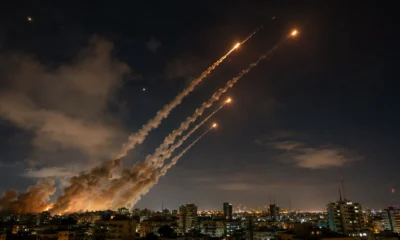
In another major development in the Middle East on Thursday morning, Israel and Syria have exchanged barrage of missiles, considered to be the most extensive strikes in decades. Israel claimed attacking dozens of Iranian targets in Syria in response to 20 rockets fired at Israeli military outposts.
Earlier, Israel had claimed of carrying out an attack on a military base south of Damascus, which was used by Iranian forces. London based Syrian Observatory for Human Rights said it killed at least 15 people, including eight Iranians. Killing of two civilians was confirmed by Syrian news agency.
The Israeli claim of hitting Iranian targets in Syria came one day after Prime Minister Benjamin Netanyahu accused Tehran of preparing to attack Israel saying “For the past months, Iran has been transferring weapons to its forces in Syria”.
While addressing live on television on Tuesday night, after Trump announced of withdrawing from Iran nuclear deal, Netanyahu said, We will react with force” to any attack. He also said “The army is prepared, the army is strong, and whoever will try us will feel well the strength of our army”.
According to Israel’s leading daily Haaretz, the Israeli military has accused Iranian Revolutionary Guards’ Al Quds force and its commander Maj Gen Qassem Soleimani, of launching the attack at the “Israeli Golan Heights”. This is the first time Israel has directly accused Iran of firing toward Israeli territory, the daily said.
Read More: Syria threatens to respond any future Israeli aggression
Israel has claimed of intercepting four of the rockets by its Iron Dome air defense system and the rest of the rockets exploded on Syrian territory. Tel Aviv has also said there were no casualties in the attack.
Israel has also claimed that the targets included weapons storage, logistics sites and intelligence centers used by elite Iranian forces in Syria. It has also claimed of destroying several Syrian air-defense systems after coming under heavy fire. It said none of its warplanes was hit.

Haaretz further said that a source in the Israeli security establishment said this attack was the largest carried out by Israel since it signed a disengagement agreement with Syria in May 1974.
Contradicting the Israeli claims, Syrian air defenses have claimed of repelling an Israeli missile aggression on Syrian territories, shooting down scores of missiles. It has claimed of intercepting rockets fired from Israeli aircraft after Tel Aviv targeted Syrian army positions in the “occupied Golan Heights”.
Read More: Israel claims most significant attacks on Syria, Russia cautions Tel Aviv
Syrian official news agency SANA, reported the Israeli aggressions targeted air defense battalions and radars in Syria with missiles fired by “enemy warplanes” from within the occupied territories. Earlier it claimed of intercepting barrage of Israeli missiles after some 20 projectiles were launched from Syrian soil at Israeli positions in the Golan Heights in response to an earlier Israeli shelling on Quneitra province.
SANA reports that the Syrian air defenses were “confronting a new wave of Israeli aggression rockets and downing them one after the other”. However, referring to a military source, it added that Israeli rocket fire had hit a Syrian radar site and an ammunition warehouse.
Earlier Syrian media said that Israeli troops had shelled the city of Ba’ath in the southern province of Quneitra. No casualties have been reported from any of the incidents.
Read More: UN Head calls for de-escalation in Syria-Israel theatre
A Syrian correspondent from Quneitra reports on Thursday that Syrian air defenses shot down Israeli missiles over Ba’ath city.
Earlier on Tuesday, when Trump announced US withdrawal from Iran nuclear deal, Israeli missiles targeted Syrian army positions in the Kishweh area south of Damascus. On the same day Israel had reportedly instructed local authorities to “unlock and ready (bomb) shelters” for the settlers.
SANA reports that aggression took place less than 24s after the Syrian air defenses shot down two Israeli missiles over Kishweh area in Damascus countryside.
Israeli media claim of “Israel’s Golan Heights” is factually wrong. In fact Israel seized the Syrian Golan Heights during 1967 six day war and has continued to occupy two-thirds of the strategically important territory ever since, in a move which has never recognized by international community.
Israel has been frequently using the occupied Golan Heights to carry out military operations against Syrian territories.
Read More: Israeli F-16 shot down by Syrians, Tel Aviv hit Iranian drone
Tehran based Press TV and Iran’s official news agency IRNA have so far neither confirmed nor denied Israel targeting Iranian military installations in Syria. Instead, Iranian media has reported the exchange of missile attacks between Israeli and Syrian forces.
SANA report says that the command of the Lebanese Army said that four Israeli warplanes violated its airspace at the same time as the aggression took place.











India News
Supreme Court questions EC over missing records in Sringeri election dispute
The Supreme Court questioned the Election Commission over missing video footage of the 2023 counting in Karnataka’s Sringeri constituency. The case involves a revised result following a recount of postal ballots.

India News
Rahul Gandhi joins India Gate protest by Ankita Bhandari’s parents
Rahul Gandhi joined the protest by Ankita Bhandari’s parents at India Gate in New Delhi on October 14. The demonstration has brought renewed attention to the 2022 murder case and the family’s concerns following Dushyant Gautam’s appointment as Sikkim Governor.

India News
Meerut murder: Muskaan Rastogi and Sahil Shukla get death sentence
A Meerut court has sentenced Muskaan Rastogi and Sahil Shukla to death in the blue drum murder case involving the killing of merchant navy officer Saurabh Rajput in March 2025.

CJP leaders Saurav Das, Ashutosh Ranka, Ajinkya Shinde sent to 5-day judicial custody

PM Modi speaks to Mark Carney as India and Canada push to strengthen ties

S Jaishankar says India is a natural option for Russia amid Europe tensions

Meerut murder: Muskaan Rastogi and Sahil Shukla get death sentence

Rahul Gandhi joins India Gate protest by Ankita Bhandari’s parents

Supreme Court questions EC over missing records in Sringeri election dispute
Rahul Gandhi joins India Gate protest by Ankita Bhandari’s parents
Meerut murder: Muskaan Rastogi and Sahil Shukla get death sentence
PM Modi speaks to Mark Carney as India and Canada push to strengthen ties
S Jaishankar says India is a natural option for Russia amid Europe tensions

Afghan Men Try To Hang With The Jet Engine Of The Aircraft in Kabul- Afghanistan News – Kabul News
Trending Top 10 News: 10000 Crore Fine on Flipkart, Apple to Launch Unique Feature, Hdfc Bank Job Ad

Trending Top 10 News: Nokia 6310, Apple sales, Bachpan ka Pyar Video Kid, Dainik Bhaskar IT Raid

Trending Top 10 News: Canada bans Indian flights, Rain in Delhi NCR, AIMIM Twitter hacked, Raj Kundra case

Trending Top 10 News: Shein India, Apple New Service, Pocket Oxygen, Oppo Launched New Phone
-
 India News21 hours ago
CJP leaders Saurav Das, Ashutosh Ranka, Ajinkya Shinde sent to 5-day judicial custody
-
 India News21 hours ago
PM Modi speaks to Mark Carney as India and Canada push to strengthen ties
-
 Latest world news21 hours ago
S Jaishankar says India is a natural option for Russia amid Europe tensions
-
 India News10 hours ago
Meerut murder: Muskaan Rastogi and Sahil Shukla get death sentence
-
 India News10 hours ago
Rahul Gandhi joins India Gate protest by Ankita Bhandari’s parents
-
 India News9 hours ago
Supreme Court questions EC over missing records in Sringeri election dispute
