English हिन्दी
Connect with us

India News

Jagdeep Dhankhar calls Article 142 a nuclear missile after Supreme Court order setting timeline for President to clear bills

The remarks follow the Supreme Court’s April 8 judgment, which marked a historic first by imposing a three-month deadline for the President and Governors to approve or reject Bills re-passed by state legislatures.

Published

on

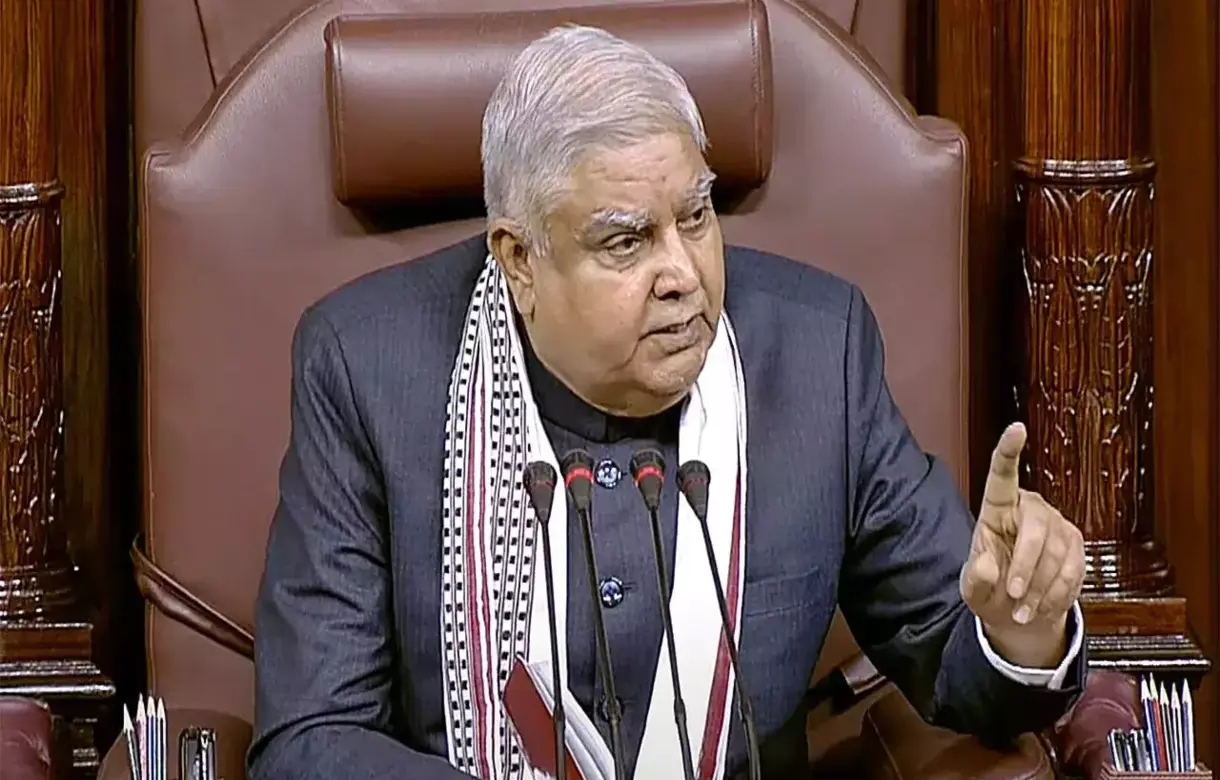
Vice President Jagdeep Dhankhar on Thursday launched a scathing attack on the judiciary, branding Article 142 of the Constitution a “nuclear missile” that threatens democratic principles, always at the judiciary’s disposal.

The remarks follow the Supreme Court’s April 8 judgment, which marked a historic first by imposing a three-month deadline for the President to approve or reject Bills reserved by the Governors.

Speaking at the valedictory ceremony for the 6th batch of Rajya Sabha interns at the Vice President’s Enclave, Dhankhar expressed alarm over a recent Supreme Court ruling directing the President to act on Bills within a set timeframe, arguing it undermines the separation of powers.

The bench, led by Justices JB Pardiwala and R Mahadevan, ruled that delays beyond this period require justification and affirmed that the President’s actions under Article 201 are subject to judicial review. The court also advised the President to refer Bills raising constitutional questions to the judiciary and urged coordination between states and the Centre.

This ruling stemmed from a dispute in Tamil Nadu, where Governor R.N. Ravi’s delay in assenting to 10 Bills was deemed “illegal” and “arbitrary” by the court, allowing the state to challenge the President’s withholding of assent.

Dhankhar, however, called the directive to the President—a figure sworn to uphold the Constitution—unacceptable. “Where are we heading? Directing the President to act within a timeframe, failing which a Bill becomes law? This allows judges to legislate, govern, and act as a super-parliament without accountability,” he said, warning of a judiciary overstepping its constitutional role under Article 145(3) to interpret the law.

Emphasising the separation of powers, Dhankhar argued that the elected Executive is answerable to Parliament and voters, unlike the judiciary. “If judges govern, who do we question? How do we hold them accountable at elections?” he asked, urging the legislature, judiciary, and executive to operate within their designated domains to safeguard democracy. “Any overreach by one into another’s sphere is a dangerous challenge,” he added.

Dhankhar also raised concerns about judicial accountability, citing a March 14-15 incident where a large cash stash was discovered at the residence of Delhi High Court Judge Yashwant Varma.

He criticised the lack of an FIR and the formation of a three-judge committee to probe the matter, questioning why the Executive’s investigative authority was bypassed. “The Constitution grants immunity from prosecution only to the President and Governors. How has another category secured such protection?” he asked.

Noting that over a month has passed since the cash haul, Dhankhar demanded transparency. “Even if it’s a can of worms or skeletons in the closet, it’s time to open the lid and let the truth out for institutional cleansing,” he said, contrasting the slow response with the swift action he believes would have followed a similar incident at his own residence.

India News

Shashi Tharoor warns US tariffs on Iran could make Indian exports unviable

Shashi Tharoor has warned that cumulative US tariffs linked to Iran trade could rise to 75%, making most Indian exports to America commercially unviable.

Published

on

Shashi Tharoor

Congress MP and chairman of the Standing Committee on Foreign Affairs Shashi Tharoor has expressed serious concern over the United States’ latest tariff announcement targeting countries that continue to trade with Iran, warning that such measures could severely impact Indian exporters.

Reacting to the decision by US President Donald Trump to impose a 25% tariff on countries doing business with Iran, Tharoor said Indian companies would struggle to remain competitive if cumulative tariffs rise to 75%. He noted that India was already at a disadvantage compared to several regional competitors.

Tharoor said he had been troubled by the US tariff regime from the outset, pointing out that India was initially subjected to a 25% tariff while rival exporting nations in Southeast Asia were charged significantly lower rates. According to him, countries such as Vietnam, Thailand, Indonesia, Pakistan and Bangladesh faced tariffs ranging between 15% and 19% on labour-intensive goods exported to the US.

He explained that the situation had worsened with additional sanctions-linked duties. With the existing 25% tariff, another 25% related to Russia-linked sanctions, and a further 25% tied to Iran-related measures, the total burden could rise to 75%. At that level, Tharoor said, most Indian exports would no longer be commercially viable in the American market.

While noting that certain sectors such as pharmaceuticals may continue to export as they are not heavily impacted by sanctions, he warned that other key export categories would be hit hard. Tharoor described the situation as very serious and said it required urgent attention.

The Congress MP also expressed hope that the newly appointed US Ambassador could help facilitate progress on a bilateral trade agreement. He stressed that India could not afford to wait through the entire year for a deal and said an agreement should ideally be concluded in the first quarter of 2026.

Commenting on recent diplomatic engagements between India and the US, Tharoor underlined the need for faster consensus on trade issues. He said that at tariff levels as high as 75%, the idea of a meaningful trade deal loses relevance. According to him, a rate closer to what the UK enjoys with the US, around 15%, would reflect the respect due to a strategic partner.

Tharoor’s remarks come after President Trump announced that any country continuing business with Iran would face a 25% tariff on all trade with the United States, a move that has raised concerns among several trading partners.

Continue Reading

India News

Indian Army symbolizes selfless service and duty, says PM Modi on Army Day

PM Narendra Modi on Army Day praised the Indian Army as a symbol of selfless service and unwavering duty, saluting the courage and sacrifice of its soldiers.

Published

on

pm modi speech

On the occasion of Army Day, Prime Minister Narendra Modi on Thursday paid tribute to the Indian Army, describing its soldiers as a symbol of selfless service who protect the nation with unwavering resolve, even in the most challenging circumstances.

In a message shared on social media platform X, the prime minister said the country salutes the courage and steadfast commitment of Indian Army personnel. He noted that their dedication to duty inspires confidence and gratitude among citizens across the country.

“Our soldiers stand as a symbol of selfless service, safeguarding the nation with steadfast resolve, at times under the most challenging conditions,” PM Modi said. He added that the nation remembers with deep respect those who have laid down their lives while serving the country.

Army Day is observed every year on January 15 to commemorate a historic moment in India’s military history. The day marks the appointment of Field Marshal K M Cariappa as the first Indian Commander-in-Chief of the Indian Army in 1949, when he took over from British officer General Sir F R R Bucher.

The occasion serves as a reminder of the Indian Army’s role in defending the country’s sovereignty and honour, as well as the sacrifices made by its personnel in the line of duty.

Continue Reading

India News

Air India, IndiGo flights disrupted after Iran shuts airspace amid US tensions

International flights operated by Air India, IndiGo and SpiceJet were disrupted after Iran shut its airspace, forcing rerouting and cancellations.

Published

on

Air india flight

International flights operated by Air India, IndiGo and SpiceJet were disrupted on Thursday after Iran abruptly shut its airspace to commercial aircraft, triggering delays and cancellations on several long-haul routes.

Iran ordered the closure of its airspace without providing an official explanation, as tensions remain elevated between Tehran and Washington and protests continue across the country against Supreme Leader Ayatollah Ali Khamenei.

Indian airlines issue travel advisories

Air India said its flights overflying the region are now operating through alternative routes, resulting in longer flight times and possible delays. The airline also confirmed that some services have been cancelled where rerouting is not feasible.

“Due to the emerging situation in Iran and the subsequent closure of its airspace, Air India flights overflying the region are using alternate routing, which may lead to delays. Some flights are being cancelled where rerouting is currently not possible,” the airline said in a statement on social media.

Passengers were advised to check flight status before travelling to the airport, with the airline reiterating that passenger and crew safety remains its top priority.

IndiGo also acknowledged disruptions to its international network, describing the situation as a “sudden airspace closure” beyond the airline’s control. The carrier said it is working to assist affected passengers by offering alternative travel options.

Customers have been advised to use flexible rebooking options or claim refunds, depending on their preference.

SpiceJet issued a similar advisory, confirming that some of its flights have been impacted due to the closure of Iranian airspace.

Airspace shutdown linked to regional security concerns

According to official notices issued to pilots, Iran’s airspace closure is expected to remain in place until 7:30 am local time. The move comes amid heightened regional tensions and follows earlier shutdowns during military confrontations involving Israel earlier this year.

Aviation risk monitoring platforms have noted that several international airlines are already avoiding Iranian airspace, citing concerns over possible military activity, air defence operations and the risk of misidentification of civilian aircraft.

The situation continues to be monitored closely, with further disruptions possible if the airspace restrictions are extended.

Continue Reading

Trending

© Copyright 2022 APNLIVE.com