English हिन्दी
Connect with us

India News

In dissenting order, Justice BV Nagarathna calls demonetisation notification unlawful

The Supreme Court Constitution bench, with 4:1 majority, backed the notes ban decision by Central Government

Published

on

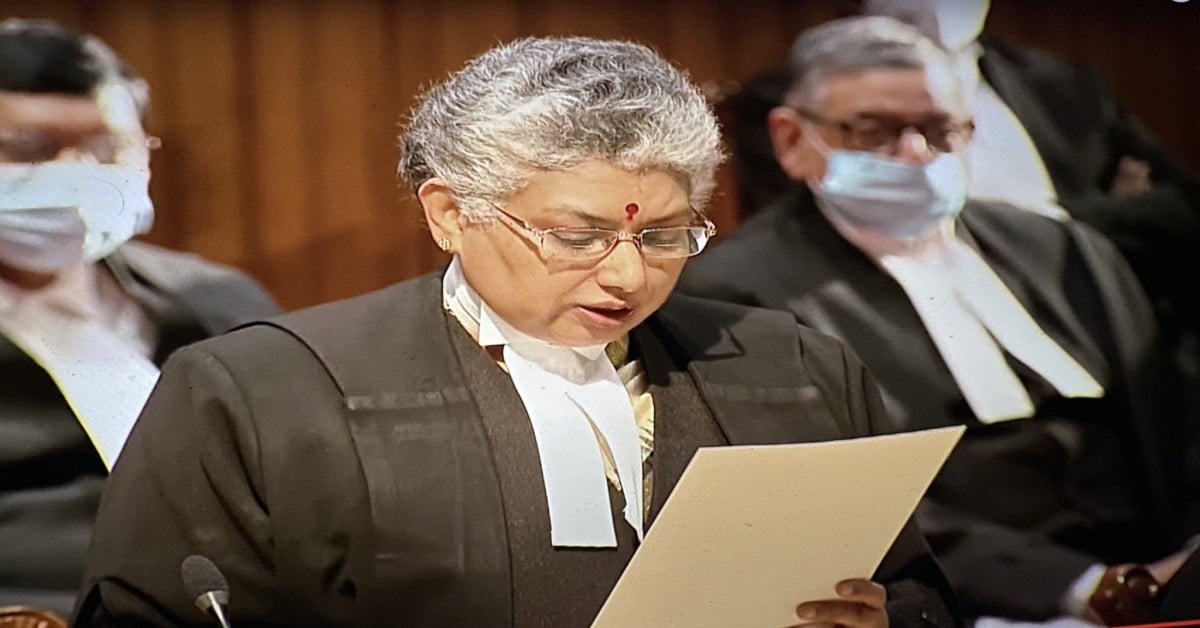
Justice BV Nagarathna

The Supreme Court has given its verdict on demonetisation. The Constitution Bench of the court with a 4:1 majority has upheld the decision of the Central Government to ban the notes of 500 and 1000 rupees six years ago. Along with this, the court has also dismissed all the 58 petitions. 4 judges have taken the decision by majority. At the same time, a judge has raised questions on demonetisation. While giving the verdict, the bench said that no error has been found in the notification of November 8, 2016 and all series of notes can be withdrawn.

Justice BV  Nagarathna’s opinion regarding demonetisation appeared different. She said that demonetisation of all series of notes at the behest of the central government is a far more serious issue than bank demonetisation. Therefore, it should be done first through executive notification and then through legislation. She further said that as per section 26(2), the proposal for demonetisation can come only from the Central Board of RBI.

Justice Nagarathna said the RBI did not apply an independent mind and only approved the Centre’s wish for demonetisation. She also said that a perusal of the records produced by the RBI shows that the entire exercise was done in just 24 hours due to the will of the Centre.

Justice Nagarathna said that in her considered view, action of demonetisation was unlawful but status quo ante could not be restored since it was in 2016. She also said that the demonetisation was an exercise of power, contrary to law, ergo unlawful.

Read Also: Demonetisation valid: Supreme Court Constitution Bench approves move to demonetize Rs 1000, Rs 500 notes

She continued by saying that the way it was carried out was illegal. According to the RBI Act, the board of the Reserve Bank of India should recommend demonetisation, however in this instance, the Centre addressed a letter to RBI on November 7 advising for such a decision, she said.

Additionally, Justice Nagarathna ruled that rather than an executive notification, a Parliamentary Act may have been used to start the demonetisation process, as it had in the past.

Phrases like “as requested by Centre Govt” suggest there was no independent application of mind by RBI, Justice Nagarathna observed after reviewing the documents and data that the Centre and RBI gave.

Delhi: Woman killed after car hits her and drags her for 4 km in Kanjhawala, CCTV footage goes viral| WATCH

14 coaches of Suryanagari Express derail in Rajasthan, 24 passengers injured, 12 trains diverted

India News

Air India sacks Phuket-Delhi flight pilot after failing drug test

Air India has terminated the Phuket-Delhi flight pilot after a confirmatory test found a psychoactive substance following the August 4 incident.

Published

on

Air India has terminated the employment of the pilot-in-command of a Phuket-Delhi flight after he tested positive for a psychoactive substance.

The pilot was in command of flight AI2379, which was travelling from Phuket to Delhi on August 4 when the aircraft suddenly lost altitude over Odisha. The incident left 24 passengers injured.

Air India said the termination was in line with its zero-tolerance policy regarding safety violations and regulatory requirements.

Air India terminates pilot with immediate effect

In a statement, the Tata-owned airline said the pilot-in-command had tested positive for a psychoactive substance.

The airline said that, considering its zero-tolerance approach to violations related to safety, fitness and regulatory requirements, the pilot’s employment had been terminated with immediate effect.

Air India also said it continues to cooperate fully with the investigation into the incident and has provided access to relevant operational, maintenance and technical records.

What happened on the Phuket-Delhi flight?

According to the preliminary findings of the Aircraft Accident Investigation Bureau (AAIB), the Airbus A320 was carrying 145 people when it experienced the near-simultaneous loss of all three hydraulic systems while cruising at around 36,000 feet.

The technical failure resulted in the autopilot disconnecting and triggered a brief stall warning. The aircraft subsequently lost altitude, resulting in injuries to 24 passengers.

The preliminary report also noted that the pilot tested non-negative for a psychoactive substance in a confirmatory test.

However, the report did not establish that the pilot’s drug-test result caused or contributed to the hydraulic system failure or the subsequent loss of altitude.

AAIB recommends action over psychoactive substance finding

The AAIB described the confirmation of psychoactive substance use as a serious concern and recommended that the Directorate General of Civil Aviation (DGCA) take appropriate action against the pilot on priority.

The investigation into the technical and other aspects of the incident is still underway.

The preliminary report also noted that the co-pilot was flying the aircraft when the incident occurred and attempted to bring the situation under control.

Air India said safety remains its highest priority and that its pilots undergo training, proficiency checks, medical examinations and other regulatory assessments in accordance with applicable requirements.

Continue Reading

India News

India offers forensic DNA support to identify Nepal flood victims

India will make forensic laboratory facilities available for DNA profiling of first-degree relatives of people missing after Nepal’s August 26 flash floods.

Published

on

India has offered forensic laboratory support to help identify people who remain missing after the devastating flash floods in Nepal.

The Ministry of External Affairs (MEA) said central and state forensic laboratories in India will make their DNA profiling facilities available for first-degree biological relatives of people missing after the August 26 flash floods in Nepal.

DNA samples can be provided by relatives in India

According to the MEA, first-degree biological relatives living in India can have their biological samples collected and DNA profiles prepared.

The relatives can include a person’s father, mother, son, daughter or sibling. DNA profiling can be carried out at Central Forensic Science Laboratories (CFSLs), State Forensic Science Laboratories (SFSLs), laboratories of the National Forensic Sciences University (NFSU), and NABL-accredited laboratories with DNA profiling capabilities.

The initiative is intended to support Nepal’s ongoing process of identifying mortal remains recovered after the flash floods.

DNA profiles to be compared with unidentified remains

The MEA said the DNA profiling may use Autosomal STR DNA profiling, as advised by Nepal Police, subject to the technical requirements communicated by the Nepali authorities.

Once prepared, DNA profiles and the preliminary information required by Nepalese authorities can be sent to Nepal Police by email for comparison with DNA profiles obtained from unidentified mortal remains.

The Indian Embassy in Kathmandu will also facilitate coordination, with copies of the DNA profiles to be shared with the embassy for this purpose.

Nepal flood death toll rises

The death toll from the flash floods has risen to at least 1,259, according to Nepalese authorities, after rescue workers recovered additional bodies from affected areas.

More than 12,000 people have been rescued, while around 5,000 people remain missing as search and rescue operations continue.

The flash floods, which followed an ice-rock avalanche near the Nepal-Tibet border, caused extensive destruction across towns and villages in northern and central Nepal.

Continue Reading

India News

PM Modi hails ISRO after successful GSLV-F17 launch, calls it proud moment

PM Modi congratulated ISRO after GSLV-F17 successfully launched EOS-05, calling the achievement a proud moment for India.

Published

on

Prime Minister Narendra Modi on Friday congratulated the Indian Space Research Organisation (ISRO) after the successful launch of the GSLV-F17 rocket carrying the EOS-05 Earth observation satellite, describing the achievement as a proud moment for the nation.

The GSLV-F17 lifted off at 2:55 a.m. IST from the Satish Dhawan Space Centre in Sriharikota, Andhra Pradesh. The EOS-05 satellite was subsequently placed into its designated sub-geosynchronous transfer orbit.

PM Modi praises ISRO’s growing capabilities

In a post on X, PM Modi said the successful mission reflected the excellence, innovation and expanding capabilities of India’s space sector.

He also highlighted the growing partnership between ISRO and Indian industry, saying it was strengthening India’s space programme and expanding capabilities across the wider space ecosystem.

The prime minister described the successful launch of GSLV-F17 carrying EOS-05 as another outstanding achievement by ISRO and a matter of national pride.

EOS-05 strengthens earth observation capabilities

According to the report, EOS-05 is India’s first-ever imaging satellite from geosynchronous orbit. The satellite is designed to provide continuous observation of the country from an altitude of nearly 36,000 km above Earth.

The mission is expected to strengthen India’s earth observation capabilities and support advanced imaging and observation applications.

ISRO Chairman Dr V Narayanan expressed satisfaction with the mission, saying the satellite was precisely injected into its intended orbit.

Mission Director Thomas Kurian described the launch as a significant milestone for the GSLV programme. He said it was the 19th flight of the GSLV and noted that EOS-05 is the heaviest satellite the launch vehicle has placed into a geosynchronous transfer orbit or sub-GTO orbit.

GSLV-F17 launch vehicle details

The GSLV-F17 stands 51.7 metres tall and has an approximate liftoff mass of 420.5 tonnes.

Science and Technology Minister Jitendra Singh also congratulated the ISRO team following the successful mission. He described EOS-05 as a state-of-the-art Earth observation satellite capable of advanced imaging across visible, infrared, multispectral and hyperspectral bands.

Continue Reading

Trending

© Copyright 2022 APNLIVE.com