
India News
Modi far ahead others in popularity, majority of Indians favour dictatorship


[vc_row][vc_column][vc_column_text]
- Nearly nine out of 10 Indians hold a favourable opinion of Prime Minister Narendra Modi.
- Seven-in-ten Indians are now satisfied with the way things are going in the country.
- More than eight-in-ten (85%) voice trust in the national government.
- The public is also quite satisfied (79%) with the way their democracy is currently working.
These findings of a Pew Research Centre survey come as a major morale booster for the BJP ahead of some key state elections and with two years to go before the next Lok Sabha elections.
The survey was conducted just as Prime Minister Narendra Modi was going to complete three years in government, between Feb. 21 – Mar. 10, 2017, a few months after the drastic, much reviled step of demonetisation. One may quibble about the sample size of the survey, which was 2,464. It was based on face-to-face interviews with respondents in 16 of India’s 18 most populous states and Delhi.
Modi’s popularity rating in the survey is seen as unusual for a leader having completed three years in office, with no sign of his popularity waning since 2015 when his government was one year old. “Three years into Modi’s five-year tenure, the honeymoon period for his administration may be over but the public’s love affair with current conditions in India is even more intense,” Pew said.
For those who oppose Modi for being autocratic, the survey provides a reality check: A majority, 53% support military rule and 55% of Indians back a governing system in which a strong leader can make decisions without interference from parliament or the courts. Support for autocratic rule is higher in India than in any other nation surveyed. India is one of only four nations where half or more of the public supports governing by the military.
The Pew research findings also lend credence to views about the saffron party’s ‘intolerance’: BJP supporters in general had more intense and stronger views that those of other parties.
About eight-in-ten (79%) in India are satisfied with the way their democracy is currently working.
Modi’s lowest ratings are for his handling of communal relations (50%) – the long fractious tensions between Muslims and Hindus and India’s various castes – and for his efforts to curb air pollution (48%). Women are particularly critical of how he has dealt with communal relations, as are people living in northern India. Rural Indians are less supportive than those in urban areas of his handling of both communal relations and air pollution. But both of these issues are relatively low priorities for Indian adults.
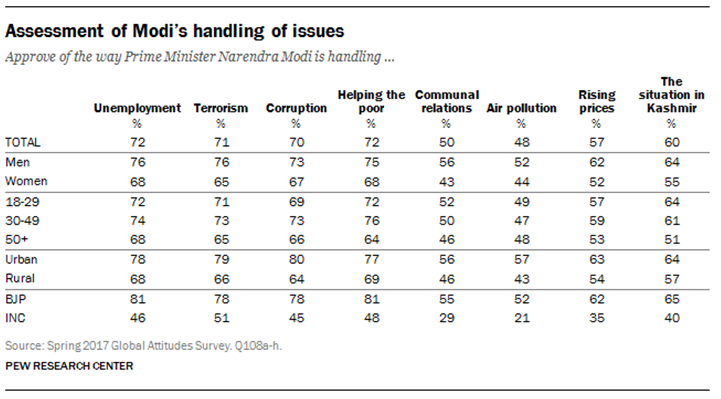
The Pew survey found that 88 per cent of Indians held a favourable view of Modi, a shade higher than the 87 per cent who gave him a thumbs-up in 2015, a year after he swept to power promising to transform India into a high-growth economy.
Modi’s favourable rating is 31 percentage points higher than that of Congress president Sonia Gandhi, the leader of the main opposition Congress party, 30 points more than that for her son and Congress vice-president Rahul Gandhi, who is expected to take over the party leadership, and 49 percent higher than Delhi chief minister and AAP convenor Arvind Kejriwal.
Public backing for Arvind Kejriwal has consistently dipped after coming to power in Delhi in 2015. Two years on, only 39 per cent Indians view him in a favourable light.
Not just Modi, but also his party, the BJP, continues to enjoy widespread public support. More than eight-in-ten Indians have a favourable view of the party, roughly its level of backing for the past three years, says the report.
About six-in-ten Indians express a positive opinion of the Congress party. Again, this is fairly consistent with past support. But the gap between BJP and Congress backing, which was 26 points in 2015 and then narrowed to 13 points in 2016, has now widened again to 25 points.
Indians in rural areas (63%) are more supportive of Congress than those in cities (51%). Those with a primary education or less are more likely to back Congress than are those with at least some college education.
Notably, 60% of Congress party supporters have a favourable view of the BJP. Just 45% of BJP backers hold a positive opinion of the Congress party. Neither party’s supporters hold positive views of the AAP.
While there has been much criticism of Modi government over demonetisation and growing unemployment, the poll found that more than 80 percent of those surveyed said economic conditions were good, up 19 percentage points since just before the 2014 election. “Overall, seven-in-ten Indians are now satisfied with the way things are going in the country. This positive assessment of India’s direction has nearly doubled since 2014,” Pew said.
More than 83 per cent Indians say the nation’s economy is good, and 30 per cent say it is very good.
Bloomberg reported that in an email reply, Bruce Stokes of Pew Research said that the data on hand does not include public sentiment over the last few months after signs emerged that the economy was in a funk after two economic disruptions in 6 months – demonetisation and the GST roll out. “What is important is that satisfaction with the economy was widely shared across demographic groups. And trust in the government and satisfaction with democracy was correlated with economic satisfaction,” Stokes told Bloomberg.
Roughly three-quarters of the public (76%) says the media, such as television, radio, newspapers and online news, have a good influence on the way things are going in India. But such sentiment is far less intensely felt (39% very good) and is down 16 points from public views in 2015. BJP supporters (79%) are much more likely than Congress backers (59%) to say the media have a good influence, and Congress supporters are somewhat more likely to have no view.
BJP supporters and those who live in urban areas are significantly more likely than Congress party backers and those in rural regions to support rule by a strong leader, by the military and by experts. Rural respondents and Congress supporters are significantly more likely to offer no opinion, however. Those with some college education or more are significantly more likely than those with a primary education or less to back rule by experts, although those with less education are also more likely to not answer. In general, there are no major differences by gender and age.[/vc_column_text][/vc_column][/vc_row]






India News
Centre sends 3 letters to Punjab government after anti-drug activist’s killing
The Centre has sought reports from the Punjab government on three incidents linked to allegations surrounding drug-related activities, including the killing of anti-drug activist Parvinder Singh Jhota.

India News
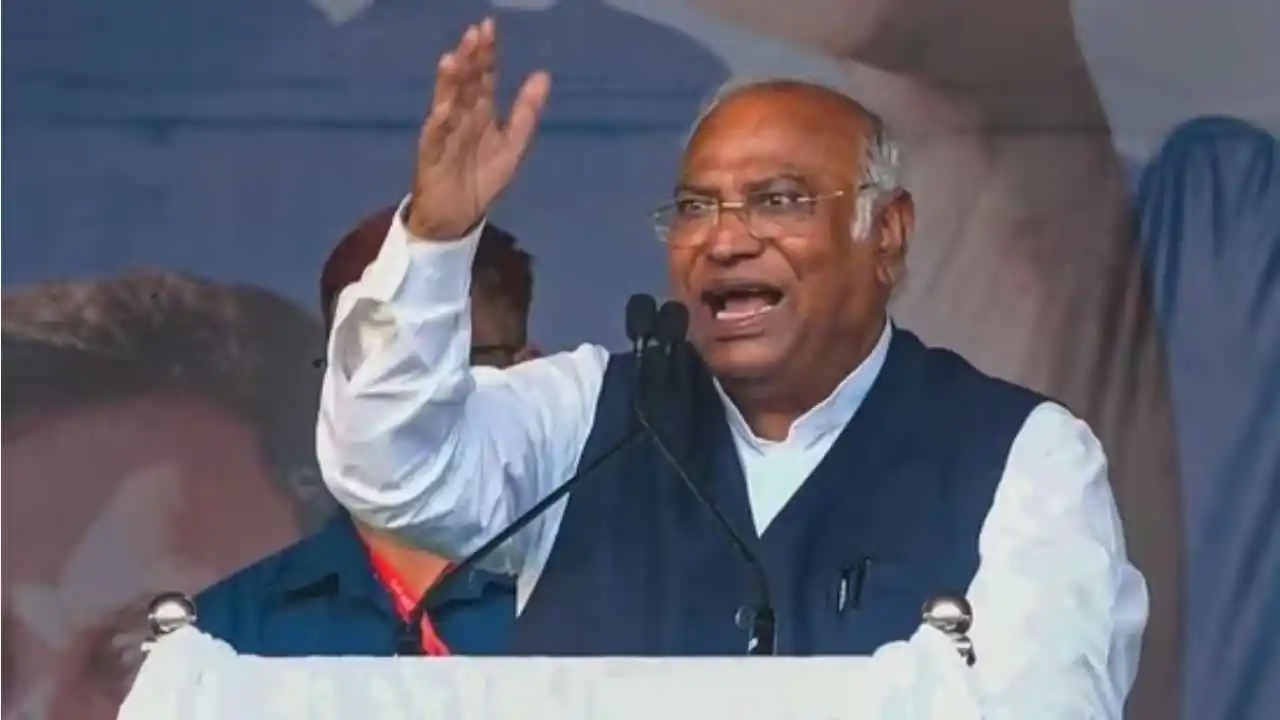
Mallikarjun Kharge seeks all-party meeting with PM Modi on delimitation
Congress president Mallikarjun Kharge has written to Prime Minister Narendra Modi for the fourth time, seeking an all-party meeting on delimitation. He also flagged the 64-day delay in proroguing Parliament’s Monsoon Session.
India News
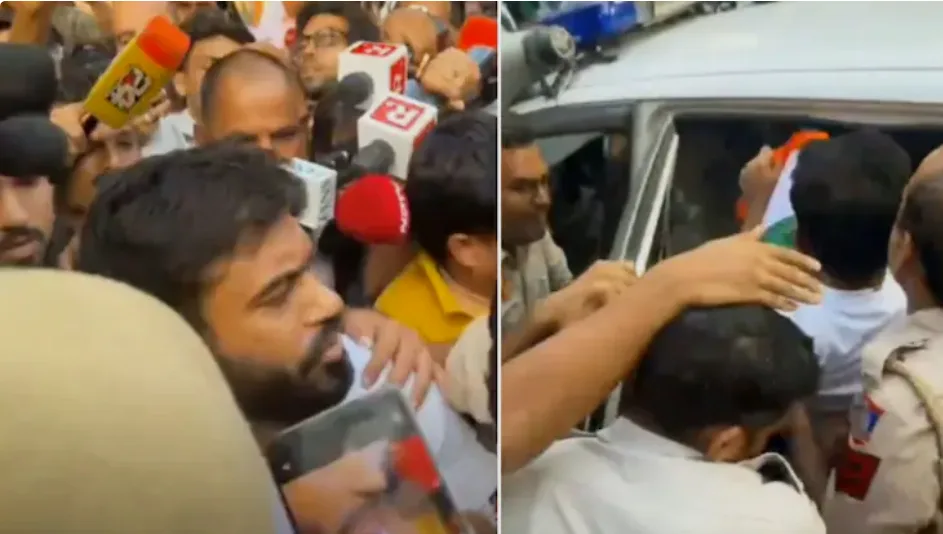
Abhijeet Dipke detained ahead of CJP’s national flag march in Delhi
Cockroach Janta Party founder Abhijeet Dipke was detained by Delhi Police on October 16, 2026, shortly before a planned national flag march. The proposed rally followed the judicial custody of two CJP members who had waved the Tricolour at Jantar Mantar.

Delhi Police offers 11-person limit for CJP’s Connaught Place protest

Magnitude 7 earthquake strikes Russia’s Kamchatka Peninsula

Mallikarjun Kharge’s ‘Your Friends’ jab at Rahul Gandhi over congress exits

Delhi deploys 25,000 personnel, installs CCTV cameras ahead of CJP march

Abhijeet Dipke detained ahead of CJP’s national flag march in Delhi

Centre sends 3 letters to Punjab government after anti-drug activist’s killing

Mallikarjun Kharge seeks all-party meeting with PM Modi on delimitation
Abhijeet Dipke detained ahead of CJP’s national flag march in Delhi
Magnitude 7 earthquake strikes Russia’s Kamchatka Peninsula
Delhi deploys 25,000 personnel, installs CCTV cameras ahead of CJP march

Afghan Men Try To Hang With The Jet Engine Of The Aircraft in Kabul- Afghanistan News – Kabul News
Trending Top 10 News: 10000 Crore Fine on Flipkart, Apple to Launch Unique Feature, Hdfc Bank Job Ad

Trending Top 10 News: Nokia 6310, Apple sales, Bachpan ka Pyar Video Kid, Dainik Bhaskar IT Raid

Trending Top 10 News: Canada bans Indian flights, Rain in Delhi NCR, AIMIM Twitter hacked, Raj Kundra case

Trending Top 10 News: Shein India, Apple New Service, Pocket Oxygen, Oppo Launched New Phone
-
 India News24 hours ago
Delhi Police offers 11-person limit for CJP’s Connaught Place protest
-
 Latest world news12 hours ago
Magnitude 7 earthquake strikes Russia’s Kamchatka Peninsula
-
 India News12 hours ago
Mallikarjun Kharge’s ‘Your Friends’ jab at Rahul Gandhi over congress exits
-
 India News12 hours ago
Delhi deploys 25,000 personnel, installs CCTV cameras ahead of CJP march
-
 India News3 hours ago
Abhijeet Dipke detained ahead of CJP’s national flag march in Delhi
-
 India News1 hour ago
Mallikarjun Kharge seeks all-party meeting with PM Modi on delimitation
-
 India News24 mins ago
Centre sends 3 letters to Punjab government after anti-drug activist’s killing
