English हिन्दी
Connect with us

India News

Modi inaugurates slew of Kedarnath redevelopment works, attacks Cong

Published

on

Modi in Kedarnath

[vc_row][vc_column][vc_column_text]The Prime Minister claimed that the UPA government in 2013 had rejected his offer to help with the re-construction of the flood-ravaged Kedarnath shrine

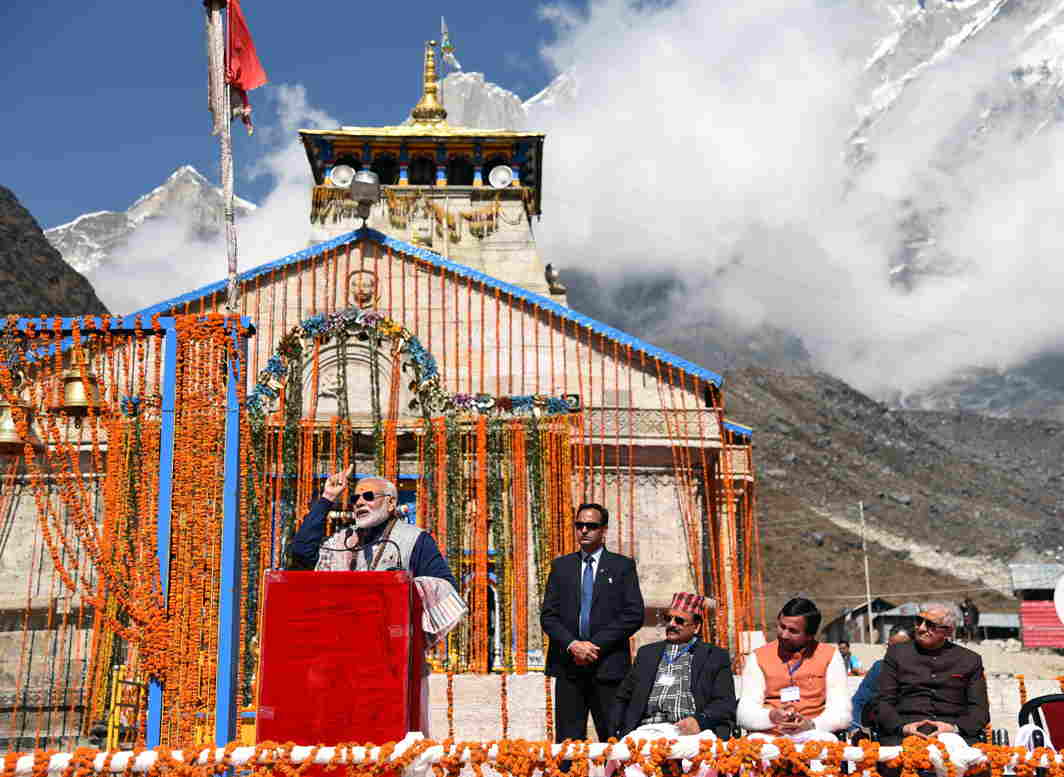
Visiting the Kedarnath shrine for the second time this year, Prime Minister Narendra Modi laid the foundation for five projects worth Rs 150 crores and announced a slew of redevelopment works for the Hindu pilgrimage site, on Friday.

The Prime Minister also launched a fresh attack at the Congress party, claiming that the UPA government had rejected his offer (when he was Gujarat chief minister) to help with re-construction of the sacred temple and its surroundings in the aftermath of the catastrophic 2013 floods that ravaged the region.

Modi had, during the 2013 floods, personally flown in to Kedarnath to ‘lead’ rescue and relief operations that were specifically aimed at ferrying Gujratis stranded in the region back to their home state. While Modi, who was then the Gujarat chief minister, and the BJP had then lauded the rescue operations and criticised the Congress – which ruled Uttarakand and at the Centre then – for its poor rescue operations, the political rival had hit back claiming that Modi’s claims were exaggerated. Unofficial but wildly trending claims on social media platforms and even on television news channels had, during the June 2013 Uttarakhand floods, sought to spread the notion that the Modi-led Gujarat government had pressed “4 Boeing jets, 25 buses, and 80 Toyota Innovas to save 15000 Gujarati pilgrims” within a matter of 24 hours. While these exaggerated claims had promptly been punctured by the Army that was carrying out most of the relief work and also the Congress, they had led to Modi being mocked by Opposition parties as a ‘Rambo’ for allowing such rumours to persist.

On Friday, while Modi steered clear of reviving those tall and unbelievable claims, he did not miss the opportunity of chastising the Congress party.

The Prime Minister claimed: “The floods of 2013 had made all of us extremely sad. That time I was not the Prime Minister, I was the Chief Minister of Gujarat. I came here to do all that I could for the victims. I had met the then Chief Minister (Vijay Bahuguna – who quit the Congress to join the BJP in May 2016) and the state government officials and offered that Gujarat would redevelop Kedarnath. During the meeting they agreed. And I announced it outside in the media. But when the news was flashed on television, and it reached Delhi, the people there (UPA government) panicked and within hours the state government was pressurised to announce that it will redevelop Kedarnath itself.”

With his party now firmly in power both at the Centre and in Uttarakhand, Modi claimed that he knew that the redevelopment of the Kedarnath shrine and its surrounding areas will be done only by the BJP.

The Prime Minister said that his party’s government in New Delhi and in the State want to promote Kedarnath as “an ideal Tirth Kshetra (pilgrim centre)” and that “We are building quality infrastructure in Kedarnath. It will be modern but the traditional ethos will be preserved. We will ensure the environment is not damaged.”

Modi laid the foundation stone for several reconstruction projects in Kedarpuri, including renovation of the Adi Shankaracharya’s tomb which was devastated in the 2013 flash floods. The Prime Minister also promised three-storey houses to the priests who live around the Kedarnath shrine, saying that in these houses one floor will be for devotees, one for the priest themselves, and one for their guests. He also assured that the width of the narrow road that leads to the shrine will be increased and all modern facilities will be provided to the residents of the region as well as to the tourists.

“I am happy that some 4.5 lakh pilgrims reached Kedarnath in the season and this number will certainly cross by 10 lakh in the next year”, the Prime Minister said, asserting that “I intended to serve baba (Kedarnath) but he perhaps had different plan for me… He possibly wanted me to serve 125 billion babas.”[/vc_column_text][/vc_column][/vc_row]

Education

CBSE makes three languages mandatory for Classes 9 and 10 from July 1

CBSE has announced that students in Classes 9 and 10 must study three languages from July 1, 2026, though no board examination will be conducted for the third language during the initial rollout.

Published

on

CBSE

The Central Board of Secondary Education has announced that students in Classes 9 and 10 will be required to study three languages from July 1, 2026, as part of the implementation of the National Education Policy (NEP) 2020 and the National Curriculum Framework for School Education (NCFSE) 2023.

Under the revised structure, students will study languages under the R1, R2 and R3 format. The board has clarified that two of the three languages must be Indian languages.

However, CBSE has stated that there will be no Class 10 board examination for the third language, also referred to as R3, during the initial phase of implementation.

What the new language structure means

According to the updated curriculum framework, students will choose three different languages. The same language cannot be selected at more than one level simultaneously.

The board has explained the structure as:

  • R1: Any language offered by CBSE
  • R2: A language different from R1
  • R3: A third language different from both R1 and R2

The move is aimed at promoting multilingual education in line with NEP 2020 recommendations.

No board exam for third language initially

CBSE has clarified that although the third language will become mandatory for Classes 9 and 10, students will not immediately face a board examination for R3 in Class 10.

Reports said the full implementation of the three-language board examination structure is expected to happen gradually over the coming years.

Schools asked to prepare for rollout

The board has already directed schools to finalise language options and upload details on the OASIS portal to ensure smooth implementation of the revised policy.

CBSE has also indicated that temporary textbook arrangements and interim measures for language teacher shortages may be introduced during the transition phase.

Continue Reading

India News

Maharashtra asks Google, Apple to remove Uber, Ola, Rapido apps over bike taxi operations

Maharashtra has asked Google and Apple to remove Uber, Ola and Rapido apps over alleged illegal bike taxi operations and safety concerns linked to passenger transport services.

Published

on

Rapido

Maharashtra has intensified its action against app-based bike taxi services, with the state government asking Google and Apple to remove apps such as Uber, Ola and Rapido from their app stores over alleged illegal bike taxi operations.

According to notices issued by Maharashtra Cyber, the companies are allegedly operating passenger transport services through bike taxis without obtaining the required permissions and approvals under transport regulations and the Motor Vehicles Act.

The cyber department said unauthorised bike taxi operations pose serious safety concerns for passengers. Authorities highlighted issues related to driver verification, insurance coverage, women’s safety measures and emergency response systems. Officials also claimed that rash and negligent driving linked to some bike taxi operations has increased public safety risks.

The state government also referred to a recent incident involving the alleged death of a woman linked to a bike taxi service, stating that a criminal case has been registered and that similar complaints have surfaced in different parts of Maharashtra.

In its communication to Google and Apple, Maharashtra Cyber reportedly asked the companies to remove and disable access to such applications from the Apple App Store and Google Play Store. The notices warned that failure to comply with directives issued by Indian law enforcement agencies could invite legal consequences under provisions of the Information Technology Act.

Maharashtra Transport Minister Pratap Sarnaik has also directed the cyber department to register FIRs against the ride-hailing platforms over their bike taxi operations in the state.

The action comes amid growing debate over the legality of bike taxi services in several Indian states. While some states permit regulated bike taxi operations, others have imposed restrictions or initiated enforcement action against aggregators operating without formal approval.

The Maharashtra government clarified that the current crackdown is specifically against alleged illegal bike taxi services and does not affect other cab and auto services provided by these platforms.

Continue Reading

India News

Those who want to leave can go: Mamata Banerjee after Trinamool’s poll setback

Mamata Banerjee has told Trinamool Congress leaders that those who wish to leave the party are free to do so after its electoral defeat, as she pushes for organisational rebuilding.

Published

on

mamta banerjee

West Bengal Chief Minister Mamata Banerjee has sent a strong message to party members amid internal unrest following the Trinamool Congress’ electoral defeat in the 2026 Assembly elections, saying those who wish to leave the party are free to do so.

The remarks come as the TMC grapples with its worst electoral performance in years and growing dissatisfaction within its ranks.

‘Will not stop anyone from leaving’

At a recent internal review meeting with party candidates, Banerjee reportedly told leaders that she would not attempt to hold back anyone planning to exit the party. She emphasised that the organisation would move forward with those who remain committed.

According to party sources, she said she would focus on rebuilding the organisation from the ground up, including restoring party offices and strengthening grassroots-level structures.

Push for rebuilding the organisation

Banerjee also called for detailed, area-wise reports from party workers and directed them to hold meetings at block and town levels to assess the reasons behind the defeat.

She further indicated that the party would undergo internal restructuring, with efforts aimed at reviving organisational strength at the local level.

Fact-finding teams and internal review

As part of the post-poll exercise, the Trinamool Congress has also set up multiple fact-finding teams to examine alleged irregularities in key districts.

These developments highlight growing internal churn within the party as it attempts to recover from its electoral setback and rebuild its support base.

Continue Reading

Trending

© Copyright 2022 APNLIVE.com