English हिन्दी
Connect with us

India News

Now an app to help farmers practice precision agriculture

Published

on

Now an app to help farmers practice precision agriculture
[vc_row][vc_column][vc_column_text]~By T V Venkateswaran

New Delhi, June 14 (India Science Wire): Engineering students at Indian Institute of Technology Roorkee have developed a mobile app that can help farmers practice precision agriculture, particularly in application of precise amounts of fertilizers.

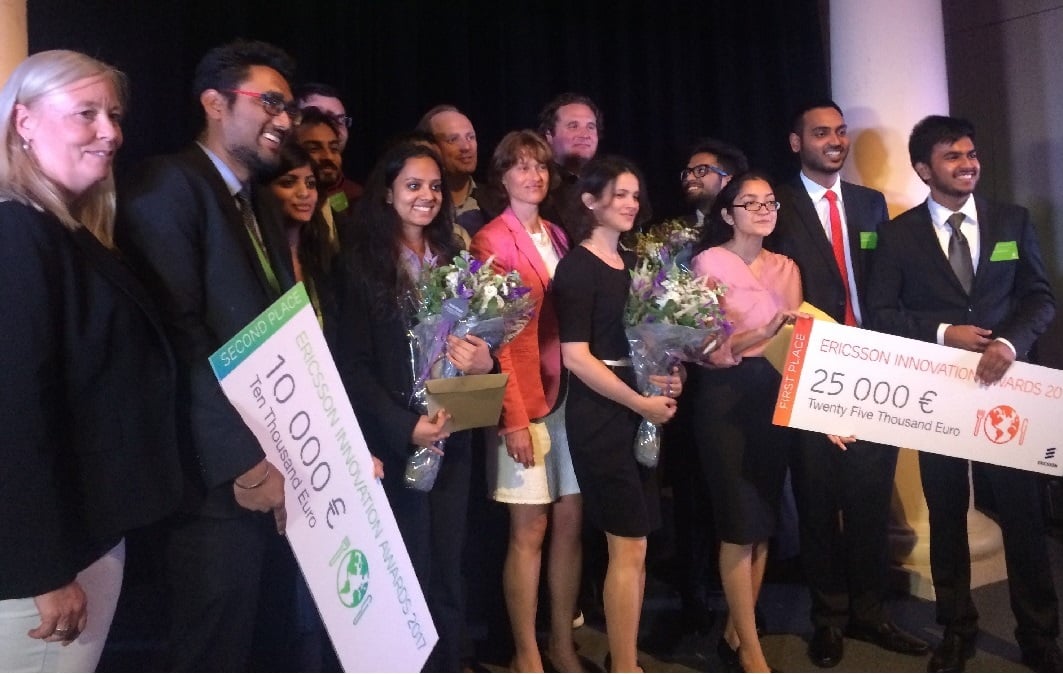
By determining health of the crops using hyperspectral imaging of crop leaves, the app could help in rational use of fertilizers. The development has won IIT Roorkee students the Ericsson Innovation Award 2017. Over 900 teams from 75 countries participated in the global contest for developing innovative ICT ideas on the theme of ‘Future of Food’.

Farmers apply fertilizer based on their experience rather than on any rational input. Therefore, if they chose not to apply fertilisers, perhaps they may be taking a risk and suffer economic losses. On the other hand, excessive application spoils the soil and damages the environment. “If only the farmers can know the health status of the plant, then they can make a more rational choice. The app developed by our students would be handy to the farmers. They would be able to know if the crops need fertilisers or not in just a snap,” says Prof Ajit Kumar Chaturvedi, Director, IIT Roorkee.

Named SNAP, the app uses a precision agriculture technology to determine the optimum fertiliser inputs for the crop and works on the principle of hyperspectral imaging of plant leaves. Spectral lines are like fingerprints that indicate presence or absence of a chemical by studying the light reflected by the leaf. Hyperspectral imaging combines conventional spectroscopy with imaging techniques to acquire both spectral and spatial information simultaneously for detecting physical, chemical, and biological attributes of the samples.

When the sunlight falls on a leaf, the reflected visible light and the near-infrared rays contain specific signals that tell about its chemical constituents. Water content, amount of macronutrients such as nitrogen (N), phosphorus (P), potassium (K), magnesium (Mg), calcium (Ca), as well as micronutrients such as sulfur (S), sodium (Na), iron (Fe), manganese (Mn), boron (B), copper (Cu), and zinc (Zn) and so on can be effectively measured using the hyperspectral imaging technology.

“The app uses mobile phone camera as the imaging device and hence could be profusely used in the field by the farmers,” pointed out Prof Chaturvedi.

The award winning team included Ekdeep Lubana, Anisha Godha Ankit Bagaria and Utkarsh Saxena with diverse expertise of electronics and communication, chemical and metallurgy. After an intense global competition, the team was one of the three global finalists to compete at Noble Museum in Stockholm, Sweden. The low-cost handheld imaging device for optimising fertiliser use in agricultural was declared the global winner and the team were awarded 25,000 Euro.

The jury was chaired by Sara Mazur, Head of Ericsson Research, had Caleb Harper, MIT Media Lab, Dr Catherine Mulligan, Imperial College London, Mattias Fyrenius, CEO Nobel Media, and Johan Jörgensen, Founder Stockholm FoodTech as members.

India Institute of Technology Delhi’s ICT product ‘Enigma’ that seeks to reduce weevil infestations in rice crop storage won the second place while  students of Aalto University, Finland who developed  ‘Foodgrid’, an attempt at minimizing the distance between farm and table by building a social and commercial platform to connect urban farmers, landowners with green space, and consumers won the third place. (India Science Wire)[/vc_column_text][/vc_column][/vc_row]

India News

Congress, BJP attack Bhagwant Mann over remarks on Punjab blasts

Congress and BJP have jointly criticised Punjab CM Bhagwant Mann after he linked recent blasts near defence sites to political motives, triggering a controversy.

Published

on

Bhagwant Mann

A political row has erupted in Punjab after Chief Minister Bhagwant Mann linked recent blast incidents to political motives, drawing sharp criticism from both the Congress and the Bharatiya Janata Party (BJP).

The controversy follows two low-intensity explosions reported within a short span of time — one near the Border Security Force (BSF) headquarters in Jalandhar and another close to an army cantonment area in Amritsar. The incidents raised concerns over security, particularly given the sensitive nature of the locations.

In response, Mann suggested that the blasts could be part of a larger political strategy. His remarks triggered a strong backlash, with opposition parties accusing him of politicising a serious security issue.

Leaders from the Congress criticised the Chief Minister’s statement, calling it inappropriate and alleging that such comments undermine the gravity of the situation. They stressed that matters related to national security should be handled with caution and responsibility.

The BJP also joined the criticism, questioning the basis of Mann’s claims and urging the state government to focus on investigation and law enforcement instead of making political allegations.

The developments have led to an unusual moment where both Congress and BJP appear aligned in their criticism of the Aam Aadmi Party-led government in the state.

Meanwhile, the blasts themselves have intensified concerns over safety in border regions, with authorities continuing their investigation into the incidents. No casualties were reported, but the proximity to defence establishments has made the issue particularly sensitive.

The episode has further escalated political tensions in the state, with security and accountability emerging as key points of debate.

Continue Reading

India News

Himanta Biswa Sarma resigns as Assam chief minister, oath ceremony likely after May 11

Himanta Biswa Sarma resigns as Assam Chief Minister after BJP-led NDA’s victory. He will continue as caretaker CM until the new government is sworn in after May 11.

Published

on

Himanta sharma

Assam Chief Minister Himanta Biswa Sarma resigned from his post on Wednesday, paving the way for the formation of a new government after the BJP-led NDA secured a decisive victory in the 2026 Assembly elections.

Sarma submitted his resignation to Governor Lakshman Prasad Acharya at Lok Bhawan in Guwahati. The Governor accepted the resignation and asked him to continue as the caretaker Chief Minister until the new government takes charge.

The resignation comes after the NDA’s strong electoral performance, where the alliance won a clear majority in the 126-member Assembly, ensuring its return to power for another term.

Oath ceremony expected after May 11

Speaking to reporters after submitting his resignation, Sarma said the swearing-in ceremony for the new government is likely to be held after May 11.

He indicated that Prime Minister Narendra Modi has been invited to attend the ceremony but is unavailable until May 11, which has influenced the tentative schedule.

Decision on next chief minister soon

Sources suggest that central observers, including senior BJP leaders, are expected to arrive shortly to oversee the selection of the legislature party leader. The newly elected MLAs will then decide on the next Chief Minister.

Despite the formal resignation, party sources indicate that Sarma is likely to continue in the role for another term, given the BJP’s strong mandate in the state.

The move marks the beginning of the government formation process in Assam following the election results declared earlier this week.

Continue Reading

India News

Rahul Gandhi and Vijay alliance took shape through backchannel talks, early signals from Congress leaders

Congress outreach and political calculations led to Rahul Gandhi and Vijay coming together after the Tamil Nadu 2026 election results.

Published

on

The coming together of Rahul Gandhi and actor-politician Vijay in Tamil Nadu after the 2026 Assembly elections was not sudden, but the result of behind-the-scenes political manoeuvring and early signals within the Congress.

According to media reports, some leaders in the Tamil Nadu Congress had already sensed the scale of Vijay’s surge during the campaign, anticipating what was later described as a “wave” in favour of his party.

After the results, where Vijay’s Tamilaga Vettri Kazhagam (TVK) emerged as the single largest party but fell short of a majority, communication channels between the Congress leadership and Vijay quickly became active.

A key moment in this evolving political equation was a phone call from Rahul Gandhi to Vijay, congratulating him on the party’s strong performance. The conversation was seen as more than a courtesy, signalling the possibility of cooperation at a time when government formation required additional support.

Reports indicate that discussions within Congress weighed the political benefits of supporting Vijay, especially given the shifting dynamics in the state where traditional dominance by major Dravidian parties has been challenged.

With TVK needing allies to cross the majority mark, Congress emerged as a potential partner, leading to a broader political realignment in the state. This development also triggered tensions within opposition alliances, highlighting the strategic importance of the decision.

The evolving partnership reflects a mix of electoral pragmatism and changing voter sentiment, particularly the growing influence of younger voters, which leaders acknowledged as a key factor in the election outcome.

Continue Reading

Trending

© Copyright 2022 APNLIVE.com