English हिन्दी
Connect with us

India News

PM Modi concludes 5-nation tour, strengthens strategic ties and receives top honours

Prime Minister Narendra Modi returned to India after a significant diplomatic tour across five nations, including participation in the BRICS Summit and receipt of top honours in three countries.

Published

on

PM Modi

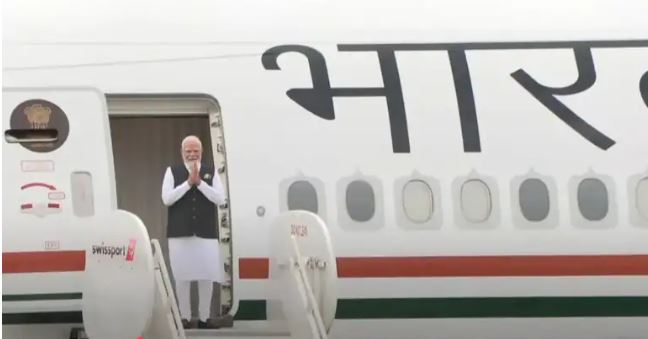
Prime Minister Narendra Modi returned to New Delhi on Thursday morning after completing a week-long five-nation diplomatic tour that included Ghana, Trinidad and Tobago, Argentina, Brazil, and Namibia. The official visit, held from July 2 to July 9, featured high-level bilateral engagements, strategic partnerships, and participation in the 17th BRICS Summit hosted in Rio de Janeiro, Brazil.

Historic visit to Ghana

PM Modi began his tour with a significant milestone—arriving in Accra on July 2, marking the first visit by an Indian Prime Minister to Ghana in over three decades. In talks with Ghanaian President John Mahama, both leaders reviewed and reaffirmed the longstanding ties between the two nations. They agreed to elevate bilateral relations to a Comprehensive Partnership, with enhanced cooperation in critical minerals, defence, maritime security, and energy.

As a mark of appreciation, PM Modi was awarded Ghana’s highest civilian honour, The Officer of the Order of the Star of Ghana. He termed the honour a “matter of immense pride.”

Engagement in the Caribbean

On July 3, PM Modi landed in Trinidad and Tobago for his first visit to the Caribbean nation as Prime Minister. His arrival also marked the first visit by an Indian PM to the country since 1999. He held discussions with Prime Minister Kamla Persad-Bissessar and addressed the Parliament.

A major announcement during this leg was the extension of Overseas Citizenship of India (OCI) eligibility to the sixth generation of the Indian diaspora in Trinidad and Tobago. Modi also received the nation’s highest award, The Order of the Republic of Trinidad and Tobago, during a ceremony held at the President’s House in Port of Spain.

Strengthening Latin American ties in Argentina

PM Modi’s next stop was Buenos Aires on July 4, where he met Argentine President Javier Milei. Their discussions focused on enhancing cooperation in areas like defence, agriculture, oil and gas, trade, and clean energy.

Calling the visit “productive,” PM Modi stated it would “add significant momentum” to bilateral relations. In recognition of his visit, he was presented the Key to the City of Buenos Aires by Jorge Macri, the city’s chief.

BRICS Summit and bilateral talks in Brazil

In Brazil, Modi attended the 17th BRICS Summit from July 6 to 7 in Rio de Janeiro. Post-summit, he travelled to Brasilia for a State Visit, where he engaged in bilateral discussions with President Luiz Inácio Lula da Silva. Talks revolved around expanding the strategic partnership in trade, technology, space, defence, agriculture, and health.

The Brazilian President conferred upon Modi The Grand Collar of the National Order of the Southern Cross, Brazil’s highest civilian decoration.

Warm welcome and honour in Namibia

The final leg of the tour took PM Modi to Namibia, where he addressed the Namibian Parliament and received a standing ovation. He was bestowed the Order of the Most Ancient Welwitschia Mirabilis, the country’s highest civilian honour, by President Netumbo Nandi-Ndaitwah. His visit highlighted shared democratic values and ongoing collaboration in conservation, defence, and capacity building.

India News

Air India, IndiGo flights disrupted after Iran shuts airspace amid US tensions

International flights operated by Air India, IndiGo and SpiceJet were disrupted after Iran shut its airspace, forcing rerouting and cancellations.

Published

on

Air india flight

International flights operated by Air India, IndiGo and SpiceJet were disrupted on Thursday after Iran abruptly shut its airspace to commercial aircraft, triggering delays and cancellations on several long-haul routes.

Iran ordered the closure of its airspace without providing an official explanation, as tensions remain elevated between Tehran and Washington and protests continue across the country against Supreme Leader Ayatollah Ali Khamenei.

Indian airlines issue travel advisories

Air India said its flights overflying the region are now operating through alternative routes, resulting in longer flight times and possible delays. The airline also confirmed that some services have been cancelled where rerouting is not feasible.

“Due to the emerging situation in Iran and the subsequent closure of its airspace, Air India flights overflying the region are using alternate routing, which may lead to delays. Some flights are being cancelled where rerouting is currently not possible,” the airline said in a statement on social media.

Passengers were advised to check flight status before travelling to the airport, with the airline reiterating that passenger and crew safety remains its top priority.

IndiGo also acknowledged disruptions to its international network, describing the situation as a “sudden airspace closure” beyond the airline’s control. The carrier said it is working to assist affected passengers by offering alternative travel options.

Customers have been advised to use flexible rebooking options or claim refunds, depending on their preference.

SpiceJet issued a similar advisory, confirming that some of its flights have been impacted due to the closure of Iranian airspace.

Airspace shutdown linked to regional security concerns

According to official notices issued to pilots, Iran’s airspace closure is expected to remain in place until 7:30 am local time. The move comes amid heightened regional tensions and follows earlier shutdowns during military confrontations involving Israel earlier this year.

Aviation risk monitoring platforms have noted that several international airlines are already avoiding Iranian airspace, citing concerns over possible military activity, air defence operations and the risk of misidentification of civilian aircraft.

The situation continues to be monitored closely, with further disruptions possible if the airspace restrictions are extended.

Continue Reading

India News

Maharashtra civic body polls today with focus on Mumbai and Pune

Maharashtra is voting today in civic body elections across 29 municipal corporations, with the BMC and Pune polls seen as crucial political tests.

Published

on

Voting is underway today for civic body elections across Maharashtra, covering 29 municipal corporations, with Mumbai and Pune emerging as the main political battlegrounds. The polls, being held after a long delay, are widely seen as a crucial test of political strength and identity ahead of larger state and national contests.

Polling began at 7.30 am for a total of 2,869 seats across 893 wards in the 29 civic bodies. The elections are taking place years after the scheduled term of most municipal corporations ended between 2020 and 2023. Voting will continue until 5.30 pm, while counting of votes is scheduled to begin at 10 am on January 16.

BMC election draws maximum attention

The Brihanmumbai Municipal Corporation (BMC), India’s richest civic body, remains the centre of attention. Unlike other corporations, the BMC follows a single-member ward system, meaning each voter casts only one vote. In the remaining 28 civic bodies, wards have three to five seats, requiring voters to cast multiple votes.

The BMC poll is particularly significant for the Thackeray brothers, Uddhav and Raj, who have come together in its backdrop after two decades. The election is seen as an opportunity for them to reassert their claim as political heirs of Bal Thackeray and revive their influence in Mumbai, a city long governed by the undivided Shiv Sena.

Test of Marathi identity politics

The elections are also being closely watched as a test of the “Marathi Manoos” plank. Rooted in the Samyukta Maharashtra movement of the 1950s and shaped politically by Bal Thackeray, the Marathi identity has remained a defining feature of Mumbai’s politics and a core theme for the Thackeray-led parties, particularly the Maharashtra Navnirman Sena.

BJP-Shinde alliance and NCP in fray

For Chief Minister Eknath Shinde, who split the Shiv Sena in 2022, the civic polls offer a chance to regain lost ground and reinforce his claim as Bal Thackeray’s political successor. His alliance partner, the BJP, is contesting 137 of the BMC’s 227 seats, while the Shinde-led Sena is contesting the remaining 90. The BJP, which won 82 seats in the last BMC election in 2019, is aiming to significantly improve its tally.

Meanwhile, Ajit Pawar’s faction of the Nationalist Congress Party is contesting the polls independently after differences with the BJP over leadership issues. The party is hoping to regain influence, especially in Pune, where the undivided NCP had controlled the civic body for a decade between 2007 and 2017.

With high political stakes, delayed polls and shifting alliances, today’s civic elections are expected to offer clear signals about Maharashtra’s evolving political landscape.

Continue Reading

India News

Karnataka to convene joint legislature session over MGNREGA repeal

The Karnataka government will convene a joint session of the legislature from January 22 to discuss the Centre’s repeal of MGNREGA, triggering sharp criticism from the opposition.

Published

on

karnataka assembly

The Karnataka cabinet on Wednesday decided to convene a joint session of the state legislature from January 22 to January 31, with the Centre’s decision to repeal the Mahatma Gandhi National Rural Employment Guarantee Act (MGNREGA) set to be the key focus.

The Congress-led government had earlier planned a two-day special session to discuss the repeal of MGNREGA, which has been replaced by the Viksit Bharat Guarantee for Rozgar and Ajeevika Mission (Gramin) (VB-G RAM G). However, State Law and Parliamentary Affairs Minister H K Patil said the plan was altered due to constitutional provisions.

Briefing reporters, Patil said the government was compelled to convene a joint session instead of a special session because of a technical requirement. Citing Article 176 of the Constitution, he explained that the Governor must address the first session of the state legislature every year.

“As a result of this technical reason, we are advancing the session. Instead of a special session, it will be a joint session,” Patil said, adding that holidays during the session would be announced by the Speaker.

He stressed that the state government would not remain silent if people’s rights were “snatched away” and said the objective of the session was to create public awareness and exert pressure on the Centre to restore MGNREGA.

Opposition questions intent of the session

Leader of Opposition in the Karnataka Assembly R Ashoka strongly criticised the decision, alleging that the joint session was convened with a “malafide intention” and amounted to a “sheer waste of money”.

Addressing a press conference, Ashoka said legislative sessions were meant for law-making and discussions on governance issues, questioning the purpose of holding a session on a matter decided by the Centre.

“What is this session convened for? Is it to utter gibberish in the House? There is no use of this session,” he said, adding that any resolution passed by the Assembly would have no practical value and would be ignored.

Continue Reading

Trending

© Copyright 2022 APNLIVE.com