English हिन्दी
Connect with us

India News

Punjab-Haryana water row: Congress, BJP, other parties attend all-party meeting over water-sharing issue called by AAP govt

“Haryana used 103% of its share by March and now demands more for April and May. Punjab needs every drop for paddy sowing,” Mann asserted, vowing to protect the state’s interests.

Published

on

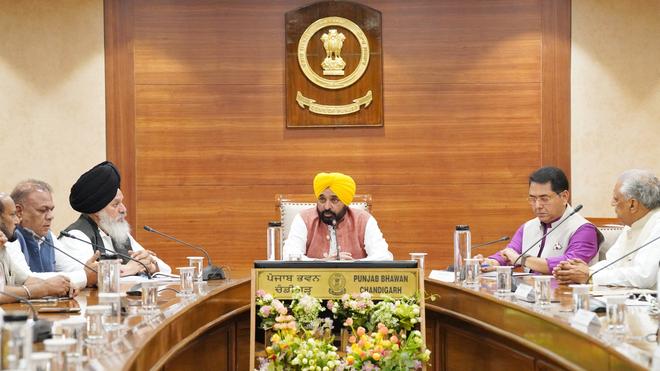
Tensions over water sharing between Punjab and Haryana escalated as the Aam Aadmi Party (AAP)-led Punjab government convened an all-party meeting in Chandigarh on Friday, May 2, 2025, to address the contentious issue.

Leaders from AAP, Congress, BJP, Shiromani Akali Dal (SAD), and Bahujan Samaj Party (BSP) gathered to discuss the state’s stance, with Punjab Chief Minister Bhagwant Mann firmly opposing the release of additional water to Haryana, claiming it has already consumed its allocated share.

Key attendees included Mann, AAP state president Aman Arora, Punjab BJP chief Sunil Jakhar, Congress leaders Tript Rajinder Singh Bajwa and Rana K.P. Singh, and SAD representatives Daljit Singh Cheema and Balwinder Singh Bhunder.

The meeting follows Mann’s sharp criticism of the Bhakra Beas Management Board (BBMB) for releasing 8,500 cusecs of water to Haryana, a decision he labeled a “robbery” of Punjab’s rights. Mann accused the BJP-ruled states of Haryana and Rajasthan of colluding to secure more water, bypassing Punjab’s authority despite its 60% stake in the BBMB.

“Haryana used 103% of its share by March and now demands more for April and May. Punjab needs every drop for paddy sowing,” Mann asserted, vowing to protect the state’s interests.
The AAP intensified its protest by staging a dharna at the Nangal dam in Rupnagar, led by Minister Harjot Singh Bains, where party workers locked the water regulation room and handed the key to police. Punjab Police bolstered security around the dam, downstream of the Bhakra dam, to prevent unrest. The government also announced a special Vidhan Sabha session on Monday to further deliberate the issue.

The BBMB, which oversees water distribution from the Bhakra, Pong, and Ranjit Sagar dams for Punjab, Haryana, and Rajasthan, faced Punjab’s ire for ignoring its objections. Mann called the decision an act of “thuggery” and “dictatorship,” insisting Punjab’s approval is mandatory.

Opposition parties echoed his sentiment, with Congress and SAD warning that Punjabis would not allow excess water to flow elsewhere. Surprisingly, Punjab BJP chief Jakhar aligned with this view, stating on X, “Punjab has no surplus water to share.”

Haryana Chief Minister Nayab Singh Saini, however, accused Punjab’s AAP government of playing “dirty politics” by halting drinking water supply, a first in the states’ history.

“This is not about irrigation but basic human needs. Punjab, as the elder brother, should not weaponize water,” Saini said, urging cooperation and decrying the politicization of a humanitarian issue.

India News

Ajit Pawar concedes civic poll setback, says public mandate is supreme

Ajit Pawar has accepted defeat in Maharashtra’s civic polls, acknowledging the public mandate and pledging stronger efforts to rebuild trust ahead of future elections.

Published

on

Ajit Pawar

Deputy Chief Minister and Nationalist Congress Party (NCP) chief Ajit Pawar on Friday accepted the verdict of the recently concluded municipal corporation elections in Maharashtra, stating that the public’s mandate must be respected above all else.

Following near-clear results in the 29 municipal corporations across the state, Pawar took to social media to formally acknowledge the party’s poor performance in several major urban centres. He said the outcome reflected the will of the people and congratulated all winning candidates.

“The public’s mandate is supreme, and we accept it with complete respect. I heartily congratulate all the winning candidates and wish them success in their upcoming terms,” Pawar said.

Ajit Pawar promises renewed effort after losses

Addressing the party’s inability to achieve the expected results, the NCP leader said his faction would introspect and work harder to regain the confidence of voters.

“In this local body election, where we did not achieve the expected success, I assure you that we will work with more responsibility, honesty and double the vigour to regain the public’s trust,” he said.

He also urged newly elected representatives to focus on public issues and speed up development work. At the same time, Pawar encouraged party workers and candidates who lost the elections to remain committed to public service, underlining that serving citizens should remain the central objective.

Setback in traditional strongholds

The civic poll results have been viewed as a significant setback for Ajit Pawar, particularly in western Maharashtra. Despite choosing to contest independently in several areas—separate from Mahayuti partners BJP and the Eknath Shinde-led Shiv Sena—to demonstrate the strength of his faction, the NCP suffered major losses in Pune and Pimpri-Chinchwad.

Both municipal corporations, long regarded as strongholds of the Pawar family, witnessed a decisive lead and victory for the BJP, leaving Ajit Pawar’s faction trailing in third or fourth position.

In Mumbai and Chhatrapati Sambhajinagar, the party struggled to make an impact, failing to secure even double-digit seats in the Brihanmumbai Municipal Corporation.

Political observers believe the strategy of “friendly contests” against the BJP did not yield the desired outcome. The results indicate that the traditional Pawar support base may have split between Ajit Pawar and his uncle Sharad Pawar’s faction, indirectly benefiting the BJP.

The outcome of the 2026 civic polls is being seen as an important signal ahead of the 2029 Maharashtra Assembly elections, pointing to shifting political equations within the ruling alliance.

Continue Reading

India News

BJP-led alliance set to wrest BMC as Thackerays trail in Mumbai civic polls

The BJP-led alliance is set to take control of the Brihanmumbai Municipal Corporation, ending the Thackerays’ long hold as early trends show a clear majority in Mumbai’s civic polls.

Published

on

modi on maharashtra election

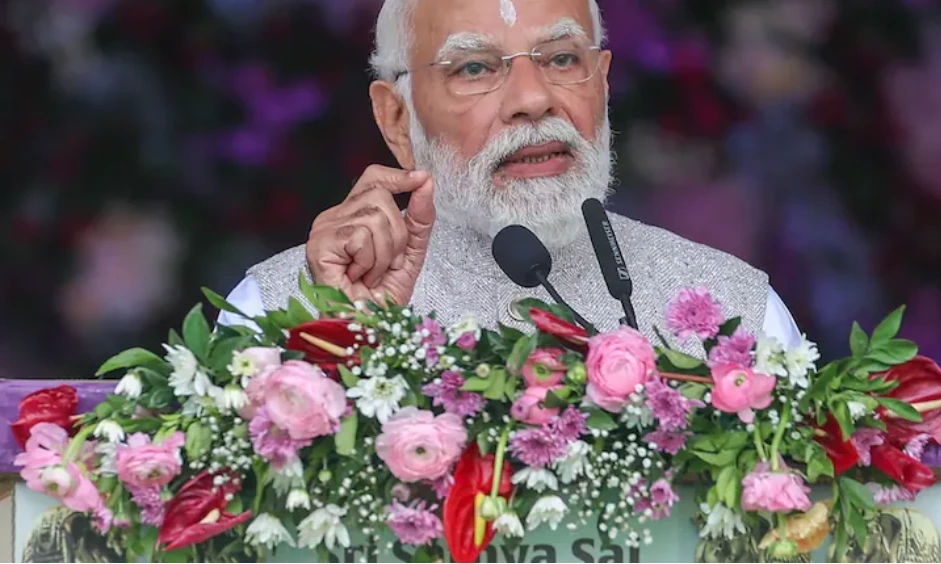
The BJP-led alliance is on course to secure control of the Brihanmumbai Municipal Corporation (BMC), ending over two decades of dominance by the Thackeray family, according to early trends from the civic body election results announced on Friday.

As counting continues, the BJP and the Eknath Shinde-led Shiv Sena alliance is leading in 117 wards, crossing the majority mark of 114 in the 227-member BMC. The BJP alone is ahead in 88 wards, while the Shinde faction of the Shiv Sena is leading in 29.

In contrast, the Thackeray cousins are trailing with leads in 70 wards. Uddhav Thackeray’s Shiv Sena (UBT) is ahead in 64 wards, while Raj Thackeray’s Maharashtra Navnirman Sena (MNS) is leading in six.

High-stakes BMC election after long delay

The BMC elections were held after a nine-year gap, following a delay of nearly four years. A total of 1,700 candidates contested the Mumbai civic polls, making it one of the most closely watched municipal elections in the country.

With an annual budget exceeding Rs 74,400 crore, the BMC is India’s richest civic body and plays a crucial role in governing Mumbai’s infrastructure, health services, and urban development.

In the 2017 elections, the then-undivided Shiv Sena, which included the Eknath Shinde faction, had retained control of the civic body.

BJP leads across Maharashtra municipal corporations

The broader picture across 29 municipal corporations in Maharashtra also favours the BJP-led front. Statewide trends show the BJP leading in 1,427 wards, while its ally, the Shinde-led Shiv Sena, is ahead in 403 wards.

The Congress is placed third with leads in 317 seats, with strong performances in areas such as Bhiwandi-Nizampur, Nagpur, and Kolhapur. Ajit Pawar’s Nationalist Congress Party (NCP) is leading in 165 wards, followed by Shiv Sena (UBT) with 157.

Pune results reinforce BJP dominance

In Pune, another key battleground, the BJP has emerged as the clear frontrunner. The party is leading in 123 of 165 seats, while the combined factions of the NCP — led by Ajit Pawar and Sharad Pawar — are together ahead in 24 seats.

Voting details

Polling was held for 2,869 seats across 893 wards in the 29 civic bodies on Thursday. A voter turnout of 52.94% was recorded, with 15,931 candidates in the fray statewide.

Apart from Mumbai and Pune, counting is underway in municipal corporations including Navi Mumbai, Thane, Vasai-Virar, Kalyan-Dombivli, Nagpur, Nashik, Pimpri-Chinchwad, Mira-Bhayandar, Bhiwandi-Nizampur, Solapur, Amravati, Akola, Kolhapur, and several others.

Continue Reading

India News

GRAP stage-III measures enforced across Delhi as air quality worsens

Delhi’s air quality has deteriorated further, prompting authorities to enforce GRAP stage-III measures across the NCR amid rising AQI levels.

Published

on

Delhi-Pollution

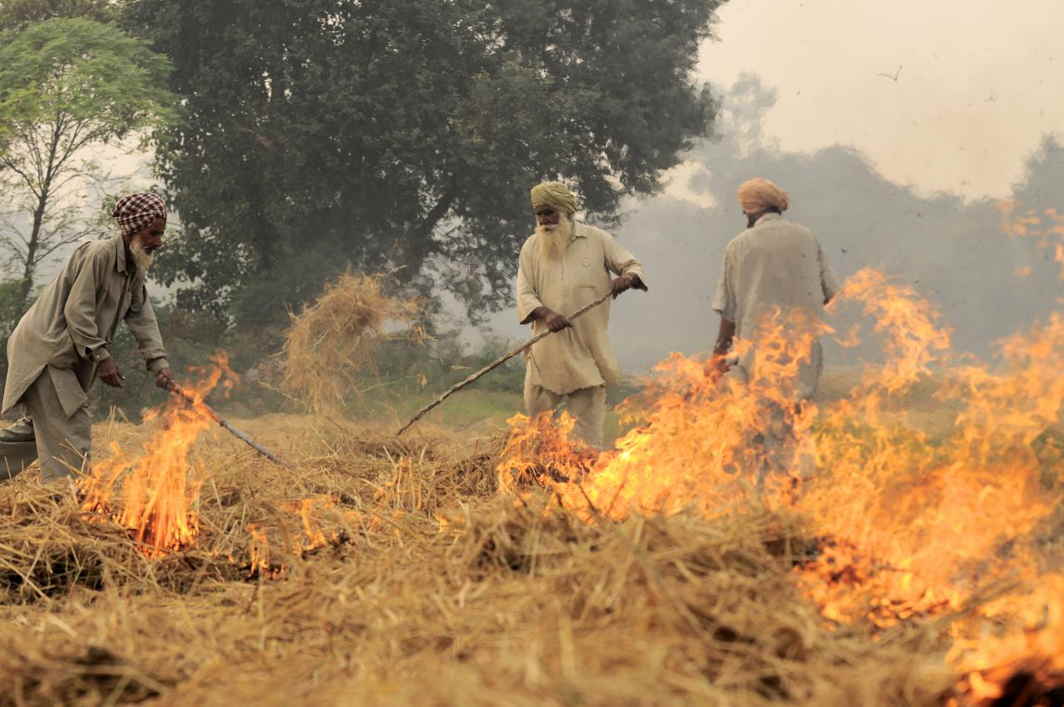
Delhi’s air quality has continued to deteriorate, prompting authorities to enforce Stage-III measures under the Graded Response Action Plan (GRAP) across the National Capital Region with immediate effect.

The Commission for Air Quality Management (CAQM) said the Air Quality Index (AQI) of the national capital showed a worsening trend over the past 24 hours. The AQI stood at 343 on January 15 at 4 pm and rose further to 354 by 4 pm on Thursday, raising concerns that pollution levels could soon enter the ‘Severe’ category.

Weather agencies have forecast unfavourable atmospheric conditions in the coming days, including low wind speeds, a stable atmosphere and poor dispersion of pollutants. Officials said these conditions could push Delhi’s average AQI beyond 400, which falls under the ‘Severe’ air quality bracket.

Stage-III restrictions come into force across NCR

In view of the rising pollution levels and the forecast of further deterioration, the CAQM sub-committee on GRAP decided to invoke all measures under Stage-III. These measures correspond to ‘Severe’ air quality levels and have been implemented as a precautionary step to prevent further decline.

The Stage-III actions will be enforced in addition to the restrictions already in place under Stages I and II of GRAP, which remain operational across the NCR. Officials said the combined measures aim to tighten controls on pollution sources, enhance monitoring and ensure stricter enforcement to curb emissions.

CAQM has directed pollution control boards and concerned agencies in the NCR to intensify preventive and regulatory steps. Authorities have been asked to ensure strict compliance with GRAP norms and take prompt action against violations.

Officials said air quality levels will be closely monitored, and further decisions will be taken based on real-time data and evolving weather conditions. Citizens have been urged to cooperate with advisories and follow measures aimed at reducing pollution levels.

Continue Reading

Trending

© Copyright 2022 APNLIVE.com