English हिन्दी
Connect with us

Economy news

RBI’s bid to safeguard economy

The Reserve Bank of India, in a bid to ease liquidity pressures on mutual funds, announced on Monday 50 thousand crore rupees Special Liquidity Facility for mutual funds.

Published

on

RBI

The Reserve Bank of India, in a bid to ease liquidity pressures on mutual funds, announced on Monday 50 thousand crore rupees Special Liquidity Facility for mutual funds. The RBI stated that the coronavirus lockdown has “heightened volatility in capital markets” and has imposed liquidity strains on mutual funds. However, the RBI added that the stress at this stage is confined only to the high-risk debt mutual fund segment and “the larger industry remains liquid”.

In a big relief for mutual fund investors, the Reserve Bank of India on Monday announced a special liquidity facility (SLF-MF) of Rs 50,000 crore with a view to ease liquidity pressures on mutual funds which have cropped up as a result of heightened volatility in capital markets due to the Covid-19 pandemic.

“The RBI has stated that it remains vigilant and will take whatever steps are necessary to mitigate the economic impact of Covid-19 and preserve financial stability. With a view to easing liquidity pressures on MFs, it has been decided to open a special liquidity facility for mutual funds of Rs 50,000 crore,” the central bank said in a statement.

Under the facility, the RBI shall conduct repo operations of 90 days tenor at the fixed rate. Banks can submit their bids to avail funding on any day from Monday to Friday excluding holidays, the RBI said.

“The scheme is available from April 27, 2020 till May 11, 2020 or up to utilization of the allocated amount, whichever is earlier,” the circular added.

Funds availed under the SLF-MF shall be used by banks exclusively for meeting the liquidity requirements of MFs by extending loans, and undertaking outright purchase of repos against the collateral of investment grade corporate bonds, commercial papers (CPs), debentures and certificates of deposit (CDs) held by MFs.

The decision came after one of the top fund houses in India — Frankiln Templeton Mutual Funds on April 24 — decided to shut down six of its debt funds due to liquidity troubles in the bond market triggered by Covid-related issues.

Economy news

ITR filing last date today: What taxpayers must know about penalties and delays

The deadline for ITR filing ends today, September 15. Missing it may lead to penalties, interest charges, refund delays, and loss of tax benefits.


Published

on

Income Tax Return

The deadline to file Income Tax Returns (ITR) for most taxpayers, including salaried individuals, pensioners, and small businesses not requiring audit, ends today, September 15. Those who miss the due date face penalties, interest charges, and loss of certain tax benefits.

Penalties for late filing

If the return is not filed by the deadline, taxpayers can still file a belated return until December 31. However, under Section 234F of the Income Tax Act, late filing attracts penalties.

  • For income up to Rs5 lakh: penalty is capped at Rs1,000.
  • For income above Rs5 lakh: penalty increases to Rs5,000.

Additionally, if any tax remains unpaid, Section 234A imposes an interest of 1% per month (or part thereof) until the return is filed.

Consequences of missing deadline

  • Loss of certain tax benefits: Belated filers cannot carry forward specific losses such as business or capital losses.
  • Restrictions on tax regime change: Taxpayers lose the option to switch between old and new tax regimes after the deadline.
  • Refund delays: Those eligible for refunds will face delays compared to timely filers.

Steps to file before time runs out

  • Gather documents: Form 16, Form 26AS, Annual Information Statement (AIS), bank interest certificates, and proofs of investments or deductions.
  • Use the e-filing portal: File immediately to avoid last-minute portal congestion.
  • Verify your return: Ensure the ITR is verified electronically or physically for it to be considered valid.

Continue Reading

Economy news

India’s GDP surges 7.8% in Q1, outpaces estimates and China

India’s GDP surged 7.8% in Q1 2025-26, the highest in five quarters, driven by strong services and agriculture sector growth, according to NSO data.

Published

on

GDP Growth

India’s economy recorded a sharp growth of 7.8% in the April-June quarter (Q1) of 2025-26, surpassing the earlier estimate of 6.5% and outpacing China’s 5.2% growth in the same period. The figure also marks a notable rise from the 6.5% growth in the corresponding quarter last year, making it the fastest expansion in the last five quarters.

Strong performance across key sectors

According to data released by the National Statistical Office (NSO), the surge was driven primarily by the services sector, which expanded 9.3% compared to 6.8% a year ago, and the agriculture sector, which rose 3.7% against 1.5% last year.

The construction sector, however, witnessed a slowdown, growing 7.6% compared to 10.1% in the same quarter of the previous fiscal.

RBI’s earlier forecast

Earlier this month, the Reserve Bank of India (RBI) had projected a more modest Q1 growth of 6.5%, with overall real GDP growth for 2025-26 expected at 6.5%. RBI Governor Sanjay Malhotra attributed the positive outlook to favorable conditions, including a good monsoon, lower inflation, and strong government capital expenditure.

He said, “The above normal southwest monsoon, lower inflation, rising capacity utilisation and congenial financial conditions continue to support domestic economic activity. The supportive monetary, regulatory and fiscal policies, including robust government capital expenditure, should also boost demand. The services sector is expected to remain buoyant, with sustained growth in construction and trade in the coming months.”

India remains fastest-growing major economy

With China reporting 5.2% growth in April-June, India has retained its position as the world’s fastest-growing major economy. The latest figures highlight resilience in the face of external pressures, including recent US tariffs on Indian imports.

Continue Reading

Economy news

Sensex falls 600 points, nifty slips 180 as US tariffs hit Indian markets

Indian equity markets witnessed sharp declines as US tariffs on Indian imports took effect. Sensex dropped over 600 points, while Nifty fell nearly 180 points in early trade.
Published

on

Stock market crash

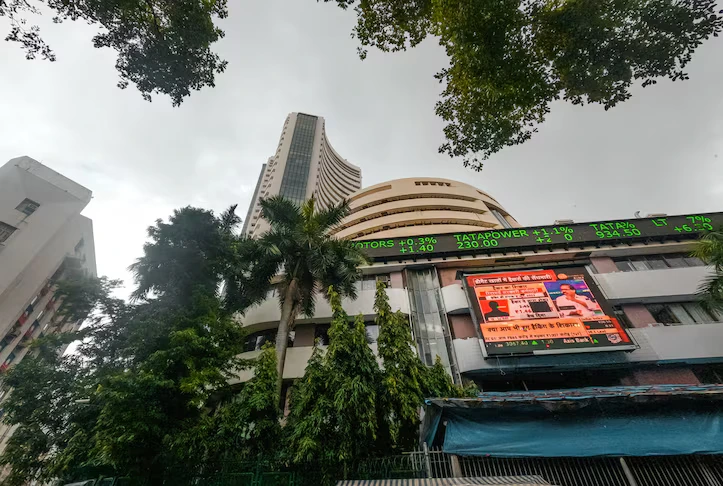
Indian stock markets opened lower on Thursday, reeling under the pressure of fresh US tariffs imposed on Indian goods.

At 9:17 am, the BSE Sensex dropped over 600 points to trade at 80,315, while the Nifty 50 declined nearly 180 points to 24,583. This comes a day after Washington enforced an additional 25% duty on Indian imports, raising the total tariff to 50%.

Broad-based sell-off across sectors

Market sentiment remained weak with 14 of the 16 major sectors posting losses. Small-cap and mid-cap indices also dipped, losing 0.2% and 0.1%, respectively.

The fall follows a steep correction earlier this week. On Tuesday, before the tariff announcement, both Nifty and Sensex fell by around 1% — their sharpest single-day decline in three months. Domestic markets remained closed on Wednesday for a local holiday.

Analysts warn of near-term pressure

According to market experts, Indian equities are likely to witness further volatility as investors digest the impact of the US action. The tariffs were imposed in retaliation for India’s continued crude oil imports from Russia, a move that has escalated trade tensions between the two nations.

Continue Reading

Trending

© Copyright 2022 APNLIVE.com