English हिन्दी
Connect with us

India News

Residents Crack the fireworks ban, post Diwali air quality worsens in Delhi-NCR

Published

on

Post-Diwali-pollution

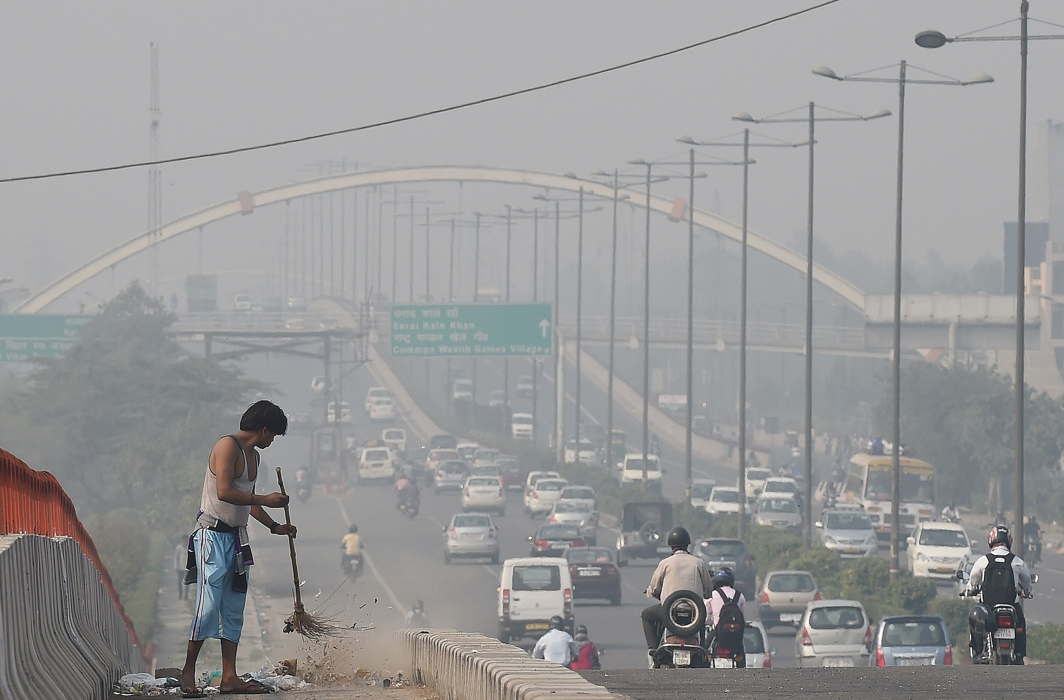
[vc_row][vc_column][vc_column_text]Delhi woke up to a hazy Friday after Diwali celebrations with the air pollution in “severe” category, partly because ban on sale of crackers in National Capital Region (NCR) failed to fully prevent fireworks.

The Supreme Court had on October 9 had affirmed a ban it had imposed on the sale of firecrackers in the Delhi-NCR, which consists of 23 districts in three states that border Delhi—14 in Haryana, seven in Uttar Pradesh and two in Rajasthan. The court had said the ban would be lifted at the end of this month, to see if there is any positive effect during Diwali.

The ban on sale of crackers did not prevent Delhiites from bursting them. Initially, Diwali got off to a much quieter start with much lesser noise and smoke till about 6 pm, compared to the previous years. But as the festivities picked up, the faint echo of crackers started growing louder and the pollution indexes sharply rose from 7 pm.

The air quality in Delhi and around was better, but only slightly, than last year’s. The Central Pollution Control Board (CPCB) was reported to have said that the pollution levels in Delhi were slightly lower compared to the air quality recorded during Diwali in 2016. The air quality index (AQI) value yesterday was 319 (Very Poor) while the air quality index last Diwali (October 30) had touched 431 (Severe).

AQI level from 0-50 is considered good, 51-100 is satisfactory, 101-200 is moderate, 201-300 is poor, 301-400 is very poor, and 401 and above is severe.

An AQI reading of ‘very poor’ essentially means that people may suffer from respiratory illnesses on a prolonged exposure to such air.

‘Severe’ category air pollution means that even healthy people will experience reduced endurance in activities and may feel strong irritations and symptoms and may trigger other illnesses. It may seriously impact those with existing respiratory or cardiovascular diseases.

In the NCR which includes Gurugram, Noida and Ghaziabad, an AQI between 400-420 was recorded today morning. Crackers were, however, burst in these regions yesterday, raising question marks on the efficacy of the administration in enforcing the top court’s ban.

A few places of the National Capital Region recorded a steep hike in pollution levels with more than 24 times the average level.

Overall, the AQI was above 400 in most places in Delhi-NCR. The US embassy’s pollution monitor recorded ‘hazardous’ air quality with the index scoring an alarming 878, which the mission considers “beyond its air quality index”, which ends at 500.

The AQI value hit the dangerous 978 mark in RK Puram, Delhi. Media reports said at 11 pm in RK Puram, PM10 read 1179 while PM2.5, the finer particulate matter, was 878 microgram per cubic metre, the highest across all DPCC stations this Diwali. The pollutants had violated the corresponding 24-hour safe limits of 60 and 100 respectively by up to 10 times.

Delhi’s Punjabi Bagh and Anand Vihar area recorded the highest level of pollution with AQI at 999 on Friday morning, which is considered to be hazardous.

The minimum level of pollution, An AQI of 221, was recorded at East Delhi’s Dilshad Garden.

The highest level of AQI, 999 – beyond which no readings are available – was recorded in the capital’s Punjabi Bagh and Anand Vihar areas.

The SAFAR (System of Air Quality and Weather Forecasting And Research), a government agency under the Earth Science ministry, estimated the 24-hour rolling average of PM2.5 and PM10 at 154 and 256 micrograms per cubic metre at around 11 pm, PTI reported.

Measures under Graded Response Action Plan (GRAP) of the Supreme Court-appointed Environment Pollution Prevention and Control Authority (EPCA) for the ‘very poor’ and ‘severe’ categories, which include a ban on diesel generator sets, came into effect on October 17 and they will remain in force till March 15.

Going by SAFAR’s forecast, the post-Diwali air will not be as poor as last year, when it was the worst in three decades. It said a host of favourable conditions were helping prevent the entry of smoke-filled air from the agricultural belt of Haryana and Punjab, where farmers burn crop stubble.[/vc_column_text][/vc_column][/vc_row]

India News

India clears Rs 3.25 lakh crore proposal to procure 114 Rafale fighter jets

India has cleared a Rs 3.25 lakh crore proposal to acquire 114 Rafale fighter jets for the Indian Air Force, marking the country’s biggest defence procurement.

Published

on

Rafale M deal

India has approved a proposal worth Rs 3.25 lakh crore to procure 114 Rafale fighter jets for the Indian Air Force, marking the largest defence acquisition programme in the country’s history.

The Defence Acquisition Council (DAC), chaired by Defence Minister Rajnath Singh, granted Acceptance of Necessity (AoN) for the Multi Role Fighter Aircraft programme. The clearance comes ahead of French President Emmanuel Macron’s upcoming official visit to New Delhi.

Under the proposal, 18 Rafale aircraft will be purchased off-the-shelf from French defence manufacturer Dassault Aviation, while the remaining 96 jets will be manufactured in India.

Make in India focus and technology transfer

The programme will be structured as a strategic partnership aimed at strengthening the government’s Make in India initiative. The deal is expected to include transfer of advanced fighter jet technology as part of domestic manufacturing.

Following the DAC’s approval, the acquisition will require final clearance from the Cabinet Committee on Security (CCS), chaired by Prime Minister Narendra Modi.

Wider approvals worth Rs 3.60 lakh crore

Alongside the Rafale programme, the DAC accorded AoN for multiple capital acquisition proposals of the armed forces at an estimated total value of about Rs 3.60 lakh crore.

For the Indian Air Force, approvals were also granted for combat missiles and an Air-Ship Based High Altitude Pseudo Satellite platform. The MRFA procurement is intended to enhance air dominance capability across the full spectrum of conflict and strengthen long-range offensive strike capacity.

The combat missiles are designed to improve stand-off ground attack capability with high accuracy. The AS-HAPS platform will support persistent intelligence, surveillance and reconnaissance operations, electronic intelligence, telecommunications and remote sensing for military use.

Army, Navy and Coast Guard procurements

For the Army, AoN was granted for the procurement of Vibhav anti-tank mines and for the overhaul of Armoured Recovery Vehicles, T-72 tanks and BMP-II Infantry Combat Vehicles. The upgrades are expected to extend the operational life of these platforms.

The Navy received clearance for a 04 MW Marine Gas Turbine-based Electric Power Generator under the Make-I category of the Defence Acquisition Procedure 2020, as well as additional P-8I Long Range Maritime Reconnaissance Aircraft. The additional P-8I aircraft are expected to enhance anti-submarine warfare, maritime surveillance and maritime strike capabilities.

The Indian Coast Guard was granted approval for the procurement of Electro-Optical and Infra-Red systems for its Dornier aircraft.

Existing Rafale fleet and naval variant

The Indian Air Force currently operates 36 Rafale aircraft across two squadrons. The last delivery of the C variant took place in December 2024.

Separately, India has ordered 26 Rafale M variant aircraft for the Navy in a deal valued at Rs 63,000 crore. These aircraft will operate from INS Vikrant and INS Vikramaditya and include provisions for maintenance, logistics support and training under a Maintenance, Repair and Overhaul arrangement.

Continue Reading

India News

Hardeep Puri hits back at Rahul Gandhi over Epstein files allegations

Hardeep Singh Puri has rejected Rahul Gandhi’s claim that references in US Department of Justice records linked to Jeffrey Epstein compromised India’s trade deal with the United States.

Published

on

Hardeep singh puri

Union Minister Hardeep Singh Puri on Thursday strongly criticised Congress MP Rahul Gandhi over allegations linked to references to his name in recently released US Department of Justice documents connected to Jeffrey Epstein.

Responding to Gandhi’s claims that the mentions had compromised India’s trade agreement with the United States, Puri dismissed the charge and said he had done nothing improper.

Speaking to media, Puri said he had met Epstein on two occasions but clarified that the meetings were arranged for official purposes and were not initiated by him.

“I didn’t seek meetings… they were set up for me,” he said, adding that two meetings did not amount to guilt by association. He emphasised that he was not part of the government at the time and said he “comes out smelling of roses” from the episode.

Row over trade agreement

The minister rejected the suggestion that references in the so-called Epstein files had placed pressure on Prime Minister Narendra Modi in negotiating a trade and tariff agreement with the United States.

Puri said that if Rahul Gandhi read the text of the India-US agreement carefully, he would understand that it is part of an interim framework that had been in the works. He stressed that for a country like India, with nearly 50 per cent of its GDP linked to the external sector, trade agreements are vital.

Taking a sharp dig at the Congress leader, Puri said Gandhi was “making a mountain out of a molehill” and accused him of not properly reading the agreement before commenting on it.

Gandhi’s allegation

On Wednesday, after speaking in the Lok Sabha and accusing Prime Minister Modi of “selling out Bharat Mata,” Rahul Gandhi claimed he had verified information that Hardeep Puri and businessman Anil Ambani were named in US Department of Justice records relating to Epstein.

Gandhi argued that the presence of Puri’s name in the files had created direct pressure on the Prime Minister, forcing him into what he described as a disadvantageous agreement for India in matters concerning farmers, data, energy security and defence.

He said no Prime Minister would compromise on such issues without facing “heavy pressure and a very strong chokehold.”

Puri responded by stating he had only met Epstein a handful of times and never in private. He said he had no interest in Epstein’s activities and added that Epstein had described him as “two-faced.”

Government response to Israel reference

Meanwhile, on January 31, Ministry of External Affairs spokesperson Randhir Jaiswal addressed reports of an email said to be part of the recently released tranche of documents that referenced Prime Minister Modi’s 2017 visit to Israel.

Jaiswal said that apart from the fact of the Prime Minister’s official visit to Israel in July 2017, the rest of the email’s references were “trashy ruminations” of a convicted criminal and deserved to be dismissed with contempt.

Fresh disclosures from US

Last month, the US Department of Justice released a new tranche of records from its files related to Epstein. The disclosure includes more than three million pages of documents, over 2,000 videos and 180,000 images.

The release follows the enactment of the Epstein Files Transparency Act, which mandates the opening of government files relating to Epstein and his longtime associate Ghislaine Maxwell.

Jeffrey Epstein died in a New York jail cell in August 2019, a month after he was indicted on federal sex trafficking charges. His death was ruled a suicide.

Continue Reading

India News

Rahul Gandhi says India must speak to Trump as equal on trade deal

Rahul Gandhi says India should negotiate with US President Donald Trump as an equal, highlighting concerns over data access, energy security and farmers amid revisions to the trade factsheet.

Published

on

Rahul_Gandhi_

Congress leader and Leader of Opposition in the Lok Sabha Rahul Gandhi on Tuesday set out what he said would have been the INDIA alliance’s approach in negotiating with US President Donald Trump on the latest trade agreement.

Speaking during the Budget session in Parliament, Gandhi said the Opposition bloc would have insisted on engaging with the United States “as equals” while safeguarding India’s strategic and economic interests.

He referred to earlier remarks by senior Congress leader Shashi Tharoor, who had described the agreement as appearing less like a free trade pact and more like a pre-committed purchase arrangement that weakens reciprocity.

Three key points outlined

Gandhi said that if the INDIA alliance were negotiating with President Trump, it would begin by acknowledging the importance of the US dollar and expressing willingness to support economic stability. However, he stressed that India’s data and market access are significant assets and any such engagement must be based on equality.

“If you want access to this data, then please understand that you are going to talk to us as an equal,” Gandhi said, adding that India should not be treated as subordinate in trade discussions.

His second point focused on energy security. Without naming specific measures, Gandhi indicated that India would protect its energy interests regardless of external pressure, an apparent reference to US calls for India to halt oil purchases from Russia.

Third, he said that while the US administration may need to safeguard its agricultural voter base, India would also protect its farmers. He added that India should not accept being equated with Pakistan in trade matters.

Changes in US factsheet

The remarks came amid political debate over an interim trade understanding between India and the United States.

The White House revised an earlier factsheet on the agreement. In the updated version, the reference to “pulses” was removed from the list of American products on which India would eliminate or reduce tariffs.

Additionally, the language describing India’s purchases of American goods was changed. The initial document had stated that India “committed” to buying more US products and purchasing over $500 billion worth of US energy, information and communication technology, agricultural goods, coal, and other items. The revised version replaced “committed” with “intends”.

Gandhi criticised the Centre in the Lok Sabha a day after the Congress alleged that India had weakened its own trade leverage.

The current phase of the Budget session is scheduled to conclude on April 2. Parliament will adjourn for recess on February 13 and reconvene on March 9 for further discussions, including examination of demands for grants by standing committees.

Continue Reading

Trending

© Copyright 2022 APNLIVE.com