English हिन्दी
Connect with us

India News

Shashi Tharoor to be tried as accused for wife Sunanda Pushkar’s suicide

Published

on

Shashi Tharoor to be tried as accused for wife Sunanda Pushkar's suicide

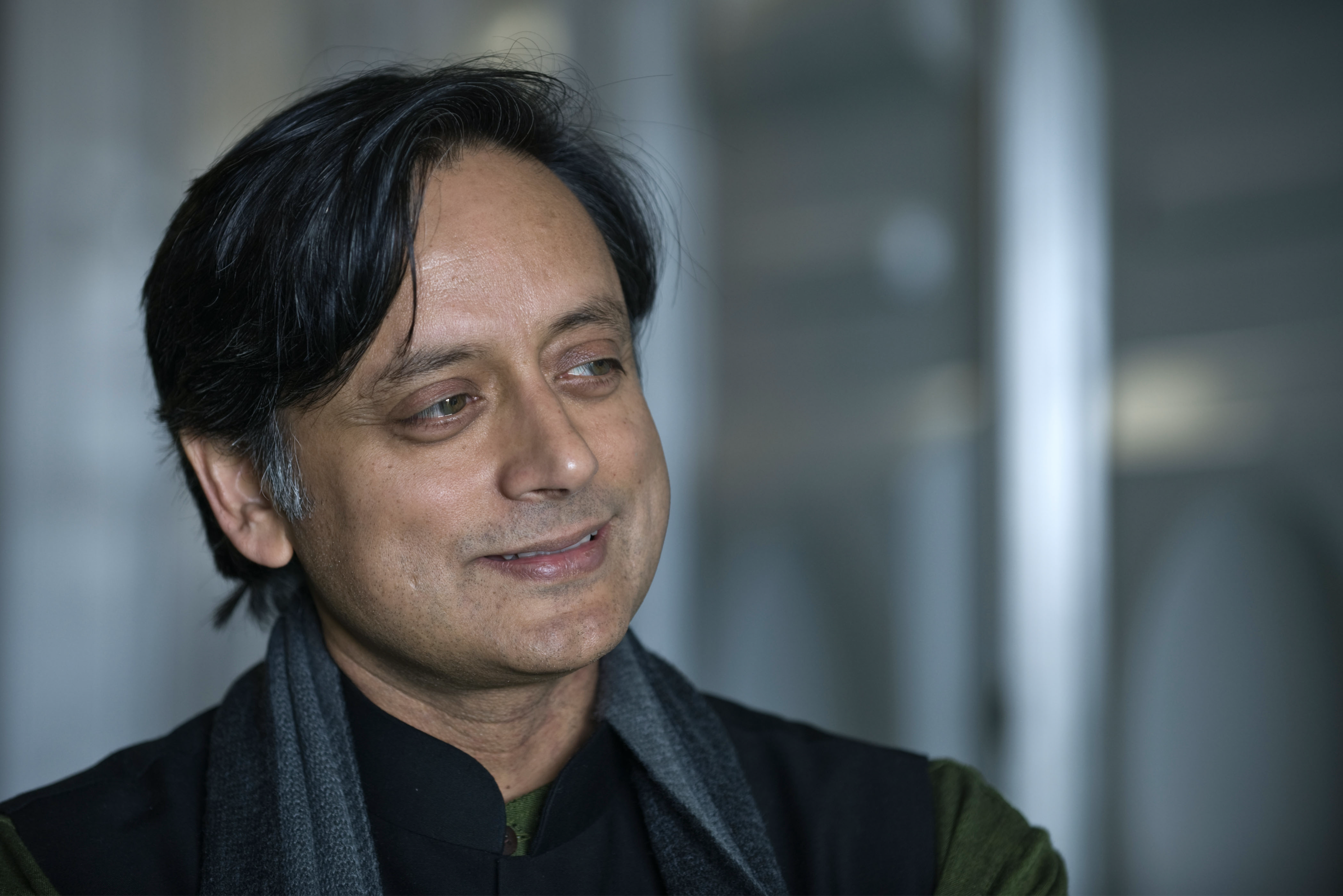
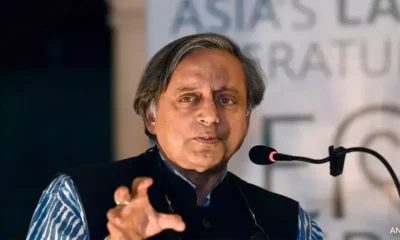
Congress MP from Thiruvananthapuram and former Union minister Shashi Tharoor will be tried as an accused for his wife Sunanda Pushkar’s suicide.

On Tuesday, June 5, a trial court in Delhi, taking cognisance of the police chargesheet naming him as accused, summoned him a month from now, on July 7. Additional Chief Metropolitan Magistrate Samar Vishal said there exist “sufficient grounds to proceed against Tharoor for commission of offences in the case”.

Tharoor has been charged with abetting the suicide of his wife Sunanda Pushkar, who was found dead in a five-star hotel in Delhi in 2014. He has also been accused of cruelty to his wife in the chargesheet submitted in court last month.

The Congress leader has been charged under sections 498 A (husband or his relative subjecting a woman to cruelty) and 306 (abetment of suicide) of the Indian Penal Code. Tharoor is the only person named as an accused in the 3,000-page chargesheet.

The police have taken as dying declaration Sunanda Pushkar’s last mails and messages on social media.

The police say about a week before her death, Sunanda Pushkar had emailed her husband that she had “lost her will to live”. In an email on January 8, nine days before her death, she had written: “I have no desire to live…all I pray for is death.”

The chargesheet quoted a special investigation team as stating that Tharoor “as a husband ignored Sunanda when she was sliding or slipping into depression and she had Alprax.” They had frequent fights, it says, and “though injury marks were not serious, they are consistent with claims that the couple fought.”

A special probe team also said Mr Tharoor “ignored her calls and disconnected her calls in the days before her death.” Sunanda Pushkar tried using social media to reach him, but those messages were also ignored, says the chargesheet.

Tharoor has called the charges “preposterous” and termed the action “unbelieveable”. The Congress has called the chargesheet “politically motivated”.

Pushkar was found dead in a luxury hotel room in south Delhi on the night of January 17, 2014, two days after she took to social media to accuse her husband of having an affair with a Pakistani journalist.

The police first claimed that Sunanda Pushkar was poisoned, and registered a murder case in January 2015, without naming any suspect.

Three years later, the police say there is no proof of murder but it was evident Sunanda Pushkar had been driven to suicide. The chargesheet mentions marital discord as the cause of suicide and says that one party led the other to commit suicide. “Sunanda Pushkar was being harassed for long. Her medical records show she was suffering from depression,” the chargesheet said.

Tharoor tweeted he will contest the chargesheet “vigorously” and hit out at Delhi Police saying, “If that was the conclusion arrived at after four plus years of investigation, it does not speak well of the methods or motivations of Delhi Police.”

“No one, who knew Sunanda, believes she would ever have committed suicide, let alone abetment on my part,” he said.

Meanwhile, Tharoor’s counsel, Vikas Pahwa told ANI that he will be taking all legal remedies available as per law. “Since the Magistrate summoned Dr Shashi Tharoor for 7th July, we shall be asking for a copy of the chargesheet, after going through it, we’ll decide our further course of action. He will take all legal remedies available to him in law.”

“Since no offences are made out and the prosecution case is absurd & preposterous and is contrary to various judgments of SC, we shall take appropriate steps to deal with the chargesheet,” he added.

India News

Delhi air quality plunges to severe as thick smog blankets the capital

Delhi’s air quality deteriorated sharply with AQI entering the ‘severe’ zone across several areas, prompting enforcement of GRAP stage-IV measures.

Published

on

Delhi's air quality

Delhi woke up to hazardous air conditions on Tuesday as dense smog covered large parts of the national capital, pushing the Air Quality Index (AQI) into the ‘severe’ category across several locations. Poor visibility and rising health concerns marked yet another spell of extreme pollution in the city.

Data from the Central Pollution Control Board (CPCB) showed the overall AQI in Delhi touching 413 in the morning, placing it firmly in the ‘severe’ bracket. Several areas across the National Capital Region (NCR) reported alarming pollution levels, indicating a widespread deterioration in air quality.

Pollution hotspots report hazardous readings

Some of Delhi’s major pollution hotspots recorded extremely high AQI levels. Anand Vihar topped the list with an AQI of 466, followed by Ashok Vihar at 444 and Chandni Chowk at 425. These areas remained in the ‘severe’ category, posing serious health risks, especially for children, the elderly and those with respiratory conditions.

Even central parts of the city were not spared. India Gate, Kartavya Path and the Rashtrapati Bhavan area were shrouded in toxic smog, with AQI levels around 384, categorised as ‘very poor’.

GRAP stage-IV measures enforced across Delhi-NCR

In response to the worsening situation, the Commission for Air Quality Management (CAQM) enforced all actions under GRAP Stage-IV across Delhi-NCR. As part of these emergency measures, truck-mounted water sprinklers were deployed to suppress dust and reduce particulate matter in the air.

As per AQI standards, readings between 401 and 500 fall under the ‘severe’ category, while levels above 300 are considered ‘very poor’, highlighting the seriousness of the current conditions.

Delhi government reviews pollution control steps

The Delhi government has reiterated its commitment to tackling rising pollution levels with strict enforcement measures. Chief Minister Rekha Gupta stated that a zero-tolerance policy will be followed against all sources contributing to air pollution in the capital.

A high-level review meeting was held at the Delhi Secretariat to assess existing measures and take further decisions. The meeting focused on enforcing Pollution Under Control (PUC) norms without any relaxation, exploring pooled and shared electric bus services across Delhi-NCR, issuing fresh guidelines for e-rickshaws, and rationalising Delhi Transport Corporation (DTC) bus routes.

Senior officials from the Environment and Transport Departments, the Delhi Pollution Control Committee (DPCC), Public Works Department (PWD) and Delhi Traffic Police, along with Environment Minister Manjinder Singh Sirsa, attended the meeting to finalise immediate and long-term steps to address the pollution crisis.

Continue Reading

India News

Rahul Gandhi alleges institutional bias, questions electoral system during Berlin address

Rahul Gandhi alleged that India’s institutions and electoral system have been weaponised to favour the BJP, remarks that sparked a strong political response.

Published

on

Rahul-Gandhi

Leader of the Opposition in the Lok Sabha, Rahul Gandhi, has said that India’s institutional framework is facing a serious challenge and has been used to favour the ruling BJP. Speaking during an interaction at the Hertie School in Berlin, Gandhi questioned the functioning of key institutions and the electoral machinery, remarks that triggered a sharp political response from the BJP.

Gandhi said the Congress believes there is a problem with the electoral system and alleged that several institutions have been captured. Referring to investigative agencies, he claimed that bodies such as the CBI and the ED have been used as political tools. According to him, cases filed by these agencies overwhelmingly target those opposing the BJP, while leaders from the ruling party face none.

He also pointed to what he described as a stark financial imbalance between the BJP and the opposition, claiming a funding ratio of 30:1. Gandhi said this disparity reflects how institutions are being used to consolidate political power.

Opposition strategy and INDIA alliance

The Congress leader said merely pointing out problems in elections is not enough and stressed the need for the opposition to build a system of resistance that can effectively counter the ruling party. He added that the challenge now goes beyond electoral contests and is about presenting an alternative vision for the country.

On the INDIA alliance, Gandhi said the unity among opposition parties is rooted in their rejection of the ideological position of the RSS. While acknowledging that tactical contests between alliance partners will continue, he said they remain united when it comes to opposing laws they disagree with and working together in Parliament.

BJP hits back at remarks abroad

Gandhi’s comments delivered overseas drew a strong reaction from the BJP. Party president and Union minister JP Nadda accused him of speaking against India while Parliament is in session and claimed that he was undermining the country’s image at a time when the Prime Minister is receiving global recognition.

BJP spokesperson Shehzad Poonawalla also criticised Gandhi, alleging that he routinely travels abroad to defame India. He accused the Congress leader of making misleading claims about the country’s institutions and economic activity while praising China.

Continue Reading

India News

DU VC Prof Yogesh Singh entrusted with additional charge of AICTE Chairman

Published

on

By

Prof. Yogesh Singh, Vice Chancellor of the University of Delhi, has been entrusted with the additional charge of the post of Chairman, AICTE till the appointment of a Chairman of AICTE or until further orders, whichever is earlier.

It is noteworthy that AICTE Chairman Prof. TG Sitharam was relieved of his duties after his term ended on December 20, 2025. According to a letter issued by the Ministry of Education, Government of India, on Monday, Prof. Yogesh Singh’s appointment is until the appointment of a regular AICTE Chairman or until further orders whichever is earlier.

Prof. Yogesh Singh is a renowned academician with excellent administrative capabilities, who has been the Vice-Chancellor of University of Delhi since October 2021. He has also served as the Chairperson of the National Council for Teacher Education. In August 2023, he was also given the additional charge of Director of the School of Planning and Architecture (SPA).

Prof. Yogesh Singh served as the Vice-Chancellor of Delhi Technological University from 2015 to 2021; Director of Netaji Subhas Institute of Technology, Delhi from 2014 to 2017, and before that, he was the Vice-Chancellor of Maharaja Sayajirao University, Baroda (Gujarat) from 2011 to 2014. He holds a Ph.D. in Computer Engineering from the National Institute of Technology, Kurukshetra. He has a distinguished track record in quality teaching, innovation, and research in the field of software engineering.

Continue Reading

Trending

© Copyright 2022 APNLIVE.com