English हिन्दी
Connect with us

India News

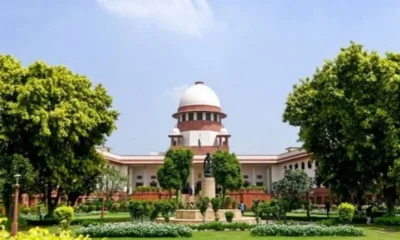
Supreme Court notice to Modi govt on plea against amendment to corruption law

Published

on

SUPREME-COURT

[vc_row][vc_column][vc_column_text]The Supreme Court today (Monday, Nov 26) issued notice to Narendra Modi government on a plea challenging constitutional validity of amendments made to the Prevention of Corruption Act in July this year making it difficult for probe agencies to expeditiously act on complaints of graft against serving and retired bureaucrats.

The amendment to the anti-graft law mandates prior sanction before starting a probe against a serving or retired government servant in a corruption case.

The Supreme Court bench comprising Chief Justice Ranjan Gogoi and Justice Ajay Rastogi was hearing a petition filed by the Center for Public Interest Litigation (CPIL).

The petition seeks a review of Section 17A of the PC Act which mandates that the still-to-be-formed Lokpal at the Centre and the Lokayuktas in States will have powers to approve initiation of inquiries against all serving and retired bureaucrats upon receipt of any complaint of graft against them. The Centre has been asked to respond to the notice within six weeks.

The Centre notified amendments to the PC Act on July 26 this year. The amended anti-graft law introduced stringent penalties for bribe givers and bribe seekers once their culpability in the act was proven but, on the other hand it made the investigative process more cumbersome.

Many anti-graft crusaders had, at the time of the passage of the amended legislation, mocked the law as one that should be called Protection (and not Prevention) of Corruption Act”.

The provision of prior sanction also introduces an element of government discretion and preference in choosing which official should be proceeded against and who should be spared.[/vc_column_text][/vc_column][/vc_row][vc_row][vc_column][vc_column_text css=”.vc_custom_1543225561723{border-top-width: 10px !important;border-right-width: 10px !important;border-bottom-width: 10px !important;border-left-width: 10px !important;padding-top: 10px !important;padding-right: 10px !important;padding-bottom: 10px !important;padding-left: 10px !important;background-color: #cecece !important;border-radius: 10px !important;}”]The amended Section 17A of the Act reads thus:

“(1) No police officer shall conduct any enquiry or inquiry or investigation into any offence alleged to have been committed by a public servant under this Act, where the alleged offence is relatable to any recommendation made or decision taken by such public servant in discharge of his official functions or duties, without the previous approval —

(a) in the case of a person who is or was employed, at the time when the offence was alleged to have been committed, in connection with the affairs of the Union, of that Government;

(b) in the case of a person who is or was employed, at the time when the offence was alleged to have been committed, in connection with the affairs of a State, of that Government;

(c) in the case of any other person, of the authority competent to remove him from his office, at the time when the offence was alleged to have been committed:

Provided that no such approval shall be necessary for cases involving arrest of a person on the spot on the charge of accepting or attempting to accept any undue advantage for himself or for any other person:

Provided further that the concerned authority shall convey its decision under this section within a period of three months, which may, for reasons to be recorded in writing by such authority, be extended by a further period of one month.”[/vc_column_text][/vc_column][/vc_row][vc_row][vc_column][vc_column_text]Critics of the amended Act claim that Section-17A “violates of Article-14, 19 and Article-21 of the Constitution of India” and that it also takes away or abridge the fundamental rights of complainants of fair investigation as well as equality before the law.

The Modi government, on the other hand, has maintained that the amended legislation serves as a strong deterrent against corruption while it also safeguards conscientious bureaucrats against motivated complaints.

Votaries of the amended Act state that it had increased the punishment for those found guilty of offering a bribe from the previous mandated jail term of six months to three years to a more stringent “up to seven years imprisonment”. The amended law also provides for a sentence of “between five to 10 years” for repeat offenders. It also stipulates that investigation and trial against government employees alleged of crimes under that Act must be completed within two years – and if this condition is not met then a maximum extension of another two years may be granted.[/vc_column_text][/vc_column][/vc_row]

India News

West Bengal Governor dissolves Assembly amid political transition 

Governor R N Ravi dissolved the West Bengal Assembly after the 2026 poll results, with the BJP securing a majority in the state elections.

Published

on

The West Bengal Legislative Assembly was dissolved following the conclusion of the 2026 Assembly elections, in which the Bharatiya Janata Party secured a clear majority in the state.

Governor R N Ravi issued the order dissolving the Assembly as the state prepared for the transition of power after the election results. According to reports, the BJP won 207 seats in the 294-member Assembly, while the Trinamool Congress secured 80 seats.

Chief Minister Mamata Banerjee questioned the election outcome and alleged irregularities in the poll process, claiming the mandate had been “looted”.

The dissolution came as the tenure of the existing Assembly ended on May 7, 2026. The development has sparked political discussions over the formation of the next government in the state.

Meanwhile, Mamata Banerjee held a meeting with newly elected Trinamool Congress MLAs in Kolkata and reportedly raised concerns over internal sabotage during the elections.

The BJP is expected to begin the formal process of government formation in West Bengal after its decisive victory in the Assembly polls.

Continue Reading

India News

Eknath Shinde’s helicopter returns to Mumbai mid-flight due to bad weather

Maharashtra Deputy Chief Minister Eknath Shinde’s helicopter was forced to return to Mumbai after the pilot detected approaching storm conditions during a flight to Thane district.

Published

on

Eknath_shinde (1)

A helicopter carrying Maharashtra Deputy Chief Minister Eknath Shinde was forced to return to Mumbai on Thursday after encountering adverse weather conditions during a flight to Thane district.

According to officials, Shinde had departed from Mahalaxmi Racecourse in south Mumbai around 3.30 pm and was travelling to Murbad in Thane district to attend a wedding function related to a party worker’s family.

The helicopter reportedly reached the Airoli area in Navi Mumbai when the pilot noticed an approaching storm and informed the deputy chief minister about the deteriorating weather conditions. Following the alert, the flight was turned back as a precautionary measure.

The helicopter later landed safely at the Pawan Hans facility in Juhu, Mumbai. Officials said Shinde was accompanied by members of his staff, including personal assistant Prabhakar Kale, special executive officer Balsingh Rajput and media adviser Vinay Patrdukar.

The incident comes amid changing weather conditions and storm activity reported in parts of Maharashtra in recent days.

Continue Reading

India News

Nitish Kumar’s son Nishant among 32 inducted in Bihar cabinet expansion

Nishant Kumar entered the Bihar cabinet for the first time as 32 ministers from NDA allies took oath in a major expansion of the state government.

Published

on

Bihar government cabinet

A major cabinet expansion took place in Bihar on Thursday, with 32 leaders from the ruling NDA alliance inducted into the state government. Among the prominent names was Nishant Kumar, son of former Bihar chief minister Nitish Kumar, who entered the cabinet for the first time.

The expansion included representatives from all major NDA allies in the state. According to reports, the BJP secured 15 ministerial berths, while JD(U) got 13 positions. Two ministers were inducted from Lok Janshakti Party (Ram Vilas), while Hindustani Awam Morcha and Rashtriya Lok Morcha received one berth each.

The oath-taking ceremony was held in Patna in the presence of senior NDA leaders, including Prime Minister Narendra Modi, Union Home Minister Amit Shah and Defence Minister Rajnath Singh.

Nishant Kumar’s induction comes weeks after he formally entered active politics. His entry into the Bihar cabinet is being viewed as a significant development for JD(U), which had long projected an anti-dynasty image under Nitish Kumar’s leadership.

The cabinet reshuffle follows Nitish Kumar’s move to the Rajya Sabha earlier this year and the formation of the government led by Chief Minister Samrat Choudhary.

Continue Reading

Trending

© Copyright 2022 APNLIVE.com