English हिन्दी
Connect with us

India News

Varanasi court rejects plea of Anjuman Masjid Committee against title suit seeking possession of Gyanvapi Mosque

The temple town was turned into a fortress on Thursday, with heavy security arrangements around the court premises.

Published

on

Gyanvapi Mosque

A court in Varanasi on Thursday disposed of a petition filed under Order 7 Rule 11 CPC against a title suit praying to hand over the possession of the Gyanvapi Mosque premises to Lord Vishweshwar Virajman (Swayambhu) and others.

The plea, filed by the committee managing the Gyanvapi Mosque called the Anjuman Masjid Committee, had challenged the maintainability of title suit filed by the Lord Vishweshwar Virajman (Swayambhu) through his next-friend and international general secretary of Vishwa Vedic Sanatan Sangh, Kiran Singh. The court of Civil Judge Senior Division Fast Track Court Mahendra Kumar Pandey fixed December 2 as the next date of hearing in the case.

Singh had sought permission to bar the entry of Muslims, hand over the premises to Hindus and worship the Shivling and perform Raag Bhog. Now the court has considered this matter as hearable.The court had heard the arguments of both the parties on October 15 and reserved its order on October 27. 

The temple town was turned into a fortress on Thursday, with heavy security arrangements around the court premises. The Vishwa Vedic Sanatan Sangh has welcomed the order.Everything belongs to the temple except the dome of Gyanvapi: Kiran SinghThe Counsels representing plaintiff Kiran Singh had argued that whether the suit was maintainable or not, the objection raised by the Anjuman Committee was a matter of evidence and trial. They said except the dome of Gyanvapi, everything belongs to the temple. When the trial will take place, only then will it be known whether it was a mosque or a temple.

Referring to the decision of Deen Mohammad, they said that there was no Hindu party in the case and therefore, it does not apply to the Hindu side. The Advocates for the Hindu side further contended that the Places of Worship (special provisions) Act, 1991 was not applicable in this case, as the structure did not show as to whether it was a temple or a mosque. The civil court has the right to conduct its trial, they added.

Read Also: Rahul Gandhi’s remarks on Savarkar helping British Govt not acceptable, says Uddhav Thackrey

They said it was a historical fact that Aurangzeb ordered the demolition of the temple and construction of a mosque. The Waqf Act did not apply to the Hindu side. As such, this suit was maintainable and the application filed by the Anjuman on the point of maintainability was liable to be dismissed.

The court had recently issued notice to the Archaeological Survey of India (ASI) and sought the opinion of the Director General on whether it was possible to safely determine the age of the ‘Shiva Linga’, which was allegedly discovered inside the Gyanvapi Mosque complex.

The High Court further ordered the Varanasi Court to set a date in the first week of December for the main lawsuit in the dispute, in which five Hindu women (plaintiffs) were requesting the right to worship Shringar Guari throughout the year inside the grounds of the Gyanvapi Mosque.

On the other hand, the Anjuman Masjid committee has termed the object discovered inside the mosque’s grounds as a “Fauwara” or fountain.

Delhi: Setback for Satyendar Jain, court rejects bail plea in money laundering case

Who is Sandhya Devanathan? Everything you need to know about the new Meta India head

India News

Centre mandates 60% free seat allocation on flights, caps selection fees

Airlines must now offer 60% seats without extra charges and ensure better seating arrangements for passengers under new government rules.


Published

on

In a significant move aimed at protecting air travellers, the Union Ministry of Civil Aviation has directed airlines to ensure that at least 60 per cent of seats on every flight are offered without any additional selection fee. The decision follows widespread complaints from passengers about hidden charges, particularly for seat selection.

The directive has been issued through the Directorate General of Civil Aviation, which has introduced a series of passenger-friendly norms to enhance transparency and improve the overall flying experience.

Under the new guidelines, airlines have also been instructed to seat passengers travelling on the same PNR together, preferably in adjacent seats. This is expected to address long-standing concerns among families and group travellers, who often face inconvenience due to scattered seating arrangements.

The regulator has further emphasised the need to safeguard passenger rights in situations such as flight delays, cancellations, and denied boarding. Airlines have been asked to prominently display these rights across their websites, mobile applications, booking platforms, and airport counters to ensure better awareness.

In addition, carriers must establish clear and transparent policies regarding the carriage of sports equipment, musical instruments, and pets. The move comes in response to frequent complaints over inconsistent rules and high charges. Airlines have been directed to align such policies with safety and operational standards while ensuring they are communicated in a simple and passenger-friendly manner.

To improve accessibility, the regulator has also asked airlines to share passenger rights information in regional languages.

Continue Reading

India News

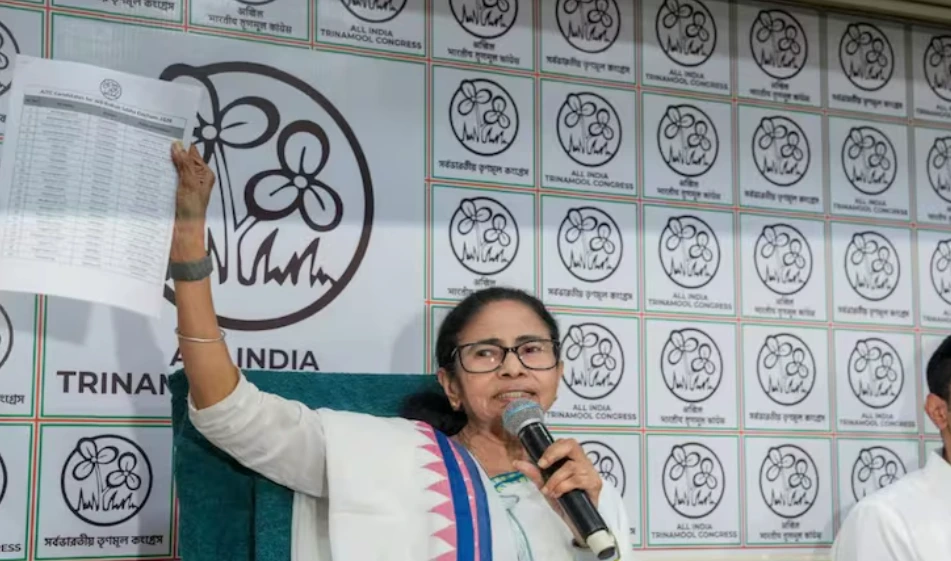
Mamata Banerjee warns BJP, EC over Bengal polls, says they will be accountable

Mamata Banerjee holds BJP and Election Commission responsible for any incidents during Bengal polls, raising concerns over officer transfers.
Published

on

West Bengal Chief Minister Mamata Banerjee has held the Bharatiya Janata Party (BJP) and the Election Commission of India responsible for any untoward incidents in the state during the upcoming assembly elections, following the transfer of key officials.

Addressing concerns over administrative reshuffles, Banerjee said that changes involving senior bureaucrats, including the chief secretary and home secretary, could affect governance and law and order in the state during a crucial period.

The Trinamool Congress chief also announced candidates for 291 constituencies for the elections scheduled to be held in two phases on April 23 and 29.

Criticising the Election Commission, Banerjee alleged that the transfers were being carried out in a manner that benefits the BJP. She questioned the timing of the decisions and said such actions weaken the state administration at a sensitive time.

She further raised concerns about disaster management and essential services, stating that experienced officials familiar with the state’s situation have been replaced. According to her, this could impact administrative efficiency if any emergency arises before the new government is formed.

Protecting Bengal’s identity

Banerjee emphasised that the election is not merely about forming a government but about safeguarding Bengal’s identity and existence. She accused the BJP of misusing central agencies and attempting to influence the electoral process.

She urged that elections should be conducted peacefully, without external interference, and in line with democratic principles. The chief minister also expressed confidence that her party would return to power with a stronger mandate.

Appealing to voters, she called for support for the Trinamool Congress, asserting that the people of Bengal will ultimately decide the outcome and protect their democratic rights.

Continue Reading

India News

Centre assures action on LPG supply disruption, court closes distributors’ plea

The Bombay High Court closed a plea by LPG distributors after the Centre assured diplomatic efforts to stabilise supply amid global disruptions.

Published

on

LPG cylinder

The Union government on Tuesday informed the Bombay High Court that it is taking diplomatic steps to address disruptions in Liquefied Petroleum Gas (LPG) supply linked to the ongoing Iran-Israel conflict, following which the court disposed of a petition filed by LPG distributors.

Appearing before the Nagpur bench, Solicitor General Tushar Mehta said the Centre was actively engaged in international-level negotiations to stabilise LPG supply. However, he noted that specific measures could not be disclosed due to their sensitive nature.

The matter was heard by a division bench comprising Justices Anil S Kilor and Raj D Wakode. The bench accepted the government’s assurances and closed the plea.

Distributors flagged supply disruption in Vidarbha

The petition was filed by six LPG distributors, including Omkar Sales, who raised concerns over disruptions in supply chains across Maharashtra’s Vidarbha region. They claimed the situation had led to a significant shortage of LPG for domestic consumers.

The distributors, dependent on Confidence Petroleum India Ltd (CPIL), alleged that despite directives prioritising domestic consumption, LPG was being diverted for export to capitalise on high international prices.

Government cites policy compliance, CPIL denies diversion

The petitioners referred to recent orders issued under the Essential Commodities Act and the Natural Gas (Supply Regulation) Order, 2026, which mandate prioritising household LPG supply during crises.

However, CPIL rejected the allegations, stating it was fulfilling pre-existing export commitments and had not violated any policy norms.

Court had earlier termed issue ‘serious’

During earlier hearings, the court had described the matter as “serious” and of “grave importance”, issuing notices to the Centre and the Ministry of Petroleum and Natural Gas.

On Tuesday, the Centre reiterated that macro-level supply challenges arising from global geopolitical tensions were being handled through diplomatic channels. It also said that any localised supply issues could be resolved by state authorities.

Taking note of these submissions, the bench disposed of the petition.

Continue Reading

Trending

© Copyright 2022 APNLIVE.com