English हिन्दी
Connect with us

India News

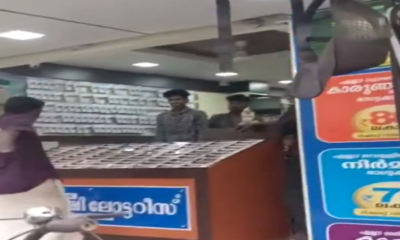
Win Win W-656 Kerala lottery result for February 21 announced: First winner gets Rs 75 lakh, check winners list here

Kerala State Lottery Department has announced the lucky draw winners of the Win Win W-656 lottery ticket today at 3 pm. The next Win Win Lottery will take place on February 28.

Published

on

Kerala engineer swallows bribe money after being caught red-handed by vigilance department, admitted to hospital

On Monday, February 21, the Kerala state lottery department announced the results for Win Win W-656. The lucky draw is being held at Gorky Bhavan, near Bakery Junction in Thiruvananthapuram. The draw is overseen by a panel of independent judges. The winner of the first prize will receive Rs 75 lakh, while the winner of the second prize will receive Rs 5 lakh. The third-place winners would receive Rs 1 lakh.

The result is available on the official website of the lottery department at keralalotteries.com.

The winner of the first prize (Rs 75 lakh) is WA 337040

The winner of the second prize (Rs 5 lakh) is WF 941613

The winners of the third prize (Rs 1 lakh) are WA 747456 WB 915458 WC 317992 WD 911270 WE 847070 WF 527729 WG 540056 WH 563134 WJ 658586 WK 898897 WL 958044 WM 644863

The winners of the consolation prize (Rs 8,000) are WB 337040 WC 337040 WD 337040 WE 337040 WF 337040 WG 337040 WH 337040 WJ 337040 WK 337040 WL 337040 WM 337040

For the tickets ending with the following numbers.

The winners of the fourth prize (Rs 5,000) are 0335 0426 1140 1405 2440 3476 4470 5583 5884 6012 6282 6760 7029 7994 8006 8044 9305 9590

The winners of the fifth prize (Rs 2,000) are 0550 1394 2166 4278 5969 6087 6411 7593 8728 9981

The winners of the sixth prize (Rs 1,000) are 0694 0755 1812 2270 3292 4793 4801 5655 6123 6676 6849 7088 7894 9708

The winners of the seventh prize (Rs 500) are 0174 0362 0412 0439 0487 0497 0535 0669 0675 0680 0795 0829 0873 0949 0997 1017 1187 1242 1312 1758 1915 2108 2112 2176 2396 2401 2447 2589 2623 2705 2830 2833 2897 3092 3174 3181 3349 3379 3382 3429 3492 3497 3663 3961 4181 4217 4298 4487 4625 4649 4846 4889 4995 5644 5744 5831 6020 6021 6046 6166 6174 6466 6494 6556 6562 6738 6807 6857 6918 7233 7381 7761 7864 8175 8179 8893 9203 9488 9615 9775 9894 9964

The winners of the eighth prize (Rs 100) are 0081 0257 0283 0304 0320 0357 0363 0516 0539 0591 0848 0889 0918 0919 0920 1084 1104 1139 1159 1353 1403 1421 1544 1556 1776 1987 2014 2032 2035 2202 2283 2501 2539 2733 2746 2917 2976 3003 3132 3228 3351 3363 3425 3530 3538 3632 3674 3735 3776 4000 4066 4095 4205 4271 4317 4348 4398 4416 4424 4495 4549 4568 4765 4802 4825 4882 4911 4917 4991 4996 5097 5136 5381 5399 5422 5470 5522 5587 5686 5726 5833 5906 6122 6171 6252 6365 6366 6377 6425 6557 6647 6791 6916 7053 7295 7429 7445 7720 7751 7752 7913 7931 7961 8009 8024 8029 8049 8074 8430 8510 8659 8704 8779 8868 8950 9078 9326 9384 9391 9396 9486 9600 9601 9718 9808 9925

The prize winners are advised to verify the winning numbers with the results published in the Kerala Government Gazette and surrender the winning tickets within 30 days.

Next Win Win Lottery

The next Win Win Lottery will be held on February 28 at Gorky Bhavan, near Bakery Junction in Thiruvananthapuram. 

Kerala State Lotteries is a lottery conducted by the Kerala government. It is the first of its kind in India. It was founded in 1967 under the lottery department of the Kerala government.

India News

PM Modi assures no discrimination in women’s quota, delimitation debate intensifies in Parliament

PM Narendra Modi has assured that women’s reservation will be implemented without discrimination, amid a heated debate over delimitation in Parliament.

Published

on

PM modi

Prime Minister Narendra Modi has assured that there will be no discrimination in the implementation of women’s reservation, as Parliament witnessed a sharp debate over the proposed linkage between the quota and delimitation exercise.

During the ongoing special session, the government reiterated its commitment to ensuring fair representation while addressing concerns raised by opposition parties regarding the timing and structure of the legislation.

The proposed framework aims to reserve 33 percent of seats for women in the Lok Sabha and state assemblies. However, its implementation is tied to a fresh delimitation exercise, which is expected after the next census.

Opposition questions timing and intent

Opposition leaders have raised concerns that linking the women’s quota to delimitation could delay its implementation. They argue that the process of redrawing constituencies may push the actual rollout further into the future.

The issue has triggered a broader political confrontation, with multiple parties questioning whether the move could alter representation across states.

Some critics have also alleged that the delimitation exercise could disproportionately benefit certain regions based on population, a charge the government has rejected.

Government reiterates commitment to fair implementation

Responding to these concerns, the Centre has maintained that the reforms are necessary to ensure accurate and updated representation based on population data.

Leaders from the ruling side have repeatedly emphasized that the process will be carried out transparently and without bias. The assurance that there will be “no discrimination” is aimed at addressing fears among states and opposition parties.

The debate marks a key moment in Parliament, with both sides engaging in intense exchanges over one of the most significant electoral reforms in recent years.

Continue Reading

India News

Give all tickets to Muslim women, Amit Shah says, attacking Akhilesh Yadav on sub-quota demand

A sharp exchange between Amit Shah and Akhilesh Yadav in Parliament over sub-quota for Muslim women highlights key divisions on women’s reservation implementation.

Published

on

A heated exchange broke out in Parliament during discussions on the women’s reservation framework, with Union Home Minister Amit Shah and Samajwadi Party chief Akhilesh Yadav locking horns over the demand for a sub-quota for Muslim women.

The debate unfolded as the government pushed forward key legislative measures to implement 33% reservation for women in the Lok Sabha and state assemblies.

Akhilesh Yadav argued that the proposed reservation must ensure representation for women from marginalised communities, including Other Backward Classes (OBCs) and Muslim women. He said that without such provisions, large sections could remain excluded from political participation.

He also questioned the timing of the bill, alleging that the Centre was avoiding a caste census. According to him, a census would lead to renewed demands for caste-based reservations, which the government is reluctant to address.

Government rejects religion-based quota

Responding to the demand, Amit Shah made it clear that reservation based on religion is not permitted under the Constitution.

He stated that any proposal to provide quota to Muslims on religious grounds would be unconstitutional, firmly rejecting the idea of a separate sub-quota for Muslim women within the broader reservation framework.

The government has maintained that the existing framework already includes provisions for Scheduled Castes (SC) and Scheduled Tribes (ST) women within the overall reservation structure.

Wider political divide over implementation

The issue of sub-categorisation within the women’s quota has emerged as a major flashpoint, even as most opposition parties broadly support the idea of women’s reservation.

Samajwadi Party leaders reiterated that their support for the bill depends on inclusion of OBC and minority women, while the government continues to defend its constitutional position.

The debate is part of a broader discussion during the special Parliament session, where multiple bills linked to delimitation and implementation of the women’s quota are being taken up.

Continue Reading

India News

No state will lose a seat, Centre assures as delimitation debate takes centre stage in Parliament

Parliament’s special session begins with key focus on implementing women’s reservation and delimitation, setting the stage for major electoral changes.

Published

on

Parliament

A special session of Parliament commenced on Thursday, with the Centre set to take up crucial legislation related to women’s reservation and delimitation of constituencies. The session, scheduled over three days, is expected to witness intense debate as the government pushes forward its legislative agenda.

At the centre of discussions is the proposal to operationalise the women’s reservation law, which seeks to allocate 33 percent of seats in the Lok Sabha and state assemblies to women. The law, passed earlier, requires enabling provisions before it can be implemented.

The rollout of the reservation is closely tied to the delimitation exercise — a process that redraws parliamentary constituencies based on updated population data. The implementation is expected only after the next census and delimitation process are completed.

The government is aiming to put in place the framework so that the reservation can be enforced in future elections, likely around 2029.

Delimitation and numbers at play

Delimitation is a key aspect of the proposed changes, as it will determine how seats are redistributed and which constituencies are reserved. The exercise is expected to reflect population shifts and may also involve an increase in the total number of Lok Sabha seats.

This linkage has made the issue politically sensitive, with several opposition parties backing women’s reservation in principle but raising concerns over how and when delimitation will be carried out.

Political reactions and expected debate

The session is likely to see sharp exchanges between the government and opposition. While there is broad agreement on increasing women’s representation, disagreements remain over the timing, process, and potential political implications of the delimitation exercise.

Some leaders have argued that delimitation could significantly alter the balance of representation among states, making it a contentious issue beyond the women’s quota itself.

The government, however, has framed the move as a step toward strengthening women’s participation in governance and ensuring more inclusive policymaking.

Continue Reading

Trending

© Copyright 2022 APNLIVE.com