English हिन्दी
Connect with us

India News

IMF warns India’s Covid situation alarming sign for other middle-income nations

For India, the report said, current bilateral purchases of vaccine plus coverage from Covaxin will cover about 25% of its population by the first half of 2022. However, India will need to immediately place sufficient vaccine orders of about 1 billion doses to get to 60% coverage. .

Published

on

black fungus patient

The International Monetary Fund warned that the ongoing Covid second wave in India, following a terrible wave in Brazil, is a sign that the worst may be yet to come in the developing world. Observing India’s ongoing Covid situation, the IMF wrote in its report that the situation in the country is a warning of the possible events in low-and middle-income nations that have seemingly escaped the pandemic till now.

A report co-authored by International Monetary Fund (IMF) economist Ruchir Agarwal and its Chief Economist Gita Gopinath on Friday said under the business-as-usual scenario, the vaccine coverage in India is expected to remain under 35% of the population by the end of 2021.

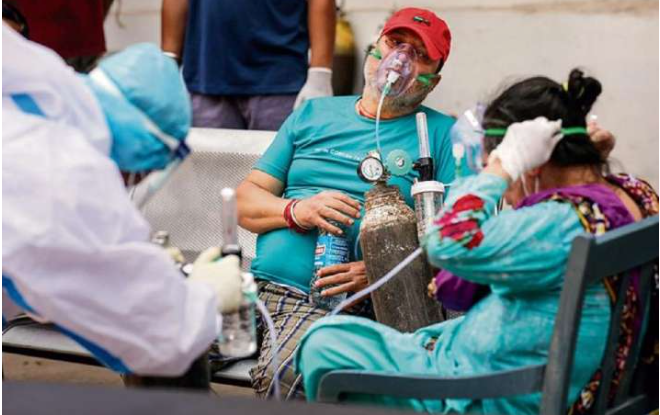
The report said India’s health system is so overwhelmed as the people are dying due to lack of medical supplies like oxygen, hospital beds and medical care while the system was fairly well during the first wave. The IMF has said that the situation in India is a warning of the possible events in low- and middle-income nations that have seemingly escaped the pandemic till now

For India, the report said, current bilateral purchases of vaccine plus coverage from Covaxin will cover about 25% of its population by the first half of 2022. However, India will need to immediately place sufficient vaccine orders of about 1 billion doses to get to 60% coverage.

In this context, the report said that the authorities had recently announced financing of about 600 million USD to the Serum Institute of India and Bharat Biotech to boost production capacity in the near term is a welcome step. In the report, authorities estimated that two billion doses will be available by the end of 2021.

In its report, the IMF said that an urgent focus should be to eliminate constraints on cross-border exports of critical raw materials and finished vaccines. Free cross-border flow of vaccine inputs and supplies is essential for the world to achieve its vaccination targets without delay.

The IMF report said India continues to face production bottlenecks, including due to ongoing shortages of critical raw materials, suggesting the need for further relaxation of de facto export restrictions under the US Defence Production Act.

Read Also: Air India data breach: Personal information of nearly 45 lakh customers leaked

Indian authorities are currently pursuing a strategy of procuring vaccines for those above 45 years of age by the central government while enabling states to procure vaccines for those aged 18-44.

India News

Kerala LSS USS result 2026: Official website slow? Check how to download scorecard online

The Kerala CM Kids LSS USS result 2026 has been declared online. Here is a comprehensive troubleshooting guide and step-by-step process to download your scorecard if the official portal bpekerala.in is down or unresponsive.

Published

on

Results

The Kerala Public Examination Section has officially announced the Kerala CM Kids LSS and USS result 2026. The scorecard link is live for candidates who sat for the scholarship eligibility examinations conducted in February 2026.

However, shortly after the declaration, several students and parents encountered difficulties trying to log onto the main portal, bpekerala.in. Due to a massive surge in simultaneous traffic from eager candidates, the official website has experienced temporary server slowdowns, loading delays, and intermittent error screens. Media reports indicate that the portal might stay slow during peak hours, but authorities ensure that the result data is perfectly safe and live online.

👉 Click Here to Check Kerala LSS USS Result 2026

Why the Kerala LSS USS result website is slow

Technical glitches right after a major result declaration are quite common due to infrastructural limitations during peak traffic. Some of the primary factors contributing to the current loading errors include:

  • High visitor traffic: Thousands of students trying to load the homepage simultaneously.
  • Server overload: Simultaneous database requests leading to temporary unresponsive servers.
  • Mobile compatibility limitations: Heavy traffic coupled with certain mobile browsers causing slow rendering times.

Step-by-step guide to download Kerala LSS USS result 2026

If you are experiencing slow loading speeds on the primary web server, you can carefully try the following steps to download your marksheet:

  • Step 1: Navigate to the official website at bpekerala.in and let the landing page load completely without interrupting.
  • Step 2: Find and click on the link labeled “CM Kids LSS USS Result 2026” or head directly to the dedicated “Results” tab on the interface.
  • Step 3: Enter your accurate credentials, which include your Registration Number and Date of Birth (formatted as DD/MM/YYYY), precisely as mentioned in your original hall ticket.
  • Step 4: Click on the “Submit” or “View Result” button. If the screen takes time to process, avoid refreshing multiple times as it can block your session.
  • Step 5: Once your breakdown of scores appears on the dashboard, download the digital copy or capture a screenshot, then print a physical copy for any future administrative or school needs.

Alternative links and troubleshooting tips

If bpekerala.in fails to open entirely, candidates are advised not to panic. A backup official digital platform has been set up to ease the main server load. Students can log into pareekshabhavan.kerala.gov.in to access mirrored links for checking their LSS and USS scholarship scores.

Additionally, you can follow these easy technical fixes to bypass server bottlenecks:

  • Clear browser data: Empty your browser cache or open the link using an Incognito/Private window.
  • Change connectivity: Switch your internet connection from mobile data to a stable Wi-Fi connection, or vice versa, to reset data routing.
  • Switch your browser: Try alternative web browsers like Mozilla Firefox or Google Chrome instead of default system web viewers.
  • Check during off-peak windows: Wait for about 15 to 30 minutes and re-attempt during non-peak windows when server traffic naturally drops down.

Continue Reading

India News

Satellite imagery shows major cloud surge across India, weather alerts issued for multiple states

A massive collision between hot summer air and shifting moisture zones has triggered a yellow weather alert across India’s northern states, while southern regions prepare for an early monsoon burst.

Published

on

The weather dynamics over the Indian subcontinent are experiencing a dramatic shift. Recent thermal infrared space data has captured a massive atmospheric disturbance moving over the upper regions of Northern India, prompting weather authorities to declare warning alerts for several regions. Simultaneously, signs of seasonal wind shifts are rapidly accelerating in the southern parts of the country.

Himalayan states on alert for heavy downpours

According to data released by the state meteorological body, a yellow alert has been activated across various Himalayan states due to an eastward-moving weather system that is triggering unstable atmospheric conditions. Advanced INSAT-3DS tracking imagery shows a giant, spiral-shaped cloud cover spreading extensively over Jammu & Kashmir, Himachal Pradesh, and Uttarakhand.

Media reports confirm that these dense, cold cloud formations are the result of an active western disturbance colliding with hot pre-monsoon air masses over Northern India. The distinct bright white bands observed in the satellite visuals represent heavily developed thunderclouds. Experts warn that these formations have the capacity to trigger severe localized rain, heavy lightning, and intense hailstorms in the affected mountain zones.

Southern India braces for early monsoon arrival

While the northern mountains handle shifting cloud patterns, a completely different weather system is gathering strength in Southern India. Deep convective cloud formations are accumulating rapidly over the Arabian Sea, specifically near Lakshadweep and the Kerala coastline.

This specific cloud pattern points to an active surge of moisture moving from the equatorial Indian Ocean directly into the southern mainland, which serves as a major indicator that the southwest monsoon is arriving ahead of schedule. Official forecasts note that the onset of the seasonal rains could happen as early as May 26, bypassing the traditional June 1 timeline. This would stand out as one of the earliest recorded monsoon arrivals in recent years.

Intense heatwave collides with incoming moist air

The upcoming seasonal transition has sparked a complex environmental situation. Even as these rain systems intensify, large areas of Central and Northwest India continue to struggle under severe heatwave conditions.

This severe clash between the scorching, dry continental air over the central plains and the incoming moist marine currents is actively fueling violent, sudden thunderstorm activities further north. Analysts monitoring the real-time satellite maps observe a massive atmospheric tug-of-war, with heavy cloud shields expanding over both the Himalayan range and the Arabian Sea, signaling the official end of peak summer conditions across the nation. Looking ahead, authorities have issued warnings for isolated heavy to very heavy precipitation over Kerala between May 28 and June 3 as the moisture currents consolidate.

Continue Reading

India News

No uniform civil code provisions will be imposed on tribals, clarifies Amit Shah

Union Home Minister Amit Shah has assured tribal communities that the proposed Uniform Civil Code will not interfere with their customs, urging them not to be misled by misinformation.

Published

on

Union Home Minister Amit Shah on Sunday declared that the proposed Uniform Civil Code (UCC) will not impact tribal populations in any manner. He called upon the community to stay vigilant against “conspiracies” and misinformation circulating on the subject.

Addressing the Janjati Sanskritik Samagam—a tribal conclave organized by the Janjati Suraksha Manch at the Red Fort grounds to mark the 150th birth anniversary year of Birsa Munda—Shah stated that specific provisions have been implemented in states ruled by the ruling party to exclude tribal communities from the scope of the code.

Clarification on customs and traditions

The Home Minister highlighted that a deliberate narrative has emerged suggesting the proposed legislation would strip tribal societies of their distinct culture, traditions, and customary lifestyles.

He explicitly clarified that the central government has no intention of forcing UCC regulations upon tribal or Vanvasi communities. Shah pointed out that where regional administrations have initiated the code, care has been taken by the leadership to ensure that indigenous populations remain fully outside its jurisdiction. He requested attendees to disseminate this assurance deeply into forest zones and rural villages to erase lingering apprehensions.

Focus on security and community development

Beyond the legislative framework, Shah detailed the progress made toward curbing internal security threats, stating that the nation is steadily advancing toward eradicating Naxalism entirely. He noted that violent disruptions had severely restricted progress in these belts for decades, leading to the loss of thousands of tribal lives. According to the minister, regional stability will now pave the way for accelerated development across remote hills and forests.

The address also covered constitutional rights regarding personal faith. Shah mentioned that the original framework of the Constitution grants every citizen the dignity to practice their traditional beliefs without facing coercion, temptation, or material inducement for religious conversion.

Reflecting on financial allocations, the minister criticized earlier political administrations for keeping tribal welfare funding low. He underscored that the current administration under Prime Minister Narendra Modi significantly elevated the dedicated tribal budget from a previous Rs 28,000 crore to Rs 1.54 lakh crore. Terming the vast gathering a historical movement for cultural preservation, Shah described the societal awakening as a major step toward safeguarding tribal heritage for future generations.

Continue Reading

Trending

© Copyright 2022 APNLIVE.com