English हिन्दी
Connect with us

Latest Politics News

Debt is just one aspect, farming is almost a terminal disease in India

Published

on

Debt is just one aspect, farming is almost a terminal disease in India
[vc_row][vc_column][vc_column_text]The core problems faced by farmers have not been taken seriously or been treated in an ad-hoc manner.

By Ranjona Banerji

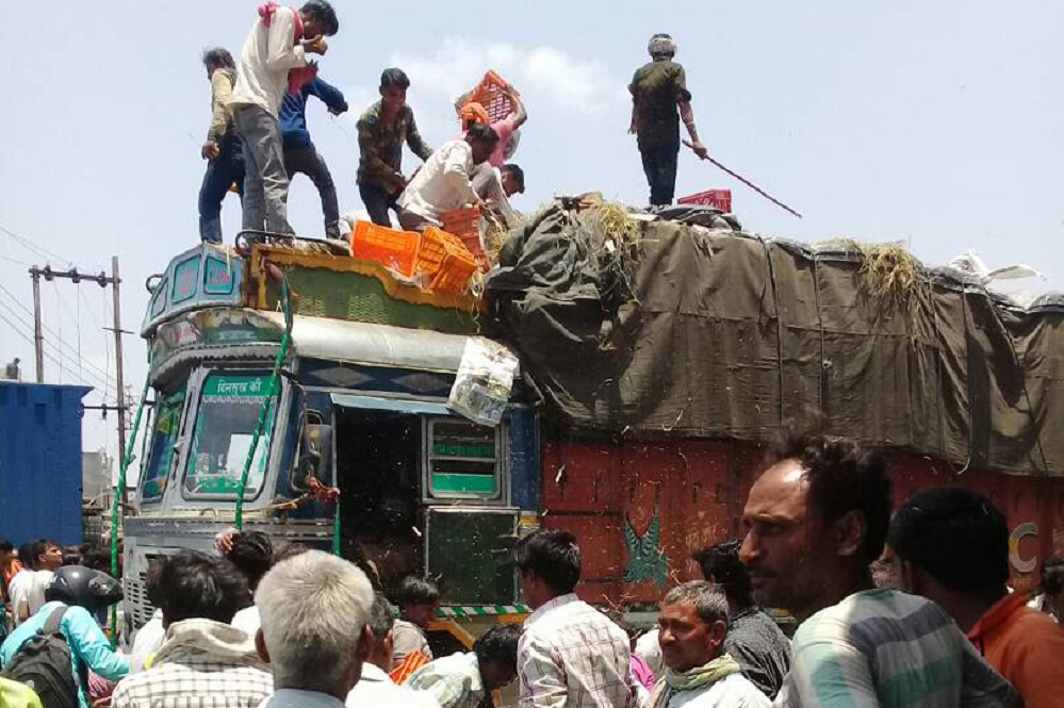
The anger of farmers across India, which had now escalated since at least five have been shot dead by the police in Mandsaur, Madhya Pradesh, will hopefully get some important people to take their problems seriously. However, I am not holding my breath on this one. The first response of MP Chief Minister Shivraj Singh Chouhan was to blame the Congress Party for the unrest and for the MP home minister Bhupendra Singh to claim that the farmers were killed by “anti-socials” and not by the police.

Since then, it has been established that the farmers were killed by police firings and the home minister had to admit to that. And political analyst Yogendra Yadav made a telling comment as far as Chouhan’s charge is concerned: If the Congress Party could mobilise so many people, it would have won more elections! But jokes aside, let us remember that Chouhan has been chief minister of MP since 2005. That’s many years without the Congress Party in power.

But after the bluster and lies which are signs of callous arrogance, comes the miscalculated sympathy. The first reaction is to offer money to the families of the farmers shot in police firing – after first denying that they had been shot by the police. Following a Cabinet meeting, loans will be waived, crop prices stabilised and so on. Evidence suggests that the anger of farmers has been brewing and escalating but government response is either slow or brutal and then too much too late.

Suicides by farmers across India have been rising. The reasons given by politicians have been bizarre and completely lacking empathy. Love affairs, drugs, dowry and impotency were some of the reasons provided for farmers’ suicides by Union agriculture minister Radha Mohan Agarwal in 2015. Reports suggest that suicides by farmers went up by 42 per cent between 2014 and 2015. Government data also suggests that most farmers killed themselves because of being unable to pay bank loans rather than other reasons including affairs and sexual problems.

Incidentally, the Union agriculture minister – and the BJP is quick to educate us that Agarwal has no connection to the unhappiness of farmers in India, not even a show of sympathy, since agriculture is also a state subject – is learning yoga in Bihar from Baba Ramdev. From what I saw on television he was somewhat unsuccessfully trying to do the Vrikshasana, a balancing act which indeed all politicians should learn.

Unfortunately for years, and this includes all governments, the core problems faced by farmers have not been taken seriously or been treated in an ad-hoc manner. All farmers have also been lumped together in one category when in fact there is a big gamut from large and corporate farmers and marginal and subsistence farmers. Politicians use loan waivers to gain votes but do nothing to stop farmers from falling into the same debt cycle. Experts like Devinder Sharma ask for better understanding from agricultural scientists and policy analysts but little help is forthcoming.

There is also an issue with cost and pricing which again leads to accusations and counter-accusations. There is political wrangling at some point to protect other votebanks along the food chain – middlemen, agricultural produce marketing committees – which only ensures that the price difference between what the farmer gets for his produce and what the end consumer pays for it is enormous.

Across the world, farmers are given subsidies by governments. Sometimes these are counter-productive like the corn revolution that has led to a dangerous instant food industry in the US, explained in horrifying detail by Michael Pollan in his book, An Omnivore’s Dilemma. But in most cases, it is because governments understand the importance of agriculturalists and also the simple fact that people have to eat.

In India, we are caught in a trap not unlike the farmers’ debt trap. We pay them lip service at times. At other times, we call them goons who duck income and other taxes and who only want “sops” from governments. Neither of these attitudes help in getting even close to solving the problems affecting Indian agriculture. And let us remember that we are still largely an agricultural economy.

Pricing, farm-gate to market distribution, lack of storage facilities, ignorance of new advances in agricultural sciences, forced buying of seeds pesticides and fertilisers, uneven access to new techniques, large differences in types of farmers and farming practices – these are only some of the problems which affect farmers in India apart from the inevitable debt traps. Add to this political opportunism by most parties and ignorance or disdain of economists and the anger visible today was only inevitable.

But the past is passed. What is required is immediate – and it has to come from listening to protesters and understanding them. Surely shooting to kill by the police – whatever the provocation – is unwarranted, condemnable and completely counter-productive.[/vc_column_text][/vc_column][/vc_row]

India News

Congress, BJP attack Bhagwant Mann over remarks on Punjab blasts

Congress and BJP have jointly criticised Punjab CM Bhagwant Mann after he linked recent blasts near defence sites to political motives, triggering a controversy.

Published

on

Bhagwant Mann

A political row has erupted in Punjab after Chief Minister Bhagwant Mann linked recent blast incidents to political motives, drawing sharp criticism from both the Congress and the Bharatiya Janata Party (BJP).

The controversy follows two low-intensity explosions reported within a short span of time — one near the Border Security Force (BSF) headquarters in Jalandhar and another close to an army cantonment area in Amritsar. The incidents raised concerns over security, particularly given the sensitive nature of the locations.

In response, Mann suggested that the blasts could be part of a larger political strategy. His remarks triggered a strong backlash, with opposition parties accusing him of politicising a serious security issue.

Leaders from the Congress criticised the Chief Minister’s statement, calling it inappropriate and alleging that such comments undermine the gravity of the situation. They stressed that matters related to national security should be handled with caution and responsibility.

The BJP also joined the criticism, questioning the basis of Mann’s claims and urging the state government to focus on investigation and law enforcement instead of making political allegations.

The developments have led to an unusual moment where both Congress and BJP appear aligned in their criticism of the Aam Aadmi Party-led government in the state.

Meanwhile, the blasts themselves have intensified concerns over safety in border regions, with authorities continuing their investigation into the incidents. No casualties were reported, but the proximity to defence establishments has made the issue particularly sensitive.

The episode has further escalated political tensions in the state, with security and accountability emerging as key points of debate.

Continue Reading

India News

Himanta Biswa Sarma resigns as Assam chief minister, oath ceremony likely after May 11

Himanta Biswa Sarma resigns as Assam Chief Minister after BJP-led NDA’s victory. He will continue as caretaker CM until the new government is sworn in after May 11.

Published

on

Himanta sharma

Assam Chief Minister Himanta Biswa Sarma resigned from his post on Wednesday, paving the way for the formation of a new government after the BJP-led NDA secured a decisive victory in the 2026 Assembly elections.

Sarma submitted his resignation to Governor Lakshman Prasad Acharya at Lok Bhawan in Guwahati. The Governor accepted the resignation and asked him to continue as the caretaker Chief Minister until the new government takes charge.

The resignation comes after the NDA’s strong electoral performance, where the alliance won a clear majority in the 126-member Assembly, ensuring its return to power for another term.

Oath ceremony expected after May 11

Speaking to reporters after submitting his resignation, Sarma said the swearing-in ceremony for the new government is likely to be held after May 11.

He indicated that Prime Minister Narendra Modi has been invited to attend the ceremony but is unavailable until May 11, which has influenced the tentative schedule.

Decision on next chief minister soon

Sources suggest that central observers, including senior BJP leaders, are expected to arrive shortly to oversee the selection of the legislature party leader. The newly elected MLAs will then decide on the next Chief Minister.

Despite the formal resignation, party sources indicate that Sarma is likely to continue in the role for another term, given the BJP’s strong mandate in the state.

The move marks the beginning of the government formation process in Assam following the election results declared earlier this week.

Continue Reading

India News

Rahul Gandhi and Vijay alliance took shape through backchannel talks, early signals from Congress leaders

Congress outreach and political calculations led to Rahul Gandhi and Vijay coming together after the Tamil Nadu 2026 election results.

Published

on

The coming together of Rahul Gandhi and actor-politician Vijay in Tamil Nadu after the 2026 Assembly elections was not sudden, but the result of behind-the-scenes political manoeuvring and early signals within the Congress.

According to media reports, some leaders in the Tamil Nadu Congress had already sensed the scale of Vijay’s surge during the campaign, anticipating what was later described as a “wave” in favour of his party.

After the results, where Vijay’s Tamilaga Vettri Kazhagam (TVK) emerged as the single largest party but fell short of a majority, communication channels between the Congress leadership and Vijay quickly became active.

A key moment in this evolving political equation was a phone call from Rahul Gandhi to Vijay, congratulating him on the party’s strong performance. The conversation was seen as more than a courtesy, signalling the possibility of cooperation at a time when government formation required additional support.

Reports indicate that discussions within Congress weighed the political benefits of supporting Vijay, especially given the shifting dynamics in the state where traditional dominance by major Dravidian parties has been challenged.

With TVK needing allies to cross the majority mark, Congress emerged as a potential partner, leading to a broader political realignment in the state. This development also triggered tensions within opposition alliances, highlighting the strategic importance of the decision.

The evolving partnership reflects a mix of electoral pragmatism and changing voter sentiment, particularly the growing influence of younger voters, which leaders acknowledged as a key factor in the election outcome.

Continue Reading

Trending

© Copyright 2022 APNLIVE.com