English हिन्दी
Connect with us

India News

Ganga river cruise will serve alcohol, Akhilesh Yadav gets in a holy river dig

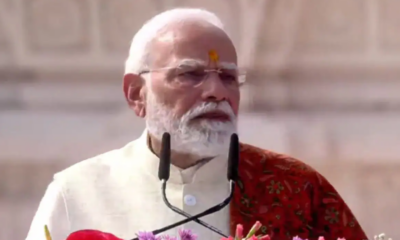
On Friday, Prime Minister Narendra Modi flagged off MV Ganga Vilas and inaugurated a Tent City.

Published

on

Ganga Vilas

Samajwadi Party chief Akhilesh Yadav took a dig at Prime Minister Narendra Modi over the newly inaugurated MV Ganga Vilas which is said to be the world’s longest river cruise.

Addressing the media on Saturday, Yadav said he heard about bars serving alcohol on MV Ganga Vilas which will run on the holy river Ganga. He also claimed that the cruise is running for a long time now, however, the BJP claimed to have flagged it off after adding more parts to the cruise.

Watch the video here:

Ahead of the inauguration of a Tent City, Yadav slammed the Bharatiya Janata Party and claimed that PM Modi-led government’s sole aim is to make money by converting religious sited into tourist attractions.

He further accused the BJP of wasting money on such projects and not using it to clean Ganga under Ganga Action Plan.

On Friday, Prime Minister Narendra Modi flagged off MV Ganga Vilas and inaugurated a Tent City. Reports said more than 200 tents will attract tourists and give them a panoramic view of the ghats located by Varanasi.

The cruise will provide facilities like a salon, spa, and gym and will cost Rs 25,000 to Rs 50,000 a day for the 51-day journey. In total, each passenger has to pay around Rs 20 lakh. Reports also said the cruise is equipped with a pollution-free system and noise control technology.

Meanwhile, wildlife experts have claimed that the three-decked river cruise can threaten the endangered Ganges river dolphin. Biologist Ravindra Kumar Sinha said cruises are a dangerous proposition for the dolphins, The Guardian reported.

MV Ganga Vilas will pass through Kaithi village and other protected cetacean habitats including Vikramshila Gangetic Dolphin Sanctuary in Bihar. The report also said Ganges river dolphins face a number of threats including poaching, excessive water extraction, and water pollution.

India News

India marks 77th Republic Day with grand parade at Kartavya Path

India marked its 77th Republic Day with a grand parade at Kartavya Path, highlighting military strength, cultural unity and international participation.

Published

on

Kartavya Path on Republic Day 2026

India is celebrating its 77th Republic Day today with a ceremonial parade at Kartavya Path in New Delhi, presided over by President Droupadi Murmu. European Council President Antonio Costa and European Commission President Ursula von der Leyen are attending the celebrations as chief guests.

Kartavya Path, stretching from Rashtrapati Bhavan to the National War Memorial, has been extensively decorated to reflect India’s journey as a republic. This year’s celebrations also mark the 150-year legacy of the national song Vande Mataram, blending historical symbolism with contemporary national achievements.

According to the Defence Ministry, the parade highlights India’s developmental progress, military capabilities, cultural diversity, and participation from citizens across the country.

Parade begins with tribute at National War Memorial

The Republic Day parade began at 10:30 am and is scheduled to run for around 90 minutes. Prime Minister Narendra Modi first visited the National War Memorial, where he laid a wreath to honour fallen soldiers. He then proceeded to the saluting dais at Kartavya Path along with other dignitaries.

President Murmu arrived at the venue in the traditional buggy, accompanied by the two chief guests and escorted by the President’s Bodyguard, the senior-most regiment of the Indian Army.

Following the unfurling of the national flag, the national anthem was played along with a 21-gun salute using indigenously developed 105 mm light field guns. The salute was presented by the 1721 Ceremonial Battery of the 172 Field Regiment.

Cultural performances and parade leadership

More than 100 cultural artists are participating in the parade, performing on the theme ‘Vividata Mein Ekta – Unity in Diversity’. The musical presentation reflects India’s cultural richness and national unity.

The parade is being commanded by Lieutenant General Bhavnish Kumar, General Officer Commanding, Delhi. Major General Navraj Dhillon, Chief of Staff at Headquarters Delhi, is serving as the Parade Second-in-Command.

Gallantry award winners and EU participation

Recipients of India’s highest gallantry awards are also part of the parade. These include Param Vir Chakra awardees Subedar Major (Honorary Captain) Yogendra Singh Yadav (retired) and Subedar Major Sanjay Kumar, along with Ashoka Chakra awardees Major General CA Pithawalia (retired) and Colonel D Sreeram Kumar.

An European Union contingent is participating with four flag bearers on three gypsies. The group is carrying the flags of the European Union, the European Union Military Staff, EU Naval Force Atalanta, and EU Naval Force Aspides.

First-ever phased battle array display

For the first time, the Indian Army is showcasing a phased battle array format during the parade, including aerial elements. The reconnaissance component includes the 61 Cavalry in combat uniform, followed by the high mobility reconnaissance vehicle — India’s first indigenously designed armoured light specialist vehicle.

Aerial support is being provided by the indigenous Dhruv advanced light helicopter and its armed variant, Rudra, underlining India’s growing defence self-reliance.

Continue Reading

India News

Didn’t violate party line: Shashi Tharoor defends stand on Operation Sindhoor

Shashi Tharoor says his stance on Operation Sindhoor was driven by national interest and insists he did not violate the Congress party line.

Published

on

Congress MP Shashi Tharoor says his views on Operation Sindhoor were guided by national interest and aligned with India’s security priorities

Congress MP Shashi Tharoor on Saturday said he has never crossed the Congress party’s stated positions inside Parliament, asserting that his only principled public disagreement was related to Operation Sindhoor.

Speaking during a session at the Kerala Literature Festival, Tharoor said he had taken a firm stand on the issue and remained “unapologetic” about it. His remarks come amid recent reports highlighting differences between him and sections of the party leadership, with speculation around his dissatisfaction over not being adequately acknowledged at a recent event in Kochi and alleged attempts by state leaders to sideline him.

Clarifying his position, Tharoor said that as a writer and observer, he had penned a newspaper column after the Pahalgam incident, arguing that the attack should not go unpunished and calling for a limited kinetic response. He added that while India’s primary focus remains development, the country should not be drawn into a prolonged conflict with Pakistan.

According to Tharoor, any response should be restricted to targeting terrorist camps rather than escalating tensions. He noted that he was surprised when the government eventually took steps that mirrored the approach he had outlined.

Referring to Jawaharlal Nehru’s famous words, “Who lives if India dies?”, Tharoor said that when the country’s security and global standing are at stake, national interest must take precedence over political differences.

He added that while political parties may disagree on various issues in the process of strengthening democracy, India must come first whenever core national interests are involved.

Continue Reading

India News

India to start first commercial semiconductor chip production in 2026, says Ashwini Vaishnaw

India is on track to begin its first commercial semiconductor chip production in 2026, with pilot production already underway and investments nearing $90 billion, according to Union Minister Ashwini Vaishnaw.

Published

on

Union Electronics and Information Technology Minister Ashwini Vaishnaw on Friday said India remains on schedule to begin commercial semiconductor chip production in 2026, in line with the targets outlined under the India Semiconductor Mission launched in January 2022.

Speaking to media, the minister said the government had committed to starting commercial production within five years of the mission’s launch and that the timeline is being met.

“The first commercial production will begin in 2026. Four semiconductor plants are expected to start operations this year, while pilot production has already begun at three plants in 2025,” Vaishnaw said.

Semiconductor ecosystem taking shape

The minister said India’s semiconductor ecosystem is developing rapidly, with global equipment manufacturers setting up operations in the country and a strong materials manufacturing base emerging alongside.

He added that the talent pipeline is progressing faster than expected. Against a target of training 85,000 skilled professionals over 10 years, India has already trained around 65,000 people in just four years, he said.

Vaishnaw noted that several milestones under the first phase of the Semiconductor Mission are either on track or ahead of schedule, reflecting growing confidence in India’s manufacturing ambitions.

Investments near $90 billion, more expected

On the investment front, the minister said total investments in the semiconductor sector have reached close to USD 90 billion so far. He added that committed investments could rise to around USD 150 billion as India approaches the upcoming AI Impact Summit scheduled to be held in New Delhi from February 16 to 20.

According to Vaishnaw, global semiconductor players are increasingly supportive of India’s efforts and are keen to participate in the country’s expanding chip manufacturing ecosystem.

ASML equipment for Dholera fab

Highlighting the importance of advanced manufacturing technology, Vaishnaw spoke about his visit to Veldhoven in the Netherlands, where he visited the headquarters of ASML, the world’s leading supplier of lithography equipment used in semiconductor manufacturing.

He said lithography remains the most complex and precision-intensive process in chip production and confirmed that India’s upcoming semiconductor fabrication facility in Dholera, Gujarat, will use equipment supplied by ASML.

Vaishnaw said the interest of global equipment manufacturers in India reflects the country’s strong design capabilities, large talent pool and consistent policy environment.

India’s progress in AI and global confidence

The minister also highlighted India’s growing role in artificial intelligence, stating that the country is developing strength across multiple layers of the AI stack, including applications, sovereign models, chips and infrastructure.

He said global industry leaders expressed strong confidence in India’s semiconductor and AI journey during discussions at the World Economic Forum in Davos, with many indicating their willingness to contribute to India’s long-term goals.

The India Semiconductor Mission, approved by the Union Cabinet in December 2021 with an outlay of Rs 76,000 crore, aims to support semiconductor fabrication, display manufacturing and chip design, and position India as a global hub for electronics manufacturing and innovation.

Continue Reading

Trending

© Copyright 2022 APNLIVE.com