English हिन्दी
Connect with us

India News

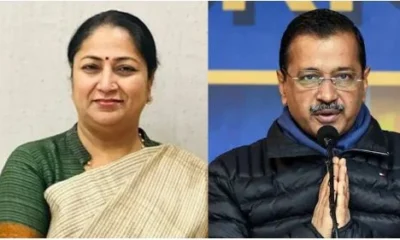
Delhi assembly row spills onto streets as BJP protests Atishi’s Sikh Guru remark

The controversy over Atishi’s alleged remarks on Sikh Guru Tegh Bahadur spilled onto Delhi’s streets as BJP supporters marched against the AAP, demanding an apology and resignation.

Published

on

BJP Protest

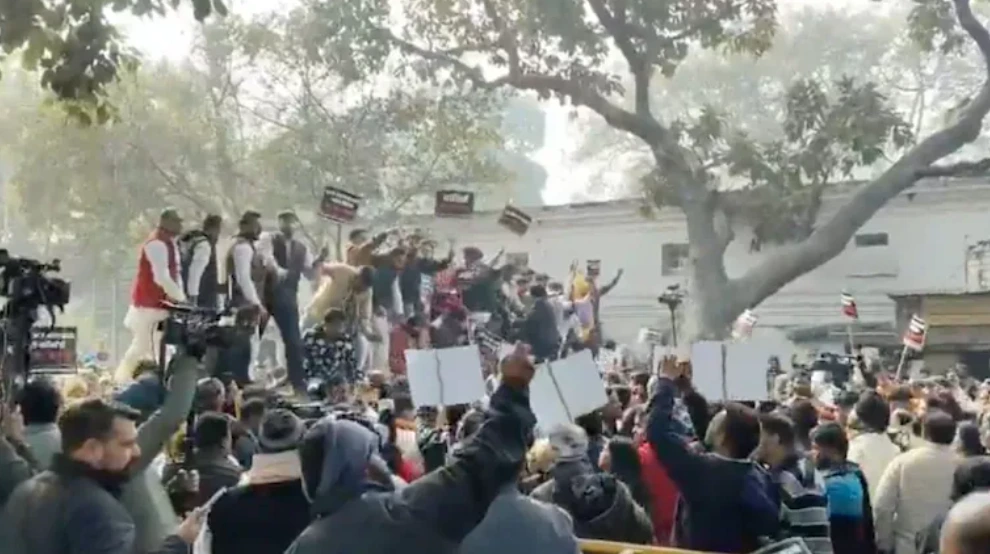
What began as repeated disruptions inside the Delhi Assembly has now moved beyond the House, with the Bharatiya Janata Party taking its protest against Aam Aadmi Party leader Atishi to the streets of the national capital.

On Friday, hundreds of BJP supporters, including members of the party’s Sikh unit, marched towards the AAP headquarters, raising slogans against Atishi and AAP national convener Arvind Kejriwal. Heavy police deployment was seen along the protest route as demonstrators attempted to move closer to the party office, escalating the political standoff.

BJP sharpens protest over remarks in House

The BJP said the street protest reflected mounting anger over what it termed “insensitive” remarks made by Atishi during a discussion related to Sikh Guru Tegh Bahadur in the Delhi Assembly. The controversy had already led to repeated disruptions during the Winter Session.

BJP MP Kamaljeet Sehrawat described the remarks as “shocking”, stating that Guru Tegh Bahadur’s sacrifice for his community and the nation could not be spoken of lightly. She said Atishi should apologise and step down from her position.

BJP MLA Kailash Gehlot also said the issue could not be dismissed, calling the remarks highly inappropriate and serious. Former Delhi minister and BJP leader Arvinder Singh Lovely joined the protest, terming the language used in the Assembly disgraceful and insulting to India’s spiritual heritage.

BJP MP Yogender Chandolia said the party would continue pressing for accountability, alleging that the remarks amounted to an insult to Guru Tegh Bahadur during an Assembly session. He said the BJP would not tolerate such statements and reiterated the demand for Atishi’s resignation.

Tension continues inside Delhi Assembly

Even as protests unfolded outside, the confrontation inside the Delhi Assembly showed no signs of easing. Four AAP MLAs — Sanjeev Jha, Jarnail Singh, Som Dutt and Kuldeep Kumar — were marshalled out of the House amid sloganeering and repeated disruptions.

AAP leaders accused the BJP of using the controversy to avoid discussion on governance-related issues. AAP MLA Sanjeev Jha said MLAs were punished for raising questions, alleging selective action by the Speaker. Jarnail Singh echoed similar concerns, claiming democratic norms were being undermined inside the Assembly.

Speaker orders forensic examination

Amid the escalating political row, Delhi Assembly Speaker Vijender Gupta had earlier ordered a forensic examination of a video containing the alleged remarks attributed to Atishi. The matter has also been referred to the Privileges Committee, which has been directed to submit its report within 15 days.

According to the Delhi Assembly secretariat, the inquiry will examine both the authenticity and the context of the remarks as tensions continue between the BJP and the AAP.

India News

ED probes alleged use of coal smuggling funds in Goa elections, I-PAC link flagged

The ED has flagged an alleged connection between coal smuggling proceeds and election-related activities in Goa after conducting raids linked to I-PAC in Kolkata.

Published

on

The Enforcement Directorate (ED) has flagged an alleged connection between election-related activities in Goa and recent raids conducted at premises linked to the Indian Political Action Committee (I-PAC) in Kolkata, according to officials familiar with the matter.

The searches are part of an ongoing probe into a suspected coal smuggling network and the alleged use of proceeds of crime during the 2021–22 Goa assembly elections. Investigators are examining whether funds generated through the illegal coal trade were diverted for political activities during the poll period.

Funds allegedly routed through hawala channels

Officials claim that money linked to the coal smuggling operation, allegedly headed by Anup Majee, was transferred using both domestic and international hawala routes. A Kolkata-based hawala operator, identified as R Kantilal, is alleged to have facilitated the movement of nearly ₹20 crore to Goa.

The alleged financial trail reportedly surfaced from WhatsApp chats recovered from an accountant connected to the coal syndicate. These messages are said to indicate the movement of funds towards election-related expenses.

Firms and individuals under scanner

According to the agency, money transfers were traced from Kolkata to an individual named Akshay Kumar, who told investigators that he was associated with firms identified as M/s Hertz and Pixelz. He reportedly claimed that these firms worked with I-PAC during the Goa elections.

The probe agency has also alleged that cash was routed through hawala channels to ASM Event and Tech Pvt Ltd, an event management company engaged during the election period. Investigators are examining the role of these entities in facilitating poll-related activities.

Alleged role of I-PAC personnel

Officials further claim that I-PAC director Pratik Jain was involved in overseeing operations in Goa and allegedly facilitated the transfer of funds connected to election work. The agency is continuing to scrutinise financial records, communication data, and statements as part of the investigation.

The probe remains ongoing, and officials said further action will depend on the outcome of the financial trail analysis and corroborative evidence.

Continue Reading

India News

Shashi Tharoor says criticism of Nehru must be balanced, calls BJP narrative selective

Shashi Tharoor says Nehru’s mistakes should be acknowledged but warns against blaming India’s first prime minister for every problem, calling the BJP’s narrative selective.

Published

on

Congress MP Shashi Tharoor on Thursday said that while India’s first Prime Minister Jawaharlal Nehru should not be viewed without criticism, blaming him alone for the country’s challenges amounts to a selective reading of history.

Speaking at the fourth edition of the Kerala Legislative Assembly International Book Festival, Tharoor said he regards Nehru as the founder of Indian democracy but does not support all his ideas or policies uncritically. He stressed that acknowledging historical mistakes is necessary, but holding Nehru responsible for every national issue is unjustified.

“I am a fan of Jawaharlal Nehru, but not an uncritical fan,” Tharoor said, adding that Nehru’s intellect and worldview deserved admiration even if some decisions warranted debate. He underlined that Nehru played a decisive role in firmly establishing democracy in post-Independence India.

Taking a swipe at the BJP, Tharoor said the current government is not anti-democratic but is “certainly anti-Nehru”, accusing it of turning the former prime minister into a convenient scapegoat. According to him, criticism of Nehru is sometimes valid, but it often goes far beyond fair assessment.

Referring to the 1962 India-China war, Tharoor acknowledged that some of the criticism has a basis, noting that certain decisions taken during Nehru’s tenure contributed to the defeat. However, he said this does not justify blaming Nehru for unrelated problems decades later.

During the session, Tharoor also spoke about his personal journey as a writer. He said his habit of reading developed during childhood due to asthma, at a time when books were his primary companions. He recalled that his first novel was written at a very young age but was later lost due to an ink spill.

Tharoor noted that Kerala continues to lead in reading culture even as reading habits decline in many parts of the world. He said his book The Great Indian Novel, written in 1989, emerged as a satirical work at a time when the genre was largely missing in India.

Addressing younger readers, Tharoor observed that shorter books could be more effective for those struggling to find time to read today. He also reminisced about his days at St. Stephen’s College, Delhi, recalling a stage production in which he played Antony while filmmaker Mira Nair portrayed Cleopatra.

The session concluded with Tharoor reciting lines from his earlier poem How to Sleep at Night.

Continue Reading

India News

BJP driven by power, not Hindutva, says Uddhav Thackeray amid BMC poll pitch

Uddhav Thackeray has accused the BJP of being driven by power rather than Hindutva, criticised its alliances, and asserted that Mumbai’s mayor will be Marathi as BMC elections approach.

Published

on

Uddhav Thackeray

Shiv Sena (UBT) chief and former Maharashtra chief minister Uddhav Thackeray has launched a sharp political offensive against the Bharatiya Janata Party (BJP), accusing it of being motivated purely by power rather than ideology, as campaigning intensifies ahead of the crucial Brihanmumbai Municipal Corporation (BMC) elections.

In an interview to a regional media channel on Thursday, Thackeray rejected the BJP’s repeated assertion of being a pro-Hindutva party, claiming that its actions were driven by opportunism and an obsession with remaining in power.

“BJP is not a Hindutva party; it is a party obsessed with power,” Thackeray said, alleging that the party was willing to align with anyone to secure political control. He claimed that the BJP’s ideological positioning was merely a façade and accused it of abandoning principles whenever it suited its interests.

Drawing a historical comparison, Thackeray referred to the role of the Jan Sangh during the United Maharashtra movement, alleging that it joined late and exited first after its objectives were met. He likened the BJP’s political expansion to a “single-celled amoeba” that seeks to absorb everything around it.

Attack on alliances and governance

Thackeray took a dig at the BJP’s political alliances, referring to its tie-up with AIMIM in the Akot Municipal Council as “BJP’s Love Jihad”. He also alleged that BJP leaders preached Hindutva publicly while privately acting otherwise, adding that civic elections should focus on governance rather than communal narratives.

“The issue in the Municipal Corporation is not Hindu versus Muslim. It is about administration and governance,” he said.

Expressing concern over the prevailing political environment, Thackeray described the upcoming BMC elections as being fought under “strange circumstances”, alleging a decline in Maharashtra’s political culture.

“There was a time when wrongdoing carried shame. Today, people openly flaunt it,” he remarked, claiming that the state’s tradition of civil political conduct had been severely damaged.

Marathi identity and Mumbai’s future

Reiterating his party’s stand on Mumbai’s identity, Thackeray asserted that the city’s mayor would be a Marathi person. He questioned attempts to impose Hindi and other languages on Mumbai, reacting strongly to recent remarks about linguistic dominance in certain suburbs.

“Who decides what language Ghatkopar speaks?” he asked, criticising BJP leaders for making such claims.

He also accused the current Maharashtra administration of burdening Mumbai with a debt of ₹3 lakh crore and alleged large-scale misuse of the city’s resources.

Highlighting concerns of the local population, Thackeray claimed that Marathi people were increasingly facing discrimination in their own city, including denial of housing and criticism of food habits.

“The Marathi person integrates wherever he goes. But today, others are coming into our home and trying to dominate us,” he said, alleging that political arrogance had grown due to power being concentrated in Delhi.

Continue Reading

Trending

© Copyright 2022 APNLIVE.com