English हिन्दी
Connect with us

India News

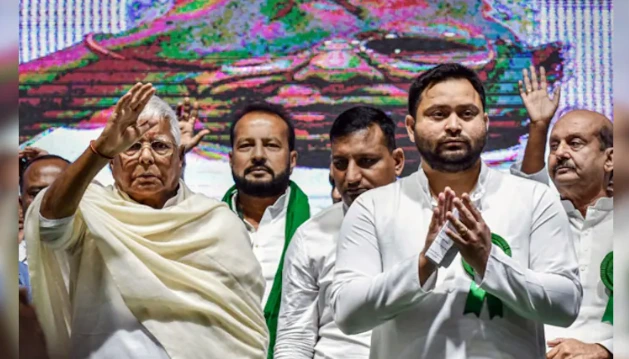
Lalu Yadav, Tejashwi, Rabri Devi chargesheeted in IRCTC corruption case ahead of Bihar polls

Delhi court frames corruption and conspiracy charges against Lalu Yadav, Rabri Devi, and Tejashwi Yadav in the IRCTC hotels case — a major setback for RJD before the Bihar polls.

Published

on

Lalu Tejashwi

In a significant setback for Rashtriya Janata Dal (RJD) chief Lalu Prasad Yadav and his family, a Delhi court on Monday framed charges in a corruption case linked to the allotment of IRCTC hotel maintenance contracts during his tenure as Railway Minister. His wife, former Chief Minister Rabri Devi, and son Tejashwi Yadav — the party’s Chief Ministerial candidate — were also charged.

The Rouse Avenue court invoked sections related to cheating, criminal conspiracy, and offences under the Prevention of Corruption Act. All three pleaded not guilty. Rabri Devi called the case “wrong”, while Lalu Yadav’s counsel maintained that there was no material evidence to justify the charges.

The ‘IRCTC hotels’ corruption case

The Central Bureau of Investigation (CBI) has alleged that contracts for maintaining two IRCTC hotels — BNR Ranchi and BNR Puri — were irregularly awarded to Sujata Hotel during Lalu Yadav’s ministerial term (2004–2009). In return, it is claimed that three acres of prime land were transferred to a benami company linked to Lalu Yadav’s family.

The CBI registered the case in 2017 and informed the court that sufficient material existed to frame charges against all accused. Lalu Yadav’s defence argued that the tenders were issued through a fair process.

Court observes “probable fraud must be tried as cheating”

In its observations, the court said, “The conspiracy is sublime, but not hidden from the court’s view,” adding that the alleged actions resulted in monetary loss to the exchequer. It ruled that the case merits a full trial to determine the extent of wrongdoing.

Political impact ahead of Bihar elections

The court’s decision is seen as a political setback for the RJD ahead of the Bihar assembly elections. The ruling is likely to give the ruling NDA an opportunity to sharpen its attacks over corruption allegations, a recurring theme in Bihar’s politics.

India News

Shashi Tharoor lists BRICS benefits after P Chidambaram questions gains

Shashi Tharoor highlighted BRICS’ diplomatic value and role for the Global South after P Chidambaram questioned the tangible benefits India has gained from recent summits.

Published

on

Shashi Tharoor

Congress MP Shashi Tharoor has highlighted the diplomatic and global significance of BRICS after senior party leader P Chidambaram questioned the tangible benefits India has received from recent meetings of the grouping.

Speaking ahead of the BRICS summit in Delhi, Tharoor described BRICS as an important platform for the Global South and said hosting the summit was a matter of prestige for India. He also acknowledged challenges within the grouping, including differences among member countries and India’s trade imbalance with BRICS nations.

What Shashi Tharoor said about BRICS benefits

Tharoor said BRICS provides an important platform for the Global South. He pointed out that the grouping has 11 countries representing a majority of the world’s population and 41% of global GDP.

According to Tharoor, the size and diversity of the grouping make it significant on the global stage. He said the platform should therefore be taken seriously by other countries.

He also highlighted the importance of India hosting the BRICS summit. Tharoor said the presence of several heads of state and government, along with observers attending at the presidential and prime ministerial level, was a matter of prestige for India.

He linked the summit to India’s diplomatic convening power, saying that its value extends beyond immediate outcomes.

Tharoor flags challenges for BRICS

While listing the benefits, Tharoor also acknowledged that BRICS faces several challenges.

One of the key issues, according to him, is the difficulty of reaching a common position on major international developments. He pointed to differences over the Iran war and the Russia-Ukraine conflict.

Tharoor noted that when BRICS foreign ministers met in New Delhi in May, the countries were unable to agree on a joint statement. India, as the chair, instead issued a chair’s declaration.

He said the ability of the grouping to reach consensus would remain an important challenge for diplomats.

India faces trade imbalance with BRICS countries

Tharoor also raised concerns about the economic side of BRICS.

He said trade among BRICS countries has been growing but argued that the trend has been disadvantageous for India. According to him, India’s exports to BRICS countries have declined while imports from those countries have increased.

This trade imbalance was presented as one of the practical concerns that India needs to consider while assessing its engagement with the grouping.

What P Chidambaram said about BRICS

Tharoor’s comments came a day after former Union minister and Congress leader P Chidambaram questioned the tangible benefits India has received from recent BRICS summits.

Chidambaram said he did not think the last two or three BRICS meetings had produced significant tangible benefits or results for India.

He also pointed out that India participates in several multilateral groupings, including BRICS, the Shanghai Cooperation Organisation, the G20 and the Quad, and questioned what concrete benefits the country had received from them.

The BJP criticised Chidambaram’s remarks and described him as part of the “naraaz phupha” group that, according to the party, could not accept India’s progress.

Why are BRICS benefits being debated?

The latest exchange highlights two sides of the BRICS debate.

Chidambaram has questioned whether the grouping has delivered enough concrete outcomes for India, while Tharoor has emphasised its diplomatic importance, its representation of the Global South and India’s ability to bring major countries together.

At the same time, Tharoor has acknowledged challenges related to consensus and India’s trade position within the grouping.

Continue Reading

India News

Delhi BRICS Summit: Schools shut, Metro runs as traffic restrictions begin

BRICS Summit 2026, Delhi BRICS Summit, Delhi traffic restrictions, Delhi schools closed, Delhi government offices

Published

on

Brics Summmit

Delhi is witnessing heightened security and traffic arrangements as the 18th BRICS Leaders’ Summit is being held at Bharat Mandapam on September 12 and 13. The movement of foreign delegations, heads of state and senior dignitaries has led to additional security measures and traffic restrictions across several parts of the capital.

For residents, the arrangements will affect schools, government offices, roads and some public services between September 11 and 13. Here’s what will remain open and what will be closed during the summit period.

Schools and Delhi government offices closed

All government, government-aided and recognised unaided private schools under the Delhi Directorate of Education will remain closed on Friday, September 11.

The Delhi Lieutenant Governor has also declared September 11 a public holiday in the capital. Delhi government offices, autonomous bodies and public sector undertakings under the Delhi government will also remain closed on the day.

Schools are expected to reopen on Monday following the weekend.

Banks and private offices to remain open

Banks in Delhi will remain operational on September 11 as the date is not listed as a bank holiday in the Reserve Bank of India’s holiday calendar.

Private offices will also continue to function. However, employees travelling through central Delhi and other areas affected by VVIP movements may encounter diversions, restrictions and delays.

Companies have been advised to allow employees to work from home wherever possible.

Delhi Metro services to continue

Delhi Metro services will continue to operate across the network during the BRICS Summit.

However, the Delhi Metro Museum at Supreme Court Metro station will remain closed from September 11 to 13. It will reopen on September 15, as September 14 is the museum’s weekly closure day.

Traffic restrictions and bus diversions

The Delhi Traffic Police has prepared arrangements for the movement of foreign dignitaries and VVIP convoys. Around 4,800 traffic personnel have been deployed for summit-related arrangements.

Traffic will be regulated at 22 identified diversion points during motorcade rehearsals and VVIP movements.

More than 35 roads may be affected at different times, including Mathura Road, Sardar Patel Marg, Shanti Path, Janpath, Ashoka Road, Barakhamba Road, Tolstoy Marg, Africa Avenue Road, Niti Marg and APJ Abdul Kalam Road.

Buses may be diverted or temporarily regulated, while cab services will continue to operate. Commuters have been advised to check traffic updates before starting their journeys and allow additional travel time.

What Delhi residents should know

The main changes during the summit period are:

  • Schools: Closed on September 11
  • Delhi government offices: Closed on September 11
  • Banks: Open
  • Private offices: Open, but employees may face travel disruptions
  • Delhi Metro: Operational across the network
  • Delhi Metro Museum at Supreme Court: Closed September 11-13
  • Road traffic: Restrictions and diversions on several routes
  • Buses: May be diverted or temporarily regulated
  • Cab services: Continue to operate

The restrictions are linked to security arrangements for the BRICS Leaders’ Summit, with authorities preparing for the movement of foreign dignitaries and VVIP convoys across the capital.

Continue Reading

India News

Delhi MCD demolishes 41 structures, seals 61 properties after hostel collapse

The MCD demolished 41 structures and sealed 61 properties across Delhi’s 12 zones on Thursday as part of an intensified drive against unauthorised construction, dangerous buildings and building-norm violations.

Published

on

The Municipal Corporation of Delhi (MCD) has intensified its enforcement drive against unauthorised construction and dangerous buildings, demolishing 41 structures and sealing 61 properties across the city’s 12 zones on Thursday.

The civic body also issued 32 show-cause notices and passed three demolition orders during the latest enforcement action. The drive follows similar action on Wednesday, when 46 properties were demolished and another 20 were sealed for violations of the Master Plan of Delhi and building bye-laws.

In the East Zone, enforcement action was carried out in areas including Khureji Khas, Jagatpuri and Laxmi Nagar. In the West Zone, MCD teams acted against unauthorised structures in Paschim Puri, Madipur, Subhash Nagar, Vipin Garden, Bakkarwala, Nangli Vihar and Nihal Vihar.

At Paschim Puri in Madipur, roof panels on the first, second and third floors were cut down. In Subhash Nagar, a roof panel was removed and a toilet block constructed on the fourth-floor terrace was demolished.

At Som Bazar Road in Vipin Garden, Uttam Nagar, a ground-floor roof panel was demolished. A property near Aakash Vihar on Bakkarwala Road was completely demolished.

Further action was taken in Nangli Vihar, where a roof panel and two first-floor walls were removed. In Nihal Vihar, Nangloi, two slab panels on the fourth floor were demolished.

In the Central Zone, the MCD took action against a G+5 building in Madanpur Khadar Extension. Four panels on the fifth floor were cut down before the building was sealed.

The civic body said several other properties have been identified for enforcement action and warned that its crackdown on unauthorised construction, misuse of properties and dangerous structures would continue in the coming days.

MCD surveys 1,355 PG buildings

Alongside the enforcement drive, the MCD has conducted a large-scale survey of buildings being used for paying guest accommodation across Delhi.

According to the civic body, around 1,355 buildings housing PG facilities have been identified, with approximately 27,000 people living in them.

The survey is intended to create a database of PG accommodations and assess the buildings where they operate. The MCD is expected to use the findings to determine further action and ensure that PG facilities are not being operated from unsafe or unauthorised premises.

54 basement shops sealed in Chandni Chowk

In a separate action, the MCD sealed 54 shops operating illegally from basements in Kucha Mahajani in Chandni Chowk.

The action was carried out on the directions of the Monitoring Committee and the Supreme Court. According to the MCD, the shops were being used for commercial activities in violation of the Unified Building Bye-Laws, 2016, and the Master Plan of Delhi, 2021.

The civic body also cited the absence of mandatory clearances from the Fire Department and other statutory authorities. The 54 shops were sealed under Section 345-A read with Section 347 of the Delhi Municipal Corporation Act.

The MCD said its enforcement campaign would continue across all 12 zones, with unauthorised construction, misuse of premises and dangerous structures remaining key areas of focus. It said public safety would remain a priority while action is taken against violations of building and planning regulations.

The latest enforcement drive comes days after the September 6 Satya Niketan tragedy, when a five-storey building being used as a boys’ hostel collapsed in the student-dominated locality near Delhi University’s South Campus.

Seven people, including five students and two labourers, were killed in the collapse. The building was located opposite Sri Venkateswara College and was being used to accommodate students.

Continue Reading

Trending

© Copyright 2022 APNLIVE.com