English हिन्दी
Connect with us

Latest Politics News

Parliament disrupted again as 2G Case verdict peps up Congress, gives it fresh ammo

Published

on

Parliament disrupted again as 2G Case verdict peps up Congress

The 2G scam case against Congress-led UPA falling through in court provided additional ammunition to the Opposition against the ruling BJP and pepped up an already aggressive Congress targeting Prime Minister Narendra Modi for his bizarre accusation of his predecessor Dr Manmohan Singh conspiring with Pakistan to influence Gujarat polls.

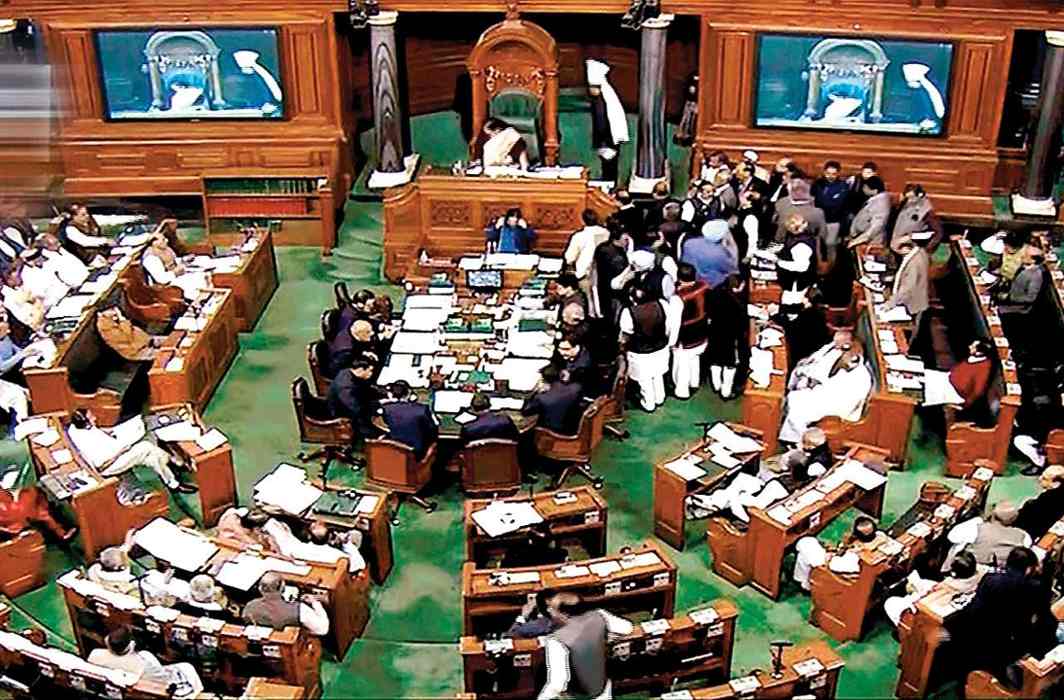
The mood manifested in the Parliament where the Congress stepped up its attack, once again forcing the Rajya Sabha to be adjourned after 2 pm. Lok Sabha, where the BJP has a majority, continued to function, although amid protests and disruptions.

The ruckus in Rajya Sabha denied cricket icon Sachin Tendulkar his maiden attempt to speak in the House. Tendulkar was to initiate a short duration discussion on the right to play and the future of sports in India, but the protests led Chairman M Venkaiah Naidu to adjourn the House for the day. In cricketing parlance, Sachin was sent back to the pavilion without getting a chance to open his account.

The signs were clear from the morning. As soon as the Rajya Sabha met to start its work for the day, Congress members shouted slogans, drowning the voices of other members and forcing Naidu to adjourn the proceedings till 2 PM.

Leader of the Opposition and Congress leader Ghulam Nabi Azad sought an explanation from Modi for the ‘false propaganda’ on the 2G scam to come to power in 2014. He said the Congress has, since the past week, been seeking an explanation from the Prime Minister over his allegations against Singh during the Gujarat polls. After the acquittal of all the 2G case accused, “we want to ask where did all the allegations (of scam) go,” he said.

“The BJP had run a propaganda on the 2G spectrum scam that had helped it “move from that side (opposition side in Rajya Sabha) to this side (ruling side) and us from that side (ruling side) to this side (opposition benches),” Azad said.

Naidu disallowed Azad’s submission saying he had not given any notice. Citing a May 22, 1990 ruling of then Rajya Sabha Chairman Shankar Dayal Sharma, Naidu said that the Chair’s ruling on not allowing suspension of a Question Hour or allowing a discussion was final.

With Congress members refusing to relent and even coming out into the Well of the House, even moving up in front of treasury benches at one point, Naidu finally adjourned the House till 2 pm, after several attempts to silence the agitated MPs and make them return to their seats.

Normally, in case of disruptions in the first hour of the sitting, the Chair adjourns proceedings till noon, and the adjournment till 2 pm was unusual.

After 2 pm, Sachin Tendulkar was to get his turn and make his maiden speech. However, Samajwadi Party (SP) leader Naresh Agarwal said he had a point of order: whether CAG reports can be leaked to newspapers before they are tabled. “Can we summon people responsible for tarnishing those in constitutional offices on the basis of CAG reports,” he wanted to know. The question was in the context of the acquittal of all 2G case accused.

He also asked whether the image of those in constitutional offices can be tarnished on the basis of CAG reports when ‘99 per cent of the points’ raised in them are settled after they reach the Public Accounts Committee (PAC) for scrutiny.

After this, when Naidu sought to initiate the discussion on sports saying this was Tendulkar’s maiden speech and he should be heard, several Congress MPs got up and raised the issue of the PM’s remark and demanding his apology, shouting slogans: ‘Desh ko gumrah karna band karo’ (stop misleading the nation).

Naidu’s admonitions failed to restore order in the House. As the protests continued, a livid Naidu asked Tendulkar to proceed. The cricketer got up, but could only look on as noisy protests went on. Naidu decided it was best to adjourn the proceedings for the day.

Thursday, being the Question day for the Prime Minister’s Office in Rajya Sabha, Modi was expected to be present during Question Hour slated at noon.

Meanwhile, a report from news agency ANI said that BJP’s Vinay Sahasrabuddhe has given a notice under rule 267 in Rajya Sabha demanding suspension of business today to discuss “serious situation arising out of the use of derogatory language against PM by senior leaders of Congress”

In Lok Sabha, too, Congress raised the issue of Modi’s remarks against Dr Singh, protesting the Speaker’s decision not to allow them to raise the matter.

The Congress members trooped into the Well during the Question Hour and raised slogans, even as Speaker Sumitra Mahajan went ahead with the proceedings. Leading the Congress charge was Jyotiraditya Scindia. Little over 30 minutes into the Question Hour, he expressed concern about not being given the chance to raise the issue.

Mahajan said she would not allow them and asserted that the issue was something that was raised at a public meeting and this was an elected House.

An agitated Scindia said the party has been raising the issue for four days but they were not being given an opportunity to speak. “Where is justice,” he asked and wondered “what kind of Parliament is this? Give us a minute (to speak).”

He also took a swipe at the ruling party saying they want to listen to only ‘Mann ki Baat’, referring to Prime Minister Narendra Modi‘s monthly radio address.

UPA Chairperson Sonia Gandhi was seen thumping the desk when Scindia was speaking amid the din. Congress MPs kept up the tempo raising slogans: ‘Pradhan Mantri maafi maango (Prime Minister, apologise)’, ‘Taanashahi bandh karo (stop authoritarianism)’ and ‘Shame, shame’.

“It is a serious issue, the allegation was against an ex-Prime Minister Manmohan Singh, an ex-Vice President and ex-Army chief,” Scindia said referring to Modi’s remarks at a recent election rally in Gujarat.

Scindia said the voice of opposition was being muffled in the House and questioned if the Government would decide what issues can be raised in the Lok Sabha.

Communist Party of India-Marxist MP Mohammed Salim and Rashtriya Janata Dal (RJD) leader Jay Prakash Narayan Yadav also came out in support of Congress.

The Speaker, however, did not permit the issue to be raised and proceeded with routine business. Congress members then staged a walkout in protest, with party leader Kharge saying the walkout was being done to “preserve the dignity of the country”.

India News

Suvendu Adhikari after Bengal win says Akhilesh Yadav is next

Suvendu Adhikari says Akhilesh Yadav is next after BJP’s Bengal win, shifts focus to Uttar Pradesh elections 2027.

Published

on

Suvendu-Adhikari

Following the Bharatiya Janata Party’s sweeping victory in the West Bengal Assembly elections 2026, senior leader Suvendu Adhikari made a strong political statement, indicating that the party’s next focus will be the Uttar Pradesh Assembly elections in 2027.

Riding on the momentum of the party’s performance in Bengal, Adhikari said that several opposition leaders have already lost political ground and added that Samajwadi Party chief Akhilesh Yadav would be “next” in line.

The BJP leader, who secured key victories in constituencies such as Bhabanipur and Nandigram, also claimed that the defeat of the ruling Trinamool Congress marked the beginning of a political decline for Chief Minister Mamata Banerjee. He asserted that her “political exile has started,” referring to her electoral losses in recent contests.

Adhikari further criticised the Trinamool Congress, comparing it with other opposition parties and alleging that it lacked ideology and was driven by family-based politics. He also suggested that several leaders and workers from the TMC could shift allegiance to the BJP in the coming period.

The BJP’s strong showing in West Bengal marks a major political shift in the state, where the party has managed to significantly expand its footprint. Political observers say the latest remarks underline the party’s intent to carry its electoral momentum into upcoming state elections, particularly in Uttar Pradesh, which is expected to be a key battleground in 2027.

Continue Reading

India News

Stalin loses Kolathur seat in Tamil Nadu results 2026 as TVK’s VS Babu scores upset

Media reports suggest MK Stalin has lost his Kolathur stronghold to TVK’s VS Babu in Tamil Nadu election results 2026.

Published

on

MK Stalin

In a significant political development in the Tamil Nadu Assembly election results 2026, Chief Minister M. K. Stalin is reported to have lost the Kolathur constituency, according to media reports based on counting data.

As per these reports, Stalin was defeated by V. S. Babu of Tamilaga Vettri Kazhagam (TVK), marking a notable upset in a seat long regarded as a stronghold of the DMK leader.

Kolathur, located in Chennai, has been closely associated with Stalin for years, making the reported outcome particularly significant in the current election cycle. Earlier counting trends had indicated a tight contest, with Stalin trailing before the result was reported.

The development comes amid a strong showing by actor-turned-politician Vijay’s party, Tamilaga Vettri Kazhagam, which has performed competitively across several constituencies in the state, according to media reports.

While the Dravida Munnetra Kazhagam (DMK) has been leading in multiple seats, the reported loss in Kolathur is being viewed as a key moment in the party’s overall performance.

Final results across Tamil Nadu are still being compiled as counting continues.

Continue Reading

India News

K Kavitha suggests US Senate-like model for Rajya Sabha amid delimitation debate

K Kavitha has proposed a US Senate-like model for the Rajya Sabha, calling for equal representation of states and stronger legislative powers amid the delimitation debate.

Published

on

K Kavitha

Telangana leader K Kavitha has proposed a significant restructuring of the Rajya Sabha, suggesting it be given powers similar to the United States Senate to protect the interests of states amid the ongoing debate over delimitation.

Speaking on the issue, Kavitha said the Upper House should have greater authority in legislative matters, including the ability to stall bills if states do not agree. She argued that such a mechanism would ensure political and financial security for states within India’s federal structure.

Her proposal comes at a time when discussions around delimitation — the redrawing of parliamentary constituencies based on population — have raised concerns about potential imbalances between states.

Equal representation for states proposed

Kavitha suggested that each state should have a fixed number of seats in the Rajya Sabha, regardless of population, to maintain balance across regions. She also advocated equal voting rights for states in the Upper House.

According to her, empowering the Rajya Sabha in this manner would help ensure that states have a stronger voice in national decision-making.

She further proposed that all key legislation, including finance bills, should be routed through the Rajya Sabha, similar to the functioning of the US Senate.

Context of delimitation debate

The proposal comes against the backdrop of the Delimitation Bill, 2026, which aims to readjust the allocation of Lok Sabha seats based on population changes. The exercise has sparked political debate, with concerns that some states could gain more representation while others may lose relative influence.

Kavitha indicated that even if some states lose seats due to delimitation, a stronger Rajya Sabha with equal representation could help maintain federal balance.

Focus on strengthening federal structure

Emphasising the need to protect the role of states, Kavitha said enhancing the powers of the Rajya Sabha would ensure that no single region dominates national policymaking.

Her remarks add to the broader political discourse around delimitation and federalism, with multiple leaders proposing alternative models to address concerns of regional imbalance.

Continue Reading

Trending

© Copyright 2022 APNLIVE.com