English हिन्दी
Connect with us

India News

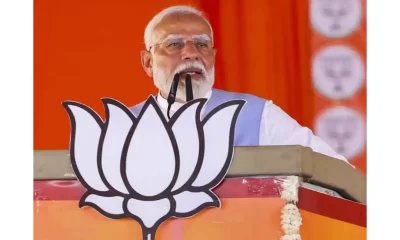
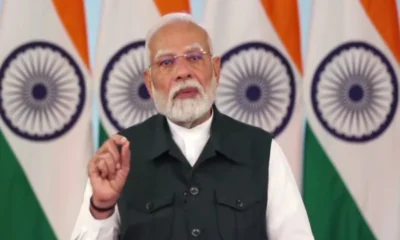
Prime Minister Narendra Modi inaugurates, lays foundation stone of multiple development projects worth Rs 15000 crore in Krishnanagar, West Bengal

Speaking at the launch of development initiatives in Krishnanagar, West Bengal PM Modi said from the infrastructure point of view, railways is part of the glorious history of West Bengal, but the historical progress that Bengal achieved could not be utilised properly after independence. He said this was the main reason that despite of all possibilities, Bengal remained left behind.

Published

on

Prime Minister Narendra Modi inaugurated and laid foundation stone of multiple development projects worth Rs 15000 crore in Krishnanagar city in West Bengal’s Nadia district on Saturday. Speaking at the launch of development initiatives in Krishnanagar, West Bengal PM Modi said from the infrastructure point of view, railways is part of the glorious history of West Bengal, but the historical progress that Bengal achieved could not be utilized properly after independence. He said this was the main reason that despite of all possibilities, Bengal remained left behind.
The Prime Minister said in the last 10 years, the central government has laid a lot of emphasis on the rail infrastructure here to bridge the gap. As a result the spending for the rail infrastructure in Bengal has increased more than twice. PM Modi is on a two day visit to 3 states arrived in West Bengal’s Arambagh on Friday afternoon, where he also launched many development projects and addressed a rally in Hooghly.

The infrastructure projects are related to sectors like road, rail and power. The Prime Minister also laid the foundation stone of Raghunathpur Thermal Power Station Phase II (2×660 MW) located at Raghunathpur in Purulia district. He also inaugurated the Flue gas desulfurization (FGD) system of Units 7&8 of Mejja Thermal Power Station.

PM Modi also inaugurated the road project for 4 lanes of the Farakka – Raiganj Section of NH-12 (100 km). Developed at a cost of about Rs 1986 crore. The project aims to reduce traffic congestion, improve connectivity and contribute to the socio-economic development of North Bengal and North East region.

He also dedicated to the nation 4 rail projects worth Rs 940 crore in West Bengal which included the doubling of the Damodar- Mohishila rail line, the third line between Rampurhat and Murarai and the doubling of the Bazarsau – Azimganj rail line and New Line connecting Azimganj- Mushidabad.  

India News

Rahul Gandhi meets farmers over India-US trade deal, BJP calls it stage-managed

Rahul Gandhi met farmer leaders over concerns surrounding the India-US trade deal, drawing sharp criticism from BJP, which termed the interaction stage-managed.

Published

on

Rahul-Gandhi

Congress leader Rahul Gandhi met representatives of several farmer organisations at his Parliament office to discuss concerns related to the proposed India-US trade framework. The meeting has triggered sharp political reactions, with the Bharatiya Janata Party (BJP) alleging that the interaction was “stage-managed”.

According to details shared, Gandhi — who is the Leader of Opposition in the Lok Sabha — held discussions with representatives of 17 major farmer unions from across the country. The farm leaders conveyed apprehensions that the trade agreement could adversely affect cultivators, particularly those growing corn, soyabean, cotton, fruits and nuts.

They urged the need for a nationwide movement to safeguard farmers’ rights and protect their incomes from any potential impact of the agreement.

BJP alleges ‘artificial narrative’

Responding to the development, Union Minister Piyush Goyal criticised the Congress leader, terming the meeting “artificial” and “baseless”. In a video post on X, Goyal alleged that Gandhi was attempting to mislead farmers.

“Mr Rahul Gandhi has once again rolled out a stage-managed, most artificial and fake narrative,” Goyal said. He further claimed that individuals posing as farmer leaders were aligned with the Congress party and were part of an orchestrated attempt to create confusion.

The minister added that the government had fully protected the interests of farmers in the India-US trade deal and accused the opposition of provoking sentiment against the country’s economic policies.

What the India-US trade framework proposes

The interim trade agreement between India and the United States focuses on lowering tariff barriers while balancing domestic agricultural sensitivities. As part of the arrangement, the US has agreed to reduce reciprocal tariffs on Indian goods — from levels as high as 50 per cent to 18 per cent — benefiting sectors such as textiles, leather, footwear and pharmaceuticals.

The government has maintained that between 90 and 95 per cent of Indian agricultural products remain outside the scope of the agreement, ensuring protection for farmers.

The political exchange reflects broader debate over the potential implications of the trade framework, particularly for the agriculture sector.


Continue Reading

India News

Ex-shooter of Mukhtar Ansari gang shot dead in Barabanki, 15 rounds fired

A former shooter linked to Mukhtar Ansari’s gang was killed in Barabanki after attackers fired 15 rounds at his vehicle during a 10-minute assault.

Published

on

A former shooter linked to the gang of Mukhtar Ansari was shot dead in Uttar Pradesh’s Barabanki district after unidentified attackers opened fire on his vehicle.

The deceased, Shoaib alias Bobby, had earlier been associated with Ansari’s criminal network. He was also an accused in the 1999 murder case of Lucknow jailer RK Tiwari.

Attack in Asaini area

According to police officials, the incident took place in the Asaini area when Shoaib was travelling from Barabanki towards Lucknow. A total of 15 rounds were fired at his vehicle during the attack.

Authorities said the firing continued for nearly ten minutes. Eyewitnesses reported hearing multiple gunshots as the vehicle came under sustained fire, creating panic in the locality. The scale of the assault and the number of bullets discharged indicate that more than one attacker may have been involved, police added.

Background of the deceased

Shoaib Bobby had been identified in the past as a shooter for the Ansari gang. He was named as an accused in the 1999 killing of jailer RK Tiwari in Lucknow.

About Mukhtar Ansari

Mukhtar Ansari, who was 63 at the time of his death in 2024, had been booked in 65 criminal cases over the years, including charges of murder and extortion. Despite his criminal record, he was elected five times as a Member of the Legislative Assembly from different political parties.

Born in 1963 into an influential family, Ansari entered organised crime during a period when contract mafia activities were prevalent in parts of Uttar Pradesh. From 2005 until his death, he remained lodged in various jails in Uttar Pradesh and Punjab.

Ansari died of cardiac arrest after being hospitalised in 2024. According to a medical bulletin issued in Hindi, he was shifted from jail in Banda to Rani Durgavati Medical College at around 8.25 pm after complaining of vomiting and being found unconscious.

Police are continuing their investigation into the Barabanki shooting.

Continue Reading

India News

Rahul Gandhi faces expulsion demand in Lok Sabha over trade deal remarks

BJP MP Nishikant Dubey has moved a notice seeking Rahul Gandhi’s expulsion from the Lok Sabha. Here is how the disqualification and expulsion process works.

Published

on

Rahul Gandhi

Nishikant Dubey, a Member of Parliament from the Bharatiya Janata Party, has sought the expulsion of Congress leader Rahul Gandhi from the Lok Sabha. Dubey has submitted a notice calling for a substantive motion against Gandhi over his remarks concerning the India–US trade deal.

The BJP MP has demanded cancellation of Gandhi’s Lok Sabha membership and has also called for a lifetime ban on him from contesting elections. The development has raised questions about the procedure for removing a sitting Member of Parliament from the House.

How can a Lok Sabha MP be expelled

The process for expelling a Member of Parliament involves several procedural steps within the House:

Submission of complaint
The process begins when a member or political party files a formal complaint against a sitting MP.

Reference to committee
The Lok Sabha Speaker may refer the matter to the Committee of Privileges for examination. The committee is tasked with conducting a detailed inquiry into the allegations.

Investigation and findings
The committee can examine evidence, call witnesses, and allow the concerned MP to present a defence. After completing its review, it submits a report outlining its findings and recommendations.

Consideration by the House
The committee’s report is tabled in the Lok Sabha. If it recommends expulsion, a motion is moved in the House to adopt the recommendation.

Voting on expulsion
For the motion to pass, it must secure a majority of members present and voting. If approved, the MP stands expelled from the House.

Rahul Gandhi’s disqualification in 2023

In 2023, a court in Surat sentenced Rahul Gandhi to two years in prison in a criminal defamation case related to a remark about the “Modi surname”. Under Section 8(3) of the Representation of the People Act, 1951, any MP convicted and sentenced to two years or more faces automatic disqualification from Parliament.

Following the conviction, Gandhi was disqualified as a Member of Parliament. However, he later challenged the verdict in the Supreme Court of India, which stayed his conviction. After the stay order, his Lok Sabha membership was restored and he resumed his role as an MP.

Continue Reading

Trending

© Copyright 2022 APNLIVE.com