English हिन्दी
Connect with us

Latest Politics News

Rafale deal: Explain choice of offset partner, give us details of pricing in 10 days, SC tells govt

Published

on

Rafale Deal

The Narendra Modi government, which has so far focused on rhetoric rather than answer questions being raised about the controversial Indo-France Rafale deal, was told by the Supreme Court today (Wednesday, October 31) to submit within 10 days the details of pricing and the selection of Anil Ambani’s defence firm as Indian offset partner in a sealed cover.

It said these details should also be provided to the petitioners in the case. Otherwise, the Centre should file an affidavit – within these 10 days – to say that the pricing in the Rafale fighter jet deal between India and France is exclusive and cannot be shared with the court.

“Court would also like to be appraised about the pricing” of the aircraft, “particularly the advantages thereof”, a bench of Chief Justice of India Ranjan Gogoi and Justices UU Lalit and KM Joseph ordered.

“We would like the details of pricing and cost to be submitted to the Supreme Court in a sealed cover. This may be submitted in the next 10 days,” said the court.

The government argued that pricing was not revealed in Parliament and the earlier government had also not disclosed such details. Chief Justice Gogoi said the government could file an affidavit or legal document in court.

“If pricing is something exclusive and you are not sharing it with us, please file an affidavit and say so,” the bench told Attorney General KK Venugopal in its oral observations.

“Such details that may be considered strategic may not be furnished to the petitioners,” said the court.

Beginning the hearing, the judges made the observation that the suitability of the jet and its utility has not been questioned. “What had been questioned is the bonafide of the decision-making and price,” they said.

In the last hearing earlier this month, the court had asked the government to furnish details of the decision-making process that led to the deal which has Anil Ambani’s Reliance Defence as its offset partner, but had emphasized that it would not get into “pricing or suitability” of the jets. The bench had made clear that its direction to the Centre was issued to satisfy itself about the legitimacy of the decision-making process for procuring 36 Rafale fighter jets.

The directions were passed on October 10 on the two PILs filed by lawyers ML Sharma and Vineet Dhanda. The top court, however, had observed that the averments made in the two PILs were “grossly inadequate” and had said that it was not issuing the notice on them.

The Centre had, last week, filed the papers concerning the decision-making process with the Supreme Court’s registry in a sealed cover.

On Wednesday, as the SC bench, headed by Chief Justice Ranjan Gogoi and also comprising Justices UU Lalit and KM Joseph, began its proceedings in the two PILs filed over the Rafale Deal controversy – by petitioners ML Sharma, who has named Prime Minister Narendra Modi as the respondent in the case, and Vineet Dhanda – it noted that since the last date of hearing in the matter, two more litigations on the subject had been received by the court – one by former BJP leaders Arun Shourie, Yashwant Sinha and advocate Prashant Bhushan and the other by Aam Aadmi Party MP Sanjay Singh.

Sinha and Shourie – both former Union ministers – and Bhushan have sought registration of an FIR into the fighter jet deal between India and France alleging “criminal misconduct” by high public functionaries. The trio has also sought a direction to CBI to investigate the offences mentioned in their complaint in a “time-bound” manner and submit periodic status reports to the apex court.

AAP MP Sanjay Singh, in his separate plea filed through lawyer Dheeraj Kumar Singh, has sought setting up of a Special Investigation Team (SIT) under the supervision of the apex court to probe the Rafale deal.

He has sought that the SIT should probe the reasons for cancellation of earlier deal entered into by the UPA government for the purchase of 126 fighter jets.

On October 10, the bench had sought from the Attorney General the details of the steps involved in the decision leading to the new deal. The CJI led bench had then clarified that the details so sought would not cover the pricing or the suitability of the equipment for the Indian Air Force, bearing in mind the sensitive nature of the matter.

The Court also directed the government to hand over the details of the decision-making process of the deal to the petitioners.

The Attorney General objected to sharing of details of the deal including its pricing, by stating that it would be covered under the Official Secrets Act. Considering the objection, the Court said that whatever documents that could be legitimately produced in public domain should be given to the petitioners and all other documents covered under the Official Secrets Act should be given to the Court in a sealed cover.

So far, the court had not sought this detail from the Centre.

When Bhushan pressed for CBI probe, the CJI replied: “For CBI probe, you have to wait.”

The top court, which has now fixed the matter for hearing on November 14, said documents considered strategic and confidential may not be shared.

The PIL alleges that in the Rafale deal there is prima facie evidence of the commission of cognizable offences under the Prevention of Corruption Act by public servants occupying the highest of public offices in the country. Though the petitioners had filed a complaint on October 4 before the CBI alleging foul play in Rafale deal, no action has been taken.

India News

AAP dominates Punjab zila parishad polls, leads in most panchayat samiti zones

AAP has won 201 out of 317 declared zila parishad zones in Punjab so far and is leading in a majority of panchayat samiti seats, with counting still underway.

Published

on

Punjab Zila Parishad Polls

The ruling Aam Aadmi Party (AAP) has recorded a strong performance in the Punjab zila parishad elections and is leading in the majority of panchayat samiti zones, as per results declared so far on Thursday. The counting process is still underway and complete results are awaited, officials said.

Polling for the rural local bodies was held on December 14 to elect representatives across 347 zones of 22 zila parishads and 2,838 zones of 153 panchayat samitis in the state.

AAP secures clear edge in zila parishads

According to the available results, outcomes have been declared for 317 zila parishad zones so far. Of these, the AAP has won 201 zones, placing it well ahead of other parties.

The Congress emerged second with victories in 60 zones, followed by the Shiromani Akali Dal (SAD) with 39 zones. The BJP won four zones, the BSP secured three, while independents claimed 10 zones.

District-wise data shows that the AAP won 22 zones in Hoshiarpur, 19 each in Amritsar and Patiala, 17 each in Tarn Taran and Gurdaspur, and 15 zones in Sangrur. The Congress registered its best performances in Gurdaspur and Ludhiana with eight zones each, followed by Jalandhar with seven zones. The SAD performed strongly in Bathinda with 13 zones, while the BJP managed to win four zones in Pathankot.

AAP leads in panchayat samiti results

In the panchayat samiti elections, trends declared so far indicate that the AAP is leading in a majority of zones. However, officials clarified that counting is ongoing and the final picture will be clear only after all ballot papers are tallied.

Kejriwal, Mann reject opposition allegations

Reacting to the trends, AAP supremo Arvind Kejriwal said the party’s performance reflected strong rural support for the Bhagwant Mann government’s work. Addressing the media in Mohali along with Chief Minister Bhagwant Mann, Kejriwal dismissed allegations of irregularities raised by opposition parties.

He said the elections were conducted in a fair and free manner and claimed that the results so far showed a clear wave in favour of the AAP in rural Punjab. Kejriwal stated that nearly 70 per cent of the zila parishad and panchayat samiti seats had gone in favour of the party.

Congress, SAD question poll conduct

The Congress and the Shiromani Akali Dal, however, accused the ruling party of misusing official machinery. Punjab Congress chief Amrinder Singh Raja Warring alleged that the AAP had “stolen” the rural mandate and claimed that the results did not reflect genuine public support.

Opposition parties had earlier also accused the AAP government of high-handedness during the polling process, allegations that the ruling party has strongly denied.

Continue Reading

India News

Rahul Gandhi Attacks Centre over G RAM G bill, calls it an attack on MGNREGA’s core principles

Rahul Gandhi has strongly opposed the G RAM G bill, accusing the Modi government of undermining MGNREGA and shifting the financial burden of rural employment schemes onto states.

Published

on

Rahul-Gandhi

Congress MP and Leader of the Opposition Rahul Gandhi on Monday sharpened his attack on the Centre over the introduction of the G RAM G bill in the Lok Sabha, alleging that the proposed law weakens the foundations of the Mahatma Gandhi National Rural Employment Guarantee Act (MGNREGA) and undermines the rights of the rural poor.

The bill, formally titled the Viksit Bharat Guarantee for Rozgar and Ajeevika Mission (Gramin) Bill, 2025, has been brought in to replace MGNREGA, which was enacted in 2005 under the UPA government.

Reacting to the move, Rahul Gandhi described the legislation as an “insult to the ideals of Mahatma Gandhi” and accused the Narendra Modi-led government of attempting to dismantle a scheme that guarantees livelihood security to millions of rural households.

Rahul Gandhi’s sharp criticism of the G RAM G bill

In a post on X, Gandhi alleged that Prime Minister Modi has consistently opposed the ideas associated with Mahatma Gandhi and has been trying to weaken MGNREGA since coming to power in 2014. He asserted that the Congress would oppose any attempt to dilute or dismantle the employment guarantee framework.

“Modiji has a deep hatred for two things – the ideas of Mahatma Gandhi and the rights of the poor,” Gandhi said, calling MGNREGA a living embodiment of Gandhi’s vision of village self-rule. He also highlighted the role of the scheme as an economic shield for rural India, particularly during the COVID period.

According to Gandhi, the Centre is now “determined to wipe out MGNREGA completely” by replacing it with a new framework that centralises power and alters the funding structure.

Opposition protests in Parliament

The introduction of the G RAM G bill triggered protests from several opposition MPs inside and outside Parliament. Congress MPs, including Priyanka Gandhi Vadra and Shashi Tharoor, raised objections to key provisions of the bill, particularly the removal of Mahatma Gandhi’s name from the scheme.

Opposition leaders argued that MGNREGA is rooted in the right to employment, decentralised decision-making by villages, and a funding structure where the Centre bears the full wage cost and most of the material expenses.

How G RAM G differs from MGNREGA

Rahul Gandhi pointed out that under MGNREGA, the Centre pays 100 per cent of wages for unskilled workers and 75 per cent of material costs, ensuring steady employment based on demand.

The new G RAM G bill proposes a shift to normative funding, under which states will have to bear 40 per cent of the overall costs. Gandhi claimed this would reduce work availability once budgets are exhausted or during crop harvest seasons, leaving rural workers without employment for extended periods.

The funding ratio for northeastern and Himalayan states has been set at 90:10, while union territories will be fully funded by the Centre. Of the estimated annual expenditure of Rs 1.51 lakh crore, the central government’s share is projected at Rs 95,692 crore.

Leaders from several opposition parties, including those from a key BJP ally, have also expressed concerns over the increased financial burden on states.

Government’s defence of the bill

Government sources have maintained that the G RAM G bill aligns with the broader ‘Viksit Bharat 2047’ vision. According to them, the shift from a demand-based to a normative funding model brings the scheme in line with budgeting practices followed for other central government programmes.

However, the sharp political pushback indicates that the replacement of MGNREGA is set to remain a major flashpoint in Parliament in the coming days.

Continue Reading

India News

Bengal draft voter list revision removes 58 lakh names, triggers political row ahead of polls

The draft voter list published after West Bengal’s Special Intensive Revision shows 58 lakh names deleted, setting off a political storm ahead of the Assembly elections.

Published

on

mamta banerjee

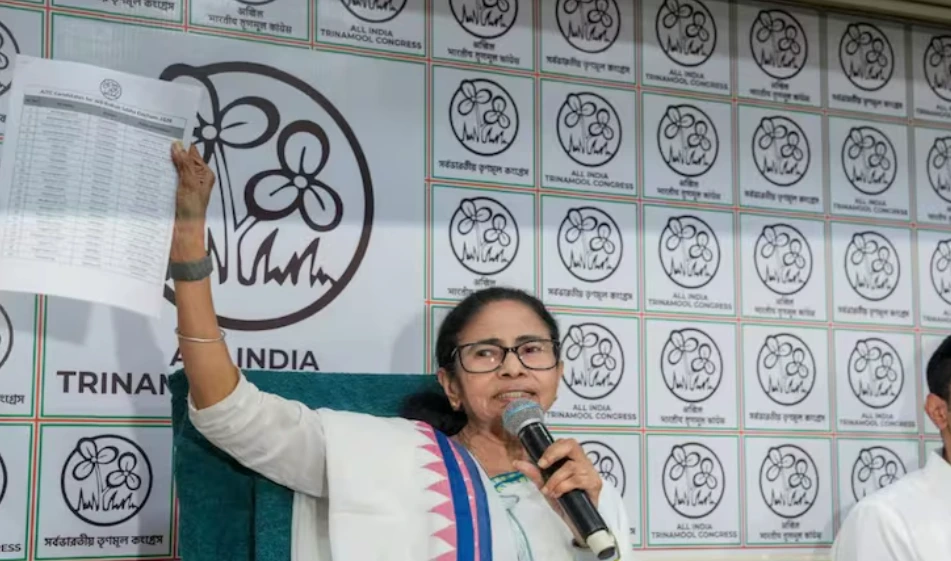
The release of West Bengal’s draft voter list following the Special Intensive Revision (SIR) has set off a fresh political controversy, with 58 lakh names found missing from the rolls. The development comes months ahead of the Assembly elections and has sharpened the ongoing debate between the ruling Trinamool Congress and the opposition BJP.

According to the draft list, 24 lakh voters have been marked as deceased, 19 lakh as relocated, 12 lakh as missing and around 1.3 lakh as duplicate entries. The exercise aims to eliminate duplication and errors from the electoral database and marks the completion of the first phase of SIR, which was last conducted in the state in 2002.

Objection window opens, final list due in February

With the draft list now published, voters whose names have been excluded can file objections and seek corrections. The Election Commission is expected to address these claims before releasing the final voter list in February next year. The announcement of the West Bengal Assembly elections is likely only after the final list is made public.

Trinamool calls deletions injustice, sets up help booths

The Trinamool Congress has strongly objected to the scale of deletions. Party MP Saugata Roy described the removal of 58 lakh names as an injustice and alleged that legitimate voters were being targeted. He said the party has set up voter assistance booths to help people submit forms for re-inclusion of their names.

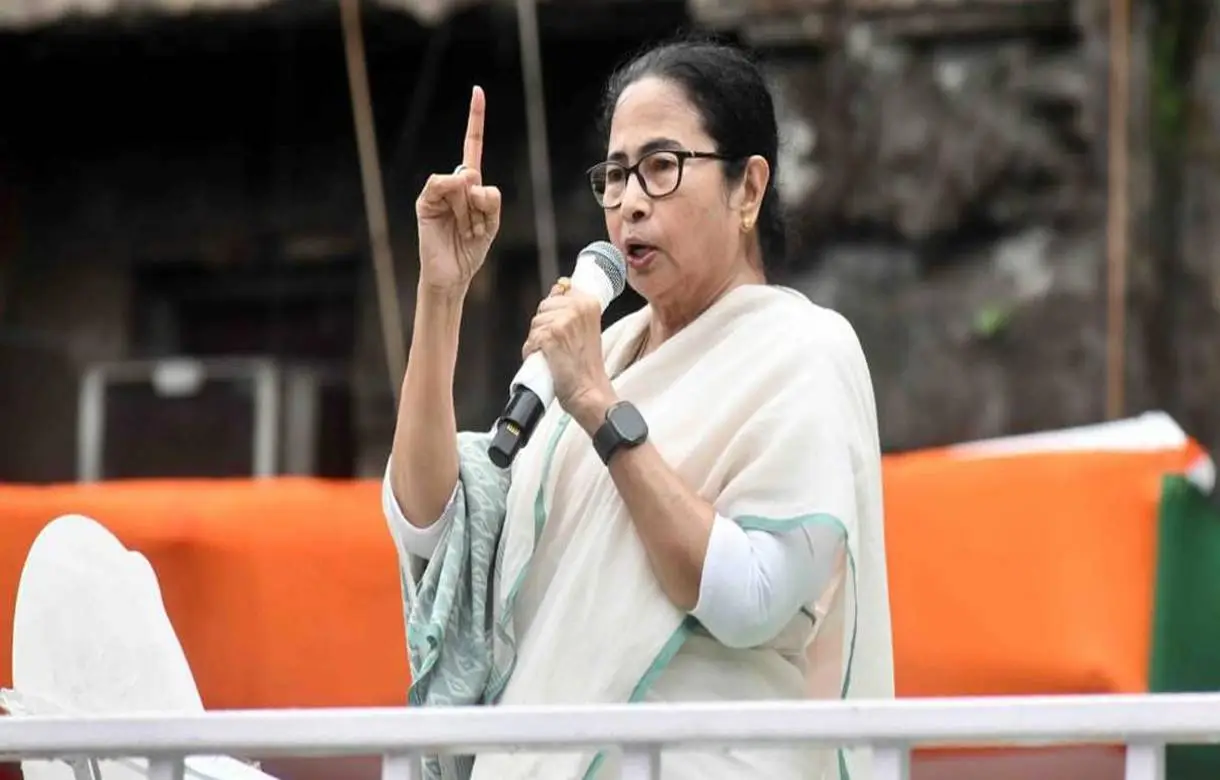
Chief Minister Mamata Banerjee has also opposed the SIR exercise, accusing the Centre and the Election Commission of attempting to strike off the names of eligible voters ahead of the polls. At a recent rally in Krishnanagar, she urged people to protest if their names were deleted from the rolls.

BJP defends SIR, targets Trinamool vote bank claims

The BJP has defended the revision exercise, accusing the Trinamool Congress of trying to shield illegal and fake voters. Leader of the Opposition in the Assembly Suvendu Adhikari claimed the Chief Minister’s opposition stemmed from fears of losing power as deceased, duplicate and illegal names were being removed from the voter list.

Earlier, Trinamool had also targeted the Election Commission over reports of Booth Level Officers facing extreme work pressure during the exercise. With the draft list now out, the political confrontation over SIR is expected to intensify further in the run-up to the elections.

Continue Reading

Trending

© Copyright 2022 APNLIVE.com