English हिन्दी
Connect with us

Latest Politics News

Rahul Gandhi wouldn’t need to fear disqualification if he had not done this

Observers had been upbeat on the Congress’s chances despite the “Aayega Modi hi” slogan and potential allies talking of a non-Congress, non-BJP alliance.

Published

on

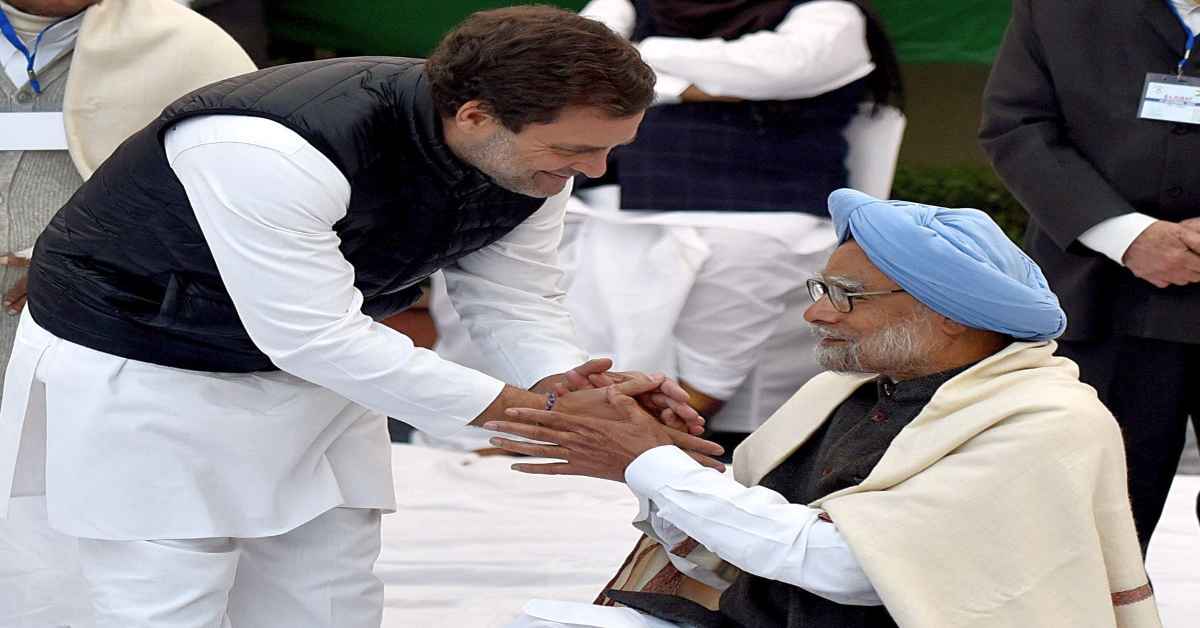
Rahul Gandhi and Manmohan Singh

Rahul Gandhi is finding himself in the eye of the news cycle storm after a Gujarat court convicted him of defamation for his 2019 remark against Prime Minister Narendra Modi.

Rahul Gandhi faces up to 2 years in jail for taking the Prime Minister’s name along with IPL founder Lalit Modi and fugitive businessman Nirav Modi and wondering if all Modis are thieves. The complaint against Gandhi was filed by BJP leader Purnesh Ishvarbhai Modi at Adajan police station in Surat district.

While convicting Gandhi, Chief Judicial Magistrate HH Varma granted him bail for 30 days for him to file his appeal, which would be in a higher court.

It is a coincidence that if Rahul Gandhi had not ripped up a Manmohan Singh government ordinance to protect legislators (MPs/MLAs/MLCs) convicted of criminal offences from disqualification, he could have escaped this Surat court judgment unscathed. But since the ordinance was withdrawn by the Manmohan Singh government, a legal protection that could have saved him and others can be looked upon wistfully.

The United Progressive Alliance-II regime had been at the receiving end of Opposition assaults over perceived corruption scams including 2G, coalgate and the railway cases, implicating ministers of allies Dravida Munnetra Kazhagam and Rashtriya Janata Dal among others.

The general perception of those years was that the allies were responsible for the falling goodwill of the Congress minority government. Though multiple parties including the Aam Aadmi Party went on the offensive, the biggest gainer from the hit on the Congress was the BJP.

Possibly, the UPA bigwigs could read among the tea leaves what lay ahead of them. Rahul Gandhi’s trashing other ordinance happened in the first few weeks of September 2013 when then PM Singh was away in the United States. The highlight of the next week was Narendra Modi being chosen as the BJP’s PM candidate above veteran leader LK Advani. What happened hence is well-known.

The Rahul Gandhi-led march, the Bharat Jodo Yatra, had won some eyeballs at the man’s ability to pull off the march with relative elan. Following the Hindenburg Research report on Adani, the Congress had shown some verve and fight in a marked departure from the grand old party dismissal.

A remark from spokesperson Pawan Khera on Modi saw Delhi Police armed police haul him off a flight at Delhi airport in connection with three FIRs against Khera, one in Assam and two in Uttar Pradesh.

Observers had been upbeat on the Congress’s chances despite the “Aayega Modi hi” slogan and potential allies talking of a non-Congress, non-BJP alliance. The Surat court decision could spark greater opposition coherence since Arvind Kejriwal himself came out in support of Gandhi.

India News

Congress high command steps in to resolve Karnataka leadership impasse with crucial Delhi meeting

The Congress leadership, including Mallikarjun Kharge and Rahul Gandhi, is holding a vital meeting in Delhi with Karnataka Chief Minister Siddaramaiah to find a definitive solution to the state’s prolonged leadership impasse.

Published

on

The top leadership of the Congress party is scheduled to hold a high-level meeting at its headquarters in the national capital today morning to address the long-standing leadership dispute in Karnataka. Senior leaders, including party president Mallikarjun Kharge and MP Rahul Gandhi, will lead the discussions aimed at resolving the continuous friction between Chief Minister Siddaramaiah and Deputy Chief Minister DK Shivakumar.

The ongoing power struggle over the state’s top position has persisted since the party’s electoral victory in 2023. For the current session, only Chief Minister Siddaramaiah has been called to join the discussions in Delhi. When questioned about the agenda by reporters, the Chief Minister stated that he was unaware of the specific subjects to be discussed, noting that political speculation is inevitable.

Background of the internal division

The internal friction intensified significantly in November 2025 when the state government completed its two-and-a-half-year mark in office. Supporters of the Deputy Chief Minister pointed to a purported unacknowledged internal arrangement suggesting a rotational chief ministership split equally across the five-year term. Despite multiple prior interventions by central party leadership to manage the internal friction, a permanent resolution has remained elusive.

While Deputy Chief Minister DK Shivakumar has not been invited to this morning’s initial session, indications suggest that separate individual discussions and a potential joint meeting involving both leaders are planned as part of the broader resolution process. Observers note that several state ministers and legislators have also traveled to the national capital as the party leadership aims to settle the administrative roadmap and finalise leadership plans before the next assembly elections.

Continue Reading

India News

No uniform civil code provisions will be imposed on tribals, clarifies Amit Shah

Union Home Minister Amit Shah has assured tribal communities that the proposed Uniform Civil Code will not interfere with their customs, urging them not to be misled by misinformation.

Published

on

Union Home Minister Amit Shah on Sunday declared that the proposed Uniform Civil Code (UCC) will not impact tribal populations in any manner. He called upon the community to stay vigilant against “conspiracies” and misinformation circulating on the subject.

Addressing the Janjati Sanskritik Samagam—a tribal conclave organized by the Janjati Suraksha Manch at the Red Fort grounds to mark the 150th birth anniversary year of Birsa Munda—Shah stated that specific provisions have been implemented in states ruled by the ruling party to exclude tribal communities from the scope of the code.

Clarification on customs and traditions

The Home Minister highlighted that a deliberate narrative has emerged suggesting the proposed legislation would strip tribal societies of their distinct culture, traditions, and customary lifestyles.

He explicitly clarified that the central government has no intention of forcing UCC regulations upon tribal or Vanvasi communities. Shah pointed out that where regional administrations have initiated the code, care has been taken by the leadership to ensure that indigenous populations remain fully outside its jurisdiction. He requested attendees to disseminate this assurance deeply into forest zones and rural villages to erase lingering apprehensions.

Focus on security and community development

Beyond the legislative framework, Shah detailed the progress made toward curbing internal security threats, stating that the nation is steadily advancing toward eradicating Naxalism entirely. He noted that violent disruptions had severely restricted progress in these belts for decades, leading to the loss of thousands of tribal lives. According to the minister, regional stability will now pave the way for accelerated development across remote hills and forests.

The address also covered constitutional rights regarding personal faith. Shah mentioned that the original framework of the Constitution grants every citizen the dignity to practice their traditional beliefs without facing coercion, temptation, or material inducement for religious conversion.

Reflecting on financial allocations, the minister criticized earlier political administrations for keeping tribal welfare funding low. He underscored that the current administration under Prime Minister Narendra Modi significantly elevated the dedicated tribal budget from a previous Rs 28,000 crore to Rs 1.54 lakh crore. Terming the vast gathering a historical movement for cultural preservation, Shah described the societal awakening as a major step toward safeguarding tribal heritage for future generations.

Continue Reading

India News

Karnataka withdraws 42 criminal cases including 2022 Aland Dargah clashes, sparks massive BJP backlash

The Congress-led Karnataka government has cleared the withdrawal of 42 criminal cases, including those linked to the 2022 Aland Dargah clashes, drawing intense fire from the BJP over allegations of encouraging violent elements.

Published

on

The Congress-led Karnataka government has officially cleared the withdrawal of 42 criminal cases, including several sensitive cases tied to the 2022 communal clashes at the Ladle Mashak Dargah in Aland town, Kalaburagi district. The decision has triggered an intense political confrontation, with the Bharatiya Janata Party (BJP) launching a fierce attack against the ruling administration.

Aland Dargah Clashes Under Focus

A major portion of the dropped cases involves 13 specific files connected to the communal violence that erupted in 2022. The tension originally ignited following allegations that a Shivling located inside the disputed Ladle Mashak Dargah premises had been desecrated. The situation rapidly escalated into large-scale unrest when a group of Hindu activists made attempts to enter the dargah to clean the structure.

During the ensuing rioting, extensive damage was inflicted on public and private property. Several vehicles were completely vandalised, including official transport vehicles used by high-ranking political figures such as Union Minister Bhagwanth Khuba and the Kalaburagi Deputy Commissioner.

Overruling Departmental and Legal Objections

According to internal sources, the state home department had initially strongly resisted the move to drop the riot-related cases. The department cited highly adverse legal opinions and expressed deep reservations regarding the suspension of prosecution in matters of sensitive communal violence.

Despite these departmental objections and legal warnings, a specialized Cabinet sub-committee reviewed and subsequently approved the withdrawal of the cases. The recommendation was then fast-tracked to the state Cabinet, which formally ratified and cleared the final decision.

“Encouraging Violent Elements,” Alleges BJP

The opposition BJP reacted sharply to the development, accusing the government of actively fostering lawlessness. Speaking on the decision, BJP spokesperson S. Prakash noted that this marks the third instance where the Congress administration has stepped in to drop severe criminal cases across the state.

“Cases linked to rioting and attempts to burn police stations were also withdrawn earlier,” Prakash stated, emphasizing that prior state actions of a similar nature had been legally contested and stayed by courts. He added that the administration has failed to learn any lessons from past judicial interventions.

The opposition spokesperson went on to allege that the decision was heavily influenced by senior party leadership, pointing toward pressure from leaders like Priyank Kharge or Mallikarjun Kharge. He claimed that by repeatedly withdrawing such cases, the government is effectively encouraging fringe elements to continue executing violence without fear of legal consequences.

State Government Stands Firm on Review Process

Defending the executive action, Karnataka Home Minister G Parameshwara clarified that the decision was neither rushed nor arbitrary. He emphasized that the Cabinet Sub-Committee meticulously reviewed approximately 52 total cases involving various socio-political organizations across the entire state.

“In the Cabinet Sub-Committee, every case was discussed individually to examine whether it could be legally withdrawn,” Parameshwara asserted. He explained that the panel moved forward only after establishing that there was concrete legal scope to do so. While refusing to delve deeper into the specific details of the Aland Dargah incident, he stated that the final step was a collective Cabinet decision where all pertinent parameters were fully evaluated.

Slamming the opposition’s narrative, Minister Satish Jarkiholi also stood by the administration’s choice. He noted that the beneficiaries of the 42 dropped cases span across multiple communities and groups, including farmers, local political leaders, and Muslims. Jarkiholi dismissed the BJP’s criticism as a standard, predictable allegation that is routinely leveled whenever such broad administrative reviews take place.

Continue Reading

Trending

© Copyright 2022 APNLIVE.com