English हिन्दी
Connect with us

Latest Politics News

UP’s psychedelic play of castes

Published

on

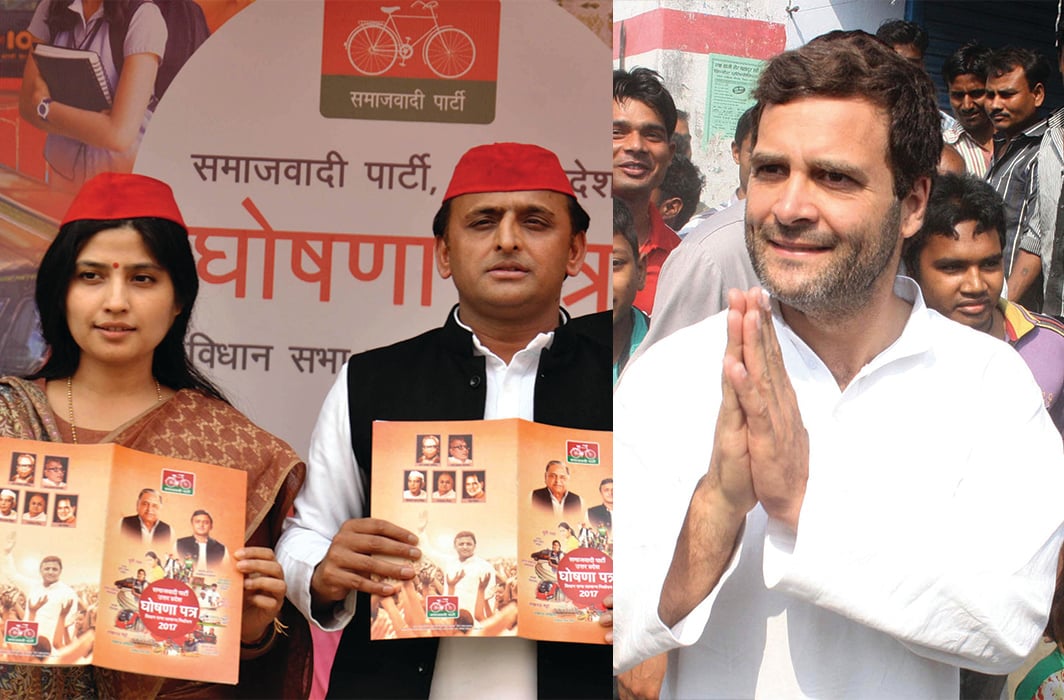
It looks like that the SP-Congress alliance, with its eye on capturing the Muslim vote, would push the BJP to try for the consolidation of the so-called Hindus cutting across caste, making it into a Hindu-Muslim divide.

There is visible desperation in Akhilesh Yadav reaching out to Congress

Parsa Venkateshwar Rao Jr

Tactics are very important, and battles need to be won if the war is to be won. Seen from this point of view, the Samajwadi Party (SP) led by Akhilesh Yadav, the Gen-Next leader of the party and the Congress, unofficially led by Nehru-Gandhi Gen-Next, Rahul Gandhi and Priyanka Vadra, agreeing to be poll partners in the February-March assembly elections in Uttar Pradesh sounds practical and pragmatic. The SP under patriarch Mulayam Singh Yadav has been an eminently anti-Congress party, which was seen as the face of upper caste domination in the caste-riven state. But times change, and so do generations. It is legitimate for both SP and Congress to reboot their agendas as it were, and to find commonalities in place of the earlier divergences and opposition.

It is possible that Akhilesh Yadav and Rahul Gandhi/Priyanka Vadra may want to sit and rethink their priorities, and bring about a political alliance between the Yadav-dominant Other Backward Class/Caste (OBC) SP and the so-called upper caste/upper crust base of the Congress. Of course, the two sides are in fact looking to the nearly 19 per cent Muslim vote, which goes under the neutral term of “minorities”. The other major group in the state’s hierarchical social/caste stratification is that of Dalits, who form a solid bloc under the Bahujan Samaj Party (BSP) led by Mayawati.

The SP, the BSP and the Congress, as well as the Bharatiya Janata Party (BJP), adopt the politically correct stance that they do not recognize caste divisions, and that they appeal to all social segments, that is caste segments. That is why, BSP gives enough seats to Muslims and Brahmins, and the SP gives a nod to Dalit presence. The Congress is looking to the Dalits and the Muslims, apart from the upper castes led by Brahmins and Rajputs. The BJP pretends as though Muslims do not exist while it tries to woo the Dalits, the Most Backward Classes/Castes (MBCs) and the upper castes. The caste combinations in the political calculus of each party make for a nice psychedelic graphic mix.

It looks like that the SP-Congress alliance with its eye on capturing the Muslim vote would push the BJP to try for the consolidation of the so-called Hindus, cutting across caste— upper, middle, backward, oppressed—lines, making it into a Hindu-Muslim divide. But the BJP will be hard put to enthuse the different segments of the Hindu society as one because the idea of Ram temple in Ayodhya does not enthuse the majority community. The BJP under Prime Minister Narendra Modi wants to shed its “brahminical” cultural affiliation and reach out to other caste groups, willing to risk losing its upper caste base. It was the BJP tidal wave that swept all before it in the 2014 Lok Sabha elections, and it seems to have traumatised the SP and the Congress, if not the BSP.

But the best laid plans of all the parties might go awry. Brahmins may not go with the BJP, BSP or the Congress. But it cannot be the case. They have to choose one among the three. The Brahmins can hope to be part of the power structure in a SP-Congress alliance, and the Dalits too can base their choice by voting for the alliance. Similarly, Muslims will have to choose from among the SP, BSP and the Congress. Psephologists and political realists describe these choices under the rubric of “tactical voting”.

Idealists are sure to be saddened by the caste battle lines and would be asking whether Uttar Pradesh can break out of the caste crucible. The truth might be that a significant number of people, especially the youth, might be opting out of the caste mould and voting for parties and candidates who lie beyond. It appears that something of this kind might have happened in the state during the 2014 Lok Sabha elections, when quite a large number of people did not vote along caste lines and therefore voted with an open mind, willing to give the BJP under Modi to govern at the centre. Will they be willing to do the same in an assembly election which means changing power equations nearer home?

The SP and the Congress would want to pre-empt the out-of-the-(caste)-box voting choice of the Muslims especially. But it would seem that the Muslim youth have a mind of their own, and they are not willing to vote on the jaded issue of secularism vs communalism. Their demands are different, and it is for economic opportunity. If they refuse to vote for Modi and the BJP, it will not be because they consider Modi/BJP to be anti-Muslim, but they would judge them on their failure to deliver on the economic promises. The Dalits are unlikely to abandon the BSP/Mayawati banner because they know that victory is politically feasible with the right caste, and not political, alliances.

Lead picture: It looks like that the SP-Congress alliance, with its eye on capturing the Muslim vote, would push the BJP to try for the consolidation of the so-called Hindus cutting across caste, making it into a Hindu-Muslim divide. Photos: UNI

India News

Shashi Tharoor likely to skip key Congress meet amid unease with party leadership

Shashi Tharoor is expected to remain absent from a crucial Congress meeting in Kerala, with sources citing dissatisfaction over his treatment during Rahul Gandhi’s Kochi visit.

Published

on

Senior Congress MP Shashi Tharoor is likely to skip an important meeting of the party’s Kerala leadership scheduled for Friday afternoon, with sources indicating that the four-time Lok Sabha member is upset over a perceived lack of due respect during Rahul Gandhi’s recent visit to Kochi.

The meeting, set to be attended by senior leaders including Rahul Gandhi and Congress president Mallikarjun Kharge, is aimed at reviewing preparations for the Kerala Assembly election later this year. Tharoor, who represents Thiruvananthapuram, is expected to be absent.

Sources said the diplomat-turned-politician has been unhappy with the party’s handling of his role during the Kochi visit, adding to existing strain between him and the Congress’ central leadership.

Tharoor has in recent months found himself under scrutiny within the party following remarks that were seen as appreciative of Prime Minister Narendra Modi and the ruling Bharatiya Janata Party. These include comments on the Prime Minister’s response to the April 22 Pahalgam terror attack and subsequent military strikes on Pakistan, as well as occasional critical observations aired through media interactions.

The tension resurfaced on Thursday after Tharoor shared a selfie with former BJP MP and current India men’s cricket team head coach Gautam Gambhir. In his post, Tharoor praised Gambhir for handling what he described as “the second-hardest job in India,” after the Prime Minister’s role.

The post drew a sharp response from a BJP spokesperson, who linked Tharoor’s comments on cricket fans questioning coaching decisions to the opposition’s criticism of the Prime Minister. The BJP leader accused the opposition of prioritising family interests over national concerns and suggested that Tharoor’s remarks once again highlighted divisions within the Congress.

The episode underscores the continuing unease between Shashi Tharoor and the Congress leadership, a rift that political rivals have frequently highlighted in public discourse.

Continue Reading

India News

BJP calls Congress anti-Hindu after Rahul Gandhi questions G-RAM-G scheme

The BJP has accused the Congress of being anti-Hindu after Rahul Gandhi said he was unfamiliar with the new G-RAM-G employment guarantee scheme that replaces MNREGA.

Published

on

Rahul-Gandhi

The Bharatiya Janata Party on Wednesday accused the Congress of being “anti-Hindu” after senior leader Rahul Gandhi said he was unfamiliar with the name of the newly introduced G-RAM-G employment guarantee scheme, which has replaced the Mahatma Gandhi National Rural Employment Guarantee Act.

Speaking at a conference held at Delhi’s Jawahar Bhavan, Rahul Gandhi remarked, “I don’t know what G-RAM-G is,” while addressing an event focused on MNREGA, the flagship rural employment programme launched during the Congress-led government. Congress president Mallikarjun Kharge made similar comments at the event.

BJP response and political backlash

The BJP reacted sharply, alleging that Rahul Gandhi’s remarks reflected hostility towards Lord Ram. Party leaders claimed the comments had “exposed the Congress’ anti-Hindu mindset,” a charge that intensified the political confrontation over the new legislation.

Several opposition leaders have argued that one of the core concerns with the G-RAM-G scheme is the replacement of Mahatma Gandhi’s name with that of a religious figure, a move they say politicises a welfare programme that was previously secular in identity.

Congress alleges attempt to weaken employment guarantee

At the conference, Rahul Gandhi said MNREGA had given poor households a legal right to employment, which he claimed Prime Minister Narendra Modi was attempting to dismantle. He also referred to the now-repealed farm laws of 2020, saying sustained public pressure had earlier forced the government to withdraw them.

“If we stand together, the government will be forced to back down and MNREGA will be restarted,” Gandhi said, asserting that the employment guarantee programme could be revived through collective resistance.

Mallikarjun Kharge accused the BJP of trying to erase Mahatma Gandhi’s legacy from public memory and said the Congress would raise the issue again during the upcoming Budget session of Parliament.

States move to support MNREGA

As the political debate continues, at least two opposition-ruled states have taken steps to support MNREGA. Karnataka and Tamil Nadu have both indicated plans to pass Assembly resolutions backing the older scheme.

In Karnataka, proceedings were disrupted after Governor Thawar Chand Gehlot declined to read out portions of a government-prepared speech that criticised the G-RAM-G framework. In Tamil Nadu, Chief Minister MK Stalin said his government would also move a resolution in support of MNREGA.

What the G-RAM-G scheme changes

The new G-RAM-G law introduces several structural changes compared to MNREGA. The guaranteed number of workdays has been increased to 125 from 100, but employment is limited to areas officially notified as rural by the central government.

Under the revised funding structure, states are now required to bear 40 per cent of the scheme’s costs, while the Centre will contribute the remaining amount. Hill states and northeastern states will pay only 10 per cent, and Union Territories will continue to receive full central funding.

The Centre will also adopt a “normative” allocation model, deciding annual fund limits for states based on defined parameters, rather than demand. This gives the Centre greater control over fund releases and the authority to suspend allocations in cases of serious irregularities.

While the government has said the changes will encourage states to take financial ownership without imposing excessive burdens, the opposition has described the scheme as “anti-poor,” warning that it could reduce employment opportunities by straining state finances.

Continue Reading

India News

Congress seeks action against Udupi DC over saffron flag row

The Congress has sought action against Udupi deputy commissioner T K Swaroopa over allegations that she waved a saffron flag during the Paryaya procession, a charge she has denied, saying her participation was part of official duty.

Published

on

Paryaya' system in Udupi

The Congress has sought action against Udupi deputy commissioner T K Swaroopa over allegations that she waved a saffron flag during the Paryaya procession held on January 18, triggering a political controversy in coastal Karnataka.

The issue surfaced after the Legal and Human Rights Cell of the Udupi District Congress Committee wrote to Chief Minister Siddaramaiah, demanding an inquiry into Swaroopa’s conduct during the religious procession linked to the Udupi Sri Krishna Math.

DC denies political motivation

Responding to the allegations, Swaroopa said she attended the event strictly in her official capacity and denied any politically motivated participation.

In a statement issued on Wednesday, she said that at around 3 am on January 18, she flagged off the Puraprevesh programme of the Swamiji as part of the biennial Paryayotsava celebrations. She added that she did so in her role as the administrator of the Udupi City Council.

Swaroopa also said she attended the civic honour programme for the new paryaya swamiji and the durbar event held after the swamiji ascended the Sarvajna Peetha, reiterating that her presence was aligned with administrative responsibilities.

Congress seeks inquiry, alleges rule violation

In the letter addressed to the chief minister on Monday, Udupi District Congress Committee Legal and Human Rights Cell president Harish Shetty alleged that ahead of the procession from Jodu Katte to Krishna Math, a BJP MLA handed over a saffron flag to the deputy commissioner, which she allegedly raised and waved in public.

The letter claimed that such an act violated service rules governing civil servants and went against the constitutional principle of secularism. The Congress has demanded a formal inquiry and appropriate action in accordance with law.

About the Paryaya system

The Paryaya or Paryayotsava marks the ceremonial transfer of ritual and administrative control of the Udupi Sri Krishna Temple. On January 18, Shiroor Matha assumed charge for the 2026–28 term, with Sri Vedavardhana Tirtha Swamiji taking over as the pontiff-administrator.

Under the centuries-old Paryaya system, the temple is managed on a rotational basis by the Ashta Mathas—Pejavara, Puttige, Adamaru, Krishnapura, Shiroor, Sodhe, Kaniyoor and Palimaru—each for a period of two years. The system was instituted by 13th-century philosopher-saint Sri Madhwacharya, the founder of the Dvaita school of philosophy.

Continue Reading

Trending

© Copyright 2022 APNLIVE.com