English हिन्दी
Connect with us

Cricket news

Virat Kohli’s decision to quit Test cricket linked to lack of freedom, desire to captain again

Virat Kohli’s sudden Test retirement was driven by denied leadership ambitions and dissatisfaction with the current dressing room environment.

Published

on

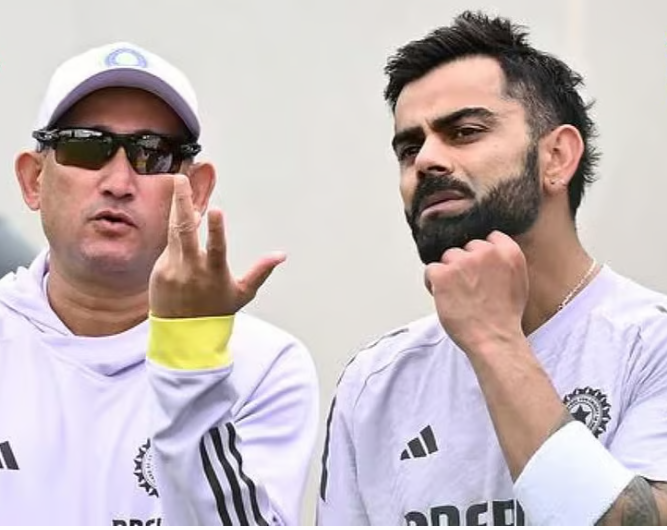
Virat Kohli’s unexpected announcement of his retirement from Test cricket has stirred the cricketing world. According to a recent report, the former Indian captain’s decision was rooted in his desire for a leadership comeback and dissatisfaction with the current team environment.

Sources close to the developments suggest that Kohli had long been contemplating a change. As India enters a new World Test Championship cycle, the 36-year-old batter was reportedly keen to take on the challenge of leading the side once more—particularly during the home series against England. However, the leadership role wasn’t offered to him, prompting a reassessment of his future in the red-ball format.

Discussions with selectors and former mentors

Kohli is said to have spoken to BCCI chief selector Ajit Agarkar on at least two occasions in recent months. These discussions, however, did not yield any shift in plans regarding team leadership. Additionally, Kohli reached out to former coach Ravi Shastri, a close confidant, and also held a conversation with former BCCI secretary Jay Shah. A scheduled meeting with BCCI vice-president Rajeev Shukla couldn’t materialize due to time constraints linked to geopolitical factors.

Shift in dressing room dynamics

As per insiders, Kohli felt the current team atmosphere lacked the sense of freedom and positive energy that once defined the dressing room. Under the existing management, the vibe appeared significantly different, contributing to his decision to step away from the format. Following a prolonged dip in form—where he averaged only 32 over three years—Kohli had been searching for renewed purpose. Without a leadership role or conducive environment, continuing in Tests no longer offered that drive.

BCCI’s new cycle plan

The Board of Control for Cricket in India reportedly intends to start afresh with a younger leadership group. While there was potential for both Kohli and Rohit Sharma to retire together post the England series, the BCCI’s focus on initiating the new World Test Championship cycle with a clear roadmap led to an earlier transition.

Cricket news

Rinku Singh returns home from T20 World Cup camp due to family emergency

Rinku Singh has flown back home from the T20 World Cup camp after his father’s health deteriorated. Team management is yet to confirm his return.

Published

on

Indian middle-order batter Rinku Singh has flown back home from the ICC Men’s T20 World Cup camp following a medical emergency in his family.

According to sources, the left-handed batter left the team environment after his father’s health condition worsened. It is learnt that his father is battling stage-4 liver cancer and is currently on ventilator support. Rinku decided to return home to be with his family during this critical period.

There is no official confirmation yet on whether the cricketer will rejoin the squad for the remainder of the tournament. Team management is closely monitoring the situation, and a further update is awaited.

Rinku has emerged as a key member of India’s white-ball setup in recent years, particularly known for his finishing abilities under pressure. Any prolonged absence could influence India’s combination in the crucial Super 8 stage of the competition.

For now, the focus remains on his family, with support expected from the cricketing fraternity as he navigates this difficult time.

Continue Reading

Cricket news

Shadab Khan lands in trouble after ‘we’ve beaten India’ remark, PCB issues warning: Report

Shadab Khan has reportedly been advised by the PCB to mind his language after his remarks on former players following Pakistan’s loss to India stirred controversy.

Published

on

pakistan cricket team

Pakistan all-rounder Shadab Khan has reportedly been cautioned by the Pakistan Cricket Board (PCB) after his remarks about former cricketers triggered controversy during the ongoing ICC T20 World Cup.

The issue surfaced after Pakistan suffered a 61-run defeat to India earlier in the tournament. Speaking to the media later, Shadab responded to criticism from former players and said that while they were legends, they “could not do what we have done,” referring to Pakistan’s win over India in the 2021 T20 World Cup.

PCB conveys displeasure over comments

According to reports, the PCB expressed its dissatisfaction with Shadab’s post-match comments and advised him to be mindful of his language during media interactions. Team manager Naveed Cheema reportedly conveyed the board’s concerns to the all-rounder.

Sources were quoted as saying that Shadab had crossed the line during the press conference and was reminded to show respect to former cricketers, including his father-in-law, former Pakistan spinner Saqlain Mushtaq.

The board has also reportedly instructed the team management to ensure that players limit their comments strictly to match-related matters. It is understood that further action could follow if similar instances occur.

Remarks came after Namibia match

Shadab’s statement came after Pakistan’s 102-run win over Namibia in Colombo, where he scored 36 off 22 balls and returned figures of 3 for 13. The comments were seen as a response to criticism directed at the current squad following their defeat to India.

Former wicketkeeper-batter Kamran Akmal described Shadab’s remarks as unnecessary, saying such words against former players warranted caution.

Media interactions under tighter control

The Pakistan team management has reportedly adopted a cautious approach regarding player interactions with the media. No players were made available for two days prior to the high-profile India clash.

In a separate instance, when Usman Tariq appeared for a pre-match interaction ahead of the Namibia fixture, the team’s media manager intervened to prevent him from responding to a tactical question. The manager stated that head coach Mike Hesson had already addressed the matter after the India match.

Pakistan are scheduled to face New Zealand in their first Super Eight fixture in Colombo on Saturday, followed by matches against England and Sri Lanka in Pallekele later in the tournament.

Continue Reading

Cricket news

Ian Healy lashes out at Australia after T20 World Cup 2026 group stage exit

Ian Healy has criticised Australia’s squad balance and selection decisions after their early exit from the T20 World Cup 2026.

Published

on

Australia’s campaign at the T20 World Cup 2026 ended at the group stage, marking a surprising early departure for the 2021 champions. With Zimbabwe progressing alongside Sri Lanka from Group B, Australia failed to secure a place in the Super 8 stage.

Losses to Zimbabwe and Sri Lanka left the Mitchell Marsh-led side under pressure. A washed-out match between Ireland and Zimbabwe ultimately sealed Australia’s elimination from the tournament.

Former Australia wicketkeeper Ian Healy did not hold back in his assessment of the team’s performance and selection strategy. Speaking on SEN Cricket, Healy said the team’s approach in the lead-up to the tournament had been flawed.

“We were duped,” Healy remarked, suggesting that the squad composition prioritised power over adaptability in conditions suited to Sri Lanka and India. He criticised what he described as a denial of possible shortcomings and an overconfidence in the chosen combination.

Healy also questioned the decision-making around team changes during the tournament. He pointed out that in a crucial match, two bowlers and a leading batter were dropped to accommodate an all-rounder, another bowler, and the captain’s return, a move he felt disrupted the balance of the side.

The former wicketkeeper expressed particular concern over the batting order and the role of certain players. He questioned the inclusion of Cooper Connolly, noting the youngster’s recent run of low scores, and argued that the team lacked specialist batters capable of building innings in challenging conditions.

According to Healy, the squad was filled with finishers but lacked players who could stabilise the innings at the top. He also mentioned Cameron Green’s position at number three, Tim David at four, and Josh Inglis’ shifting role in the batting order as examples of what he called an “unbalanced team”.

Healy concluded that the selection direction taken a year ago, which he believes prioritised power-hitting over traditional batsmanship and form, ultimately backfired in subcontinental conditions.

Australia’s early exit means the Super 8 stage of the T20 World Cup 2026 will proceed without one of the tournament’s traditional heavyweights.

Continue Reading

Trending

© Copyright 2022 APNLIVE.com