English हिन्दी
Connect with us

India News

Sports Ministry asks Indian Olympic Association to form panel to run Wrestling Federation of India

The temporary panel formed by the IOA will look after the day-to-day affairs of the WFI, including making entries for participation of sportspersons in international events, and holding sporting events.

Published

on

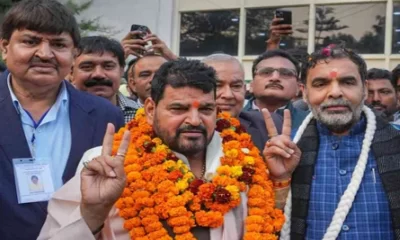
After Sanjay Singh-led Wrestling Federation of India body’s suspension, the Sports Ministry has asked the Indian Olympic Association (IOA) to form a temporary panel to run the WFI. In a letter to the Indian Olympic Association chief, the Sports Ministry said the temporary committee can manage and control the affairs of the WFI including selection of athletes.

The letter which was signed by Tarun Pareek, undersecretary to the Centre, read that taking note of the compelling current situation arising out of the influence and control of the WFI’s former office bearers, serious concerns have arisen about the governance and integrity of the WFI.

The letter added that this situation requires for immediate and stringent corrective measures to uphold the principles of good governance in sports organisations, and thus, now it becomes incumbent on the part of the IOA to make suitable arrangements for the interim period for managing the affairs of WFI, so that sportspersons of wrestling discipline do not suffer in any manner and the principle of good governance is the sports body do not get jeopardised.

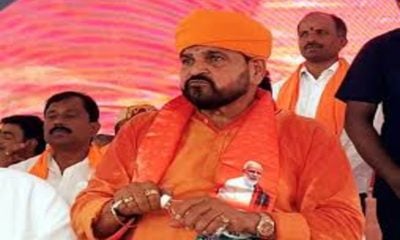
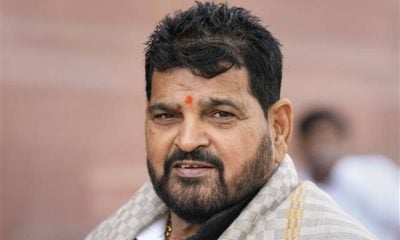
Meanwhile, another round of election to the WFI cannot be ruled out since the latest administration led by the newly elected chief Sanjay Singh, a loyalist of former WFI chief Brij Bhushan Sharan Singh, has been suspended by the Centre. Reports said that the temporary panel formed by the IOA will look after the day-to-day affairs of the WFI, including making entries for participation of sportspersons in international events, and holding sporting events.

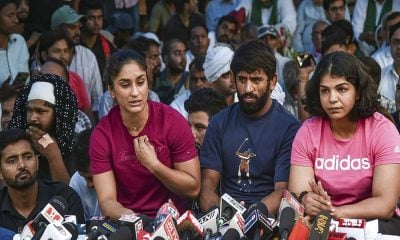
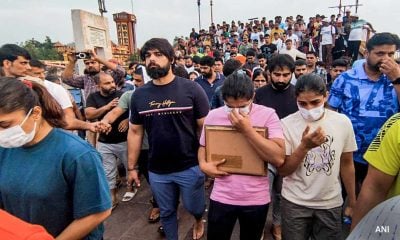
Earlier, the Sports Ministry in a statement noted the newly elected body appears to be in complete control of former office bearers in complete disregard to the Sports Code. It stated that the Wrestling Federation of India is being run from the premises controlled by former office bearers, which is also alleged premises wherein sexual harassment of the players have been alleged and at present the court in hearing the matter.

India News

Union Budget 2026: What the middle class gains despite no income tax slab changes

Union Budget 2026 retains income tax slabs but offers indirect relief to the middle class through TCS cuts, simpler tax filing, cheaper medicines and higher job-creating expenditure.

Published

on

Union Budget 2026: what the middle class gains despite no income tax slab changes

Union Budget 2026 may not have delivered direct income tax relief to salaried taxpayers, but the government has introduced several indirect measures aimed at easing financial pressure on middle-class households.

While tax slabs remain unchanged, the Budget outlines steps to simplify compliance, reduce taxes on overseas spending, lower the cost of essential medicines, and support job creation through higher public spending.

Income tax status quo continues

The government has retained the existing income tax framework for individuals. Annual income up to Rs 12 lakh continues to remain tax-free, and with the Rs 75,000 standard deduction, effective tax-free income rises to Rs 12.75 lakh.

No changes have been announced in income tax slabs, signalling policy continuity rather than immediate relief for salaried taxpayers.

Compliance relief and tax rationalisation measures

A key focus of Budget 2026 is reducing compliance burdens and improving the taxpayer experience.

The government has proposed a reduction in Tax Collected at Source (TCS) on overseas tour programme packages to 2%, down from the earlier rates of 5% and 20%. TCS under the Liberalised Remittance Scheme (LRS) for education and medical expenses has also been cut to 2% from 5%, providing relief to families sending money abroad for essential purposes.

To ease return filing pressure, timelines have been staggered. Individual taxpayers filing ITR-1 and ITR-2 can continue to file returns till July 31, while non-audit businesses and trusts will now get time till August 31.

Protection for small investors

The Budget proposes taxing all share buybacks as capital gains instead of dividends, a move aimed at protecting minority retail investors.

In another relief measure, interest awarded by Motor Accident Claims Tribunal (MACT) to individuals will be exempt from income tax, and the applicable TDS will be removed.

A single-window system will also be introduced for submitting Form 15G and Form 15H through depositories for TDS on dividends and interest, simplifying compliance for senior citizens and small savers.

Cheaper medicines and essential products

Healthcare costs may ease slightly as the government has announced duty exemptions on about 17 cancer medicines. Personal imports of medicines for seven rare diseases will also be allowed duty-free.

In addition, customs duty relief has been extended to critical components used in the manufacture of microwave ovens, television equipment, leather goods and footwear, which could help moderate consumer prices.

Job creation through higher spending

The government has raised capital expenditure to over Rs 12 lakh crore, with allocations for railways, tourism, logistics and technology sectors. These investments are expected to support employment generation and long-term economic activity, indirectly benefiting middle-class households.

Continue Reading

India News

Budget 2026 balances high capex and growth, says PM Modi

Prime Minister Narendra Modi said Union Budget 2026 strikes a balance between high capital expenditure and strong growth while reinforcing reforms and fiscal discipline.

Published

on

pm modi

Prime Minister Narendra Modi on Saturday said the Union Budget 2026 strikes a fine balance between high capital expenditure and sustained economic growth, calling it a roadmap for long-term national development.

Speaking after Finance Minister Nirmala Sitharaman presented her ninth consecutive Budget, the prime minister said the proposals reflect a vision of trust-based governance and a human-centric economic framework. He added that India is not just focused on being the fastest-growing economy but is working towards becoming the world’s third-largest economy.

PM Modi said the Budget also reinforces India’s strong global standing and will provide fresh momentum to the country’s reform agenda. According to him, the measures announced will energise what he described as India’s “reform express”.

The prime minister highlighted the Budget’s focus on promoting tourism in the northeastern region, noting that it would create new opportunities and support regional development.

On fiscal management, the finance minister retained the states’ share in the divisible pool of central taxes at 41 per cent. She announced that Rs 1.4 lakh crore has been provided to states as Finance Commission grants for 2026–27, in line with the recommendations of the commission.

The Finance Commission, chaired by Arvind Panagariya, had submitted its report to the President in November 2025 after consultations with states and Union Territories, several of which had sought a higher share.

Sitharaman pegged the fiscal deficit for 2026–27 at 4.3 per cent of GDP, lower than the revised estimate of 4.4 per cent for 2025–26. She also said the debt-to-GDP ratio is projected to decline to 55.6 per cent in 2026–27 from 56.1 per cent in the previous fiscal.

A gradual reduction in the debt burden will help free up resources for priority sectors by lowering interest outgo, the finance minister said.

Continue Reading

India News

India to build seven high-speed rail corridors, Finance Minister announces

Union Budget 2026-27 unveiled seven high-speed rail corridors and a dedicated east-west freight corridor to boost sustainable transport and economic growth.

Published

on

India to build seven high-speed rail corridors, Finance Minister announces

Finance Minister Nirmala Sitharaman, presenting the Union Budget 2026-27 in Parliament on Sunday, announced that India will develop seven high-speed rail corridors connecting key cities across the country.

These corridors, described as ‘growth connectors’, aim to promote environmentally sustainable passenger transport systems. The proposed high-speed rail links will connect:

  • Mumbai and Pune
  • Hyderabad and Pune
  • Hyderabad and Bengaluru
  • Hyderabad and Chennai
  • Chennai and Bengaluru
  • Delhi and Varanasi
  • Varanasi and Siliguri

In addition to passenger rail, Sitharaman announced a dedicated east-west freight corridor connecting Dankuni in the east with Surat in the west. This initiative, along with the operationalisation of 22 new national waterways over the next five years, is intended to enhance multimodal transport and reduce logistics costs.

“These initiatives will strengthen freight movement and support sustainable cargo transportation,” the Finance Minister said.

The Budget also emphasizes infrastructure development in cities with populations over five lakh (Tier II and Tier III), which have emerged as key growth centres. Sitharaman further proposed a public capital expenditure of Rs 12.2 lakh crore for the financial year 2026-27.

She outlined that the Union Budget is guided by three core responsibilities—accelerating economic growth, fulfilling aspirations, and ensuring equitable access to resources for families, communities, and regions.

Describing the plans as part of a broader reform agenda, she added, “The ‘Reform Express’ is on its way.”

Continue Reading

Trending

© Copyright 2022 APNLIVE.com