English हिन्दी
Connect with us

Latest world news

China admits terrorism presence in Pakistan

Published

on

Sushma Swaraj

Global Times advises India to befriend with China, respect Pakistan 

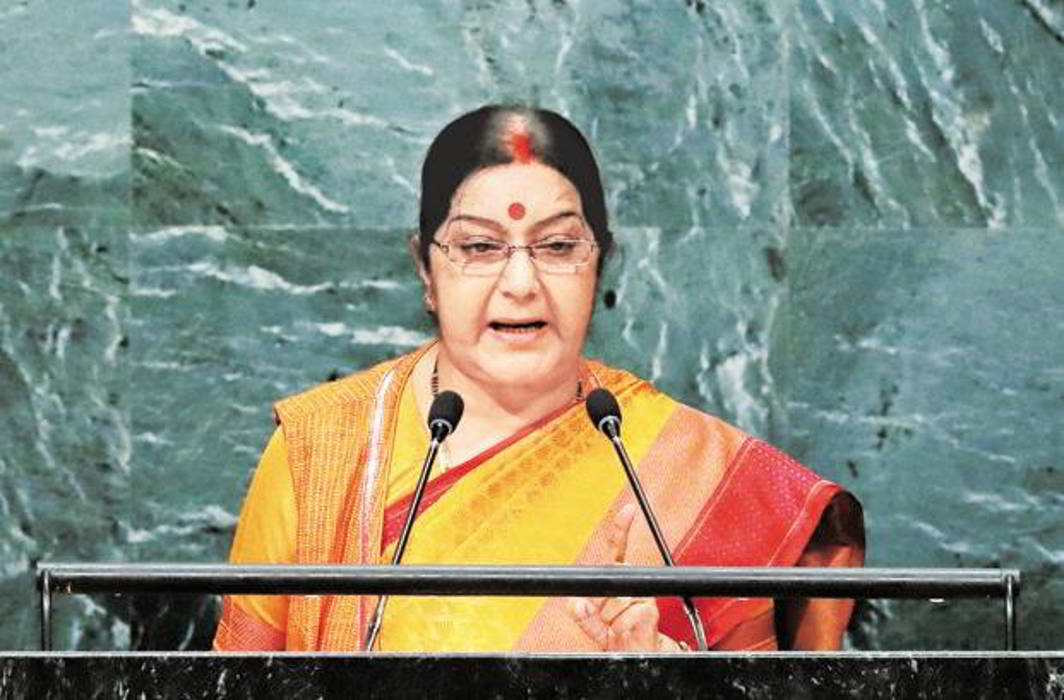
Minister of External Affairs Sushma Swaraj’s scathing attack against Pakistant at UN General Assembly has successfully extracted China’s admission about presence of terror in Pakistan. Beijing failed to defend Islamabad for its role in spreading the menace and left the question unresolved.

Global Times, the official daily published from Beijing, discussed Sushma Swaraj’s address at UNGA in its Tuesday’s edition. The editorial titled “India’s bigotry no match for its ambition” said, “There is indeed terrorism in Pakistan. But is supporting terror the country’s national policy? What can Pakistan gain from exporting terrorism? Money or honour.”

The editorial further said, “With smooth development of its economy and foreign relations in recent years, an arrogant India has looked down on Pakistan and assumed a haughty air with China.”

The Chinese daily asked India not to rely on US and Europe but develop friendly ties with China and respect Pakistan. It said, “India takes for granted that it should be “feared” by neighbours and wooed by the US and Europe.” The daily advised New Delhi that “India should befriend China and respect Pakistan, preventing disputes from spilling over.”

While addressing at UN General Assembly Sushma Swaraj, on Saturday, said, “India and Pakistan became free within hours of each other. Why is it that today India is a recognised IT superpower in the world, and Pakistan is recognised only as the pre-eminent export factory for terror?”

She further said, “We established scientific and technical institutions which are the pride of the world. But what has Pakistan offered to the world and indeed to its own people apart from terrorism? We produced scholars, doctors, engineers. What have you produced? You have produced terrorists.”

The daily made references to the recent stand-off between India and China at Doklam in the Sikkim section. It was resolved on August 28, after 73 days long stand-off, when both agreed to withdraw their forces from the plateau.

Latest world news

US freezes immigrant visa processing for 75 countries, India not in list

The United States suspends immigrant visa processing for 75 countries, excluding temporary visas, as part of stricter immigration measures.

Published

on

The United States has indefinitely suspended immigrant visa processing for 75 countries, targeting individuals seeking permanent residency based on nationality. The move, set to take effect on January 21, excludes tourist and temporary work visas, but is expected to have a significant impact on family-based immigration.

Reasons behind the visa freeze

The US State Department said the suspension aims to prevent the entry of foreign nationals likely to require government welfare and public benefits. “The Trump administration is bringing an end to the abuse of America’s immigration system by those who would extract wealth from the American people,” said State Department spokesman Tommy Pigott.

While the administration cites the risk of immigrants draining government resources, studies by the Cato Institute and other research groups suggest immigrants generally use fewer benefits than US-born citizens.

Who will not be affected

Temporary visas for tourists, business travelers, and sports fans remain unaffected. Exceptions are also allowed for individuals with dual nationality, a valid passport from a country not on the list, or travel serving an “America First” national interest. Approved visas that have not yet been printed must be refused according to the State Department.

Countries affected

The visa freeze covers nations across Africa, Asia, Latin America, the Middle East, and Eastern Europe. Some of the most affected countries include Pakistan, Bangladesh, Somalia, Russia, Iran, Afghanistan, Brazil, Nigeria, and Thailand.

Other countries on the full list include Albania, Algeria, Armenia, Azerbaijan, Bahamas, Barbados, Belarus, Belize, Bhutan, Bosnia and Herzegovina, Myanmar, Cambodia, Cameroon, Cape Verde, Colombia, Côte d’Ivoire, Cuba, Democratic Republic of the Congo, Dominica, Egypt, Eritrea, Ethiopia, Fiji, The Gambia, Georgia, Ghana, Grenada, Guatemala, Guinea, Haiti, Iraq, Jamaica, Jordan, Kazakhstan, Kosovo, Kuwait, Kyrgyzstan, Laos, Lebanon, Liberia, Libya, North Macedonia, Moldova, Mongolia, Montenegro, Morocco, Nepal, Nicaragua, Republic of the Congo, Rwanda, St Kitts and Nevis, St Lucia, St Vincent and the Grenadines, Senegal, Sierra Leone, South Sudan, Sudan, Syria, Tanzania, Togo, Tunisia, Uganda, Uruguay, Uzbekistan, and Yemen.

Trump administration immigration record

The Trump administration has already imposed stricter vetting procedures over the past year, revoking over 100,000 visas and deporting more than 605,000 people, with 2.5 million others leaving voluntarily. Critics highlight that the policy disproportionately affects immigrants from non-European countries.

Continue Reading

Latest world news

Anything less than US control of Greenland unacceptable, says Trump

Donald Trump has said American control of Greenland is vital for national security and missile defence, reigniting debate over the Arctic island’s strategic importance.

Published

on

donald-trump

US president Donald Trump has said that American control over Greenland is essential for the United States’ national security, describing it as “vital” for a planned air and missile defence system known as the Golden Dome.

In a social media post on Wednesday, Trump claimed the United States “needs Greenland for the purpose of National Security” and asserted that the Arctic island plays a key role in the proposed defence architecture. He further said that NATO would become “far more formidable and effective” if Greenland were under US control, adding that “anything less than that is unacceptable.”

Comments ahead of US-Denmark talks

Trump’s remarks came just hours before senior Danish and Greenlandic officials were scheduled to hold talks at the White House with US Vice President JD Vance and Secretary of State Marco Rubio. The discussions are focused on Greenland and broader security issues in the Arctic region.

Responding to US concerns, Denmark’s defence minister Troels Lund Poulsen said the country was increasing its military presence in Greenland. He also noted that Copenhagen was in discussions with allies regarding a stronger NATO footprint in the Arctic.

NATO role and strategic concerns

Trump said NATO “should be leading the way” in building the proposed multi-layer missile defence system. He warned that if the alliance did not act, rival powers could step in, stating that Russia or China might otherwise take the lead.

The US president has repeatedly spoken about taking control of Greenland, a strategically located and sparsely populated island that is an autonomous territory within the Kingdom of Denmark. His renewed comments underline continued US interest in the Arctic’s strategic importance amid rising global security competition.

Continue Reading

Latest world news

Iran set to execute anti-Khamenei protester as Trump warns of strong US action

Iran is preparing to execute a protester linked to anti-regime demonstrations as US President Donald Trump warns of strong action amid a deadly crackdown.

Published

on

unrest in iran

Iran is reportedly preparing to execute an anti-government protester on Wednesday, triggering sharp warnings from US President Donald Trump, who said Washington would take “very strong action” if the hanging goes ahead. The development comes amid a sweeping crackdown on nationwide protests that rights groups say has killed more than 2,000 people.

According to human rights groups, 26-year-old Erfan Soltani, arrested last week during protests in Karaj near Tehran, has been sentenced to death and faces execution without a proper trial. Iranian authorities have not publicly detailed the charges or judicial process in his case.

Trump urges Iranians to keep protesting

Trump has publicly encouraged Iranians to continue protesting, saying “help is on its way”, while warning Tehran against executing demonstrators. Speaking to media, the US president said the United States would respond forcefully if Iran began hanging protesters arrested during the unrest.

Earlier, Trump posted messages urging people in Iran to continue demonstrations and said he had cancelled meetings with Iranian officials until the killing of protesters stops. He did not specify what assistance the US might provide or which meetings had been cancelled.

Iranian prosecutors have reportedly threatened capital punishment under charges of “moharebeh”, or waging war against God, for some detainees linked to the protests.

Rising death toll and reports from morgues

Rights groups say the crackdown has been one of the deadliest in recent years. According to activist organisations, the death toll has crossed 2,500, including civilians and members of the security forces. Iranian officials, however, have blamed what they described as “terrorists” for the deaths and have not provided a clear breakdown.

Videos circulating on social media show bodies lined up at the Kahrizak mortuary near Tehran, wrapped in black bags, as families search for missing relatives. Authorities have declared national mourning for security personnel killed during the unrest and announced mass funeral ceremonies in the capital.

Internet blackout and Starlink access

Iran has imposed a widespread internet blackout, now extending beyond five days, limiting communication and information flow. Amid the restrictions, SpaceX has reportedly waived subscription fees for its Starlink satellite service in Iran, allowing users with receivers to access the internet without payment, according to groups working to restore connectivity.

Some international phone links were partially restored, but reports indicate services remain unstable and limited.

Political tensions and international reaction

Iranian leaders have insisted that control has been restored following days of protests described as one of the biggest challenges to the clerical leadership since the 1979 revolution. Supreme Leader Ayatollah Ali Khamenei has hailed pro-government rallies as evidence that the protest movement has failed.

Senior Iranian officials have accused Trump and Israeli leadership of responsibility for violence in Iran. Meanwhile, Western leaders have condemned the use of force against protesters, with some warning that sustained repression could further destabilise the country.

Analysts note that while the protests represent a serious challenge to Iran’s leadership, the government retains powerful security and enforcement mechanisms, making the outcome uncertain.

Continue Reading

Trending

© Copyright 2022 APNLIVE.com