English हिन्दी
Connect with us

Latest world news

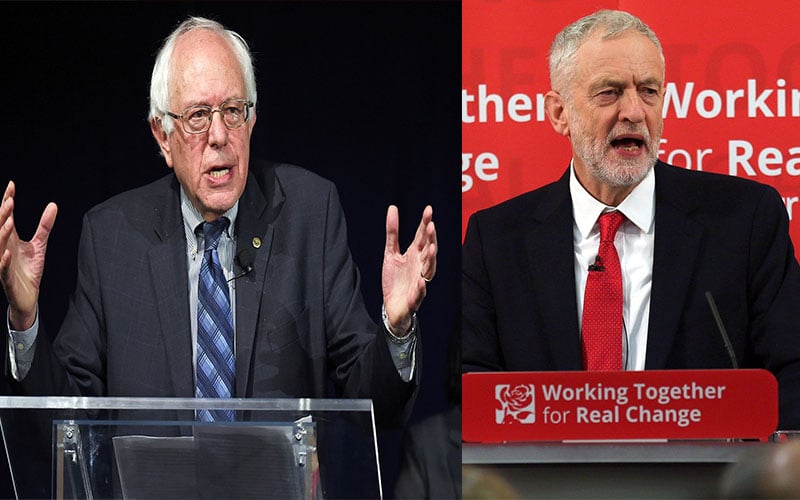
Corbyn And Sanders Most Popular Politicians In Britain And US

Published

on

Bernie Sanders and Jermy Carbyn

[vc_row][vc_column][vc_column_text]By: Saeed Naqvi

The recent rise in the electability of Labour Party leader Jeremy Corbyn as Britain’s next Prime Minister, according to the latest opinion polls, has not made headline news. This is not surprising because Establishments everywhere, of which the media is a part, imagine that an idea can be made to vanish by playing it down.

The findings of the poll have been published even in conservative newspapers like The Telegraph in London. This virtually amounts to a taboo being lifted from the idea of Corbyn. Call it acquiescence, if you like.

Senior Labour leaders, indeed authors of New Labour, like Tony Blair and Lord Peter Mandelson must be close to a nervous breakdown. Or, they must be working very hard, as Mandelson has admitted in interviews, to “undermine Corbyn”.

The difficulty with mean-minded cribbing by Mandelson is that it generates sympathy among Corbyn’s growing tribe of supporters. Take this quote from a Labour member: “The idea that Jeremy Corbyn as Prime Minister implementing policies that actually benefit the people terrifies the Establishment. It is no surprise that Mandelson has found space in his busy schedule for spending time on Oligarch’s Yachts to attempt to undermine Jeremy.”

 This being the tone of the exchange, Corbyn’s path to eventual success will be made ever more difficult by the Establishment of which Mandelson and the Deep State are parts.

There is, however, a tailwind of recent history particular to Britain, which may be helping Corbyn.

 Accelerated globalization after the Soviet collapse, was a shot in the arm for capitalism. This, in its turn, generated arbitrary inequalities which erupted in such movements as “Occupy Wall Street”. The Republican Tea Party was the immediate counter punch.

The popular will adapts to changing climate. Establishments, obstinately resistant to change, begin to strategize: how to channelize or thwart the popular will.

 In almost all western democracies the conflict is on: Establishments vs. the people. A Left wing Syriza brought 43 year old Alexis Tsipras to power as Prime Minister of Greece. Germany and the EU broke the movement’s will. Revert to austerity or we shall not pick up your debts.

In Spain, where the ghost of Franco still hovers over public life, Prime Minister Mariano Rajoy of the Right Wing Peoples Party, supervised over such unspeakable corruption (another gift of globalization), that a new communist-inclined party Podemos, under the leadership of 39 year old Pablo Iglesias, burst upon the scene. The resulting stalemate between the Peoples Party, Socialist and Podemos led to a repeat election which yielded more or less the same configuration. The Establishment worked overtime. On the pain of being decimated, Socialists allowed themselves to be persuaded to abstain in a Parliamentary vote. This enabled the corrupt PP hold onto power. The idea is to weaken and eventually erase Podemos by sheer attrition and election fatigue.

In the process of warding off unfriendly political trends, the establishment learnt another lesson. The sprinkling of leaders breaking out of the two party suffocation were all anti austerity, leftists and in their 30s and 40s. Why could not the “right” respond with similar décor and aspirations?

 That exactly is what has been attempted in Spain by launching Ciudadanos, (Citizens) a centrist party with an unusual rise on an anti corruption platform. I met people in Madrid and Barcelona who described the new party as “Podemos of the right”. In terms of youth, Ciudadanos is an improvement. Its leader, Albert Rivera, 35, is four years younger than Pablo Iglesias.

 “They are stealing Podemos’ aesthetics” laments Madrid’s Communist Mayor who hung a giant placard outside her office: “Refugees Welcome”. She tweets “We are not going to criminalize the Muslim community” Carmena said. “The response to terror must be solidarity.” Her punchline was “co existence = safer cities”.

The aesthetics which define young leaders in Greece, Spain, Canada appear to have been grafted on France’s Emmanuel Macron too. He is their age and talks of influencing the EU to reduce the burden of austerity. The scale of his success has encouraged him to be openly ambidextrous.  He has invited Donald Trump to the National Day parade on July 14. This despite Trump having withdrawn from the Paris accord on climate change.

 In brief, different kinds of gyrations define western democracies today. In this over all confused picture another reality remains largely unnoticed.

A Fox News poll published some months ago (mostly ignored) shows that Bernie Sanders has a +28 rating above all US politicians on both ends of the political spectrum.

The Guardian’s Trevor Timm wrote recently: “One would think with numbers like that, Democratic politicians would be falling all over themselves to be associated with Sanders, especially considering the party as a whole is more unpopular than the Republicans and even Donald Trump right now. Yet instead of embracing his message, the Establishment wing of the party continues to resist him at almost every turn, and they seem insistent that they don’t have to change their ways to gain back the support of huge swaths of the country.”

 The moral of the story is this: a rattled Establishment is in many democracies rushing to thwart or redirect the popular will – and with mixed success.

Against this backdrop, there appears on the horizon a certain British exceptionalism. Jeremy Corbyn’s election as Labour leader despite Tony Blair, Mandelson, and the Parliamentary party, results of the Brexit referendum, the manner in which Theresa May was trounced in June 8 elections – all point to the Establishment in Britain unlike elsewhere, clearly contained by the people.[/vc_column_text][/vc_column][/vc_row]

Latest world news

PoK protest leader seeks India’s help amid Pakistan crackdown, alleges humanitarian crisis

JAAC leader Sardar Aman Khan has appealed to India for humanitarian assistance, alleging shortages of food and medicines amid Pakistan’s crackdown on protesters in Pakistan-occupied Kashmir.

Published

on

The leader of the Joint Awami Action Committee (JAAC), Sardar Aman Khan, has appealed to India for humanitarian assistance amid the ongoing unrest in Pakistan-occupied Kashmir (PoK), claiming that the region is facing severe shortages of essential supplies following a crackdown by Pakistani authorities.

According to Khan, residents are struggling to access food and medicines as security operations against protesters continue. He also urged India to consider opening the Line of Control (LoC) to allow humanitarian assistance and provide civilians with the option of crossing into India if the situation worsens.

JAAC chief calls for humanitarian assistance

Speaking at a public gathering, Khan claimed that an economic blockade imposed after the crackdown had created serious hardships for people in the region.

In a video that has circulated widely on social media, he is heard saying that PoK residents need India’s assistance due to shortages of essential commodities.

He also appealed for the opening of crossing points along the LoC, particularly in the Poonch and Doda sectors, alleging that the ongoing restrictions had further intensified the humanitarian situation.

During the rally at Rawalakot’s Eidgah Ground, Khan asked the crowd whether they should move towards the Line of Control. The gathering repeatedly responded in support of the proposal.

He further warned that if public demands continued to be met with force, people could consider other options.

It is important to note that the authenticity of the viral video, reportedly from Khan’s June 30 rally, has not been independently verified.

Protests continue across PoK

The appeal comes as demonstrations continue across Pakistan-occupied Kashmir, where protests against the Pakistani administration have been ongoing since last month.

During a recent rally at Eidgah Ground, protesters raised slogans including “PoK is not part of Pakistan” and “We want freedom,” indicating that the movement has expanded beyond demands for reforms to include calls for independence from Pakistan’s political control over the region.

Crackdown follows ban on JAAC

The unrest intensified after Pakistani authorities banned the Joint Awami Action Committee on June 5, designating the grassroots organisation as a terrorist group.

According to a recent report by the International Centre for Peace Studies, Pakistan has historically exercised significant political control over Pakistan-occupied Kashmir and Pakistan-occupied Gilgit-Baltistan through mainstream political parties aligned with Islamabad.

The report also noted that the ruling party in Islamabad has consistently won elections in both regions, suggesting a long-standing pattern of political influence.

Meanwhile, several analysts have argued that the ongoing crisis reflects growing dissatisfaction among local residents with the regional administration, which they describe as lacking independent authority. They also contend that the ban on the JAAC and the use of force against protesters are part of broader efforts to suppress the expanding protest movement.

Continue Reading

Latest world news

Death to Trump chants heard during Ayatollah Ali Khamenei’s funeral appearance in Iran

Crowds at a funeral ceremony attended by Iran’s Supreme Leader Ayatollah Ali Khamenei chanted “Death to Trump” as regional tensions remained high following the recent Iran-Israel conflict.

Published

on

donald-trump

Crowds attending a funeral ceremony in Iran raised chants of “Death to Trump” as the country’s Supreme Leader, Ayatollah Ali Khamenei, made a public appearance during the event.

The slogans were heard as thousands gathered to pay tribute to those killed during the recent conflict involving Iran and Israel. The ceremony also marked one of Ayatollah Khamenei’s notable public appearances after the military escalation that had heightened tensions across the region.

Anti-US slogans raised during ceremony

Videos circulating from the funeral ceremony showed mourners chanting “Death to America” and “Death to Trump” while Ayatollah Khamenei attended the event. Such slogans have long been associated with state-backed public gatherings in Iran and were repeated during the ceremony attended by senior Iranian officials and large crowds.

The funeral was held to honour military commanders, nuclear scientists and other individuals who Iran says were killed during the recent conflict. The gathering drew thousands of people to the capital, where processions and official tributes were organised.

Public appearance after recent conflict

Ayatollah Khamenei’s appearance came after weeks of heightened tensions in the Middle East following Israeli strikes on Iranian targets and subsequent military exchanges between the two countries. The conflict also saw the United States carry out strikes on Iranian nuclear facilities, further escalating regional tensions.

The funeral ceremony was among the Supreme Leader’s most significant public appearances since the conflict, with state media extensively covering the event.

Regional tensions remain high

Relations between Iran, Israel and the United States remain strained despite the ceasefire announced following the recent hostilities. Officials from the three countries continue to exchange strong statements over the military operations and the future of Iran’s nuclear programme.

The funeral ceremony reflected the continuing anti-US and anti-Israel sentiment expressed by sections of the Iranian establishment and supporters attending the event.

Continue Reading

India News

USA marks 250 years with Independence Day with nationwide celebrations

Published

on

The United States of America is observing its Independence Day on July 4 with celebrations taking place across the country. Public events, parades, concerts, and fireworks have been organized in several cities as Americans mark the nation holiday.

Large gatherings have been reported in cities including Washington D.C., New York, Boston, and Philadelphia, where thousands of people are participating in officials and community-led celebrations. Public parks, streets, and other venues have been prepared to host visitors throughout the day.

Government officials, including US President Donald Trump, extended Independence Day greetings and participated in events celebrating the occasion. Ceremonies honouring military personnel, experts, and first responders have also been held in different parts of he country.

Authorities have stepped up security arrangements at major event locations to manage large crowds. Additional police forces and emergency response teams have been posted, while officials have advised the public to follow safety instructions during the celebrations.

The holiday has also resulted in increased travel activity, with airports, highways, and railway stations experiencing heavy passenger movement. Hotels, restaurants and tourist attractions are seeing a rise in visitors as many people use the long weekend for travel and family gatherings.

Although weather conditions have disrupted a few outdoor events in some areas, most programme are continuing as scheduled. Fireworks displays are expected to take place in the evening at several locations, including major cities known for their annual Independence Day celebrations.

The nation celebrates Independence Day every July 4. It marks the adoption of the Declaration of Independence in 1776, when 13 American colonies became independent from British rule. It is one of the most important national holidays in the United States and is celebrated with parades, fireworks, official ceremonies, and community events across the country.

Continue Reading

Trending

© Copyright 2022 APNLIVE.com